forum
library
tutorial
contact
US Wildlife Managers Allowed
Targeted Removal of Sea Lions
by Staff
Times of India, July 15, 2026
|
the film forum library tutorial contact |
|
US Wildlife Managers Allowed
by Staff
|
Estimated consumption near Bonneville Dam peaked in 2002 at 4.5%
of the salmon run has declined to about 2.8 percent of the run in 2024.
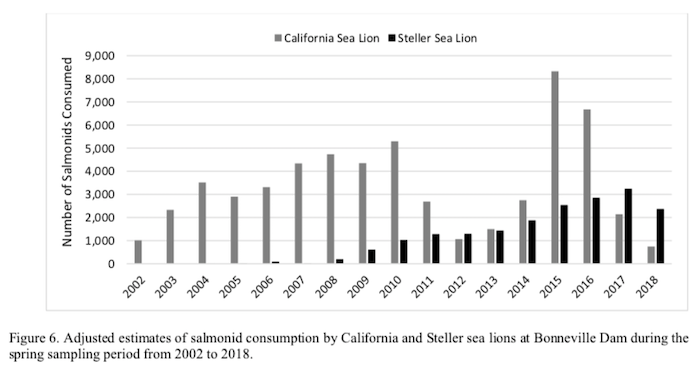 For years now, the return of salmon to the rivers of the Pacific Northwest has symbolised one of North America's native migrations. However, at the base of the Bonneville Dam on the Columbia River, salmon's annual journey has also created a conservation dilemma as California sea lions have discovered that the dam acts as a bottleneck, concentrating thousands of migrating salmon in a confined area, thus creating an easy feeding ground for them. With the endangered salmon population declining, wildlife managers are faced with a difficult question of whether they should protect a federally safeguarded marine mammal or intervene to conserve imperilled fish.
This debate had ultimately led the United States to trap, relocate, and in some cases, remove sea lions that repeatedly preyed on threatened salmon. According to a review titled Battle Royale: The Fight over Sea Lions, Salmon, and Hydroelectric Dams in the Columbia River, the conflict shows how conservation laws can collide with one another when one protected species threatens the survival of another.
How dams created an ideal hunting ground for sea lions
The challenge emerged as California sea lions began travelling inland from the Pacific Ocean to the Bonneville Dam. The dam, built to generate hydroelectric power and aid navigation, unintentionally created a choke point where the migrating fish gathered before passing through the fish ladder. According to the UC Davis review, the sea lions were presented with a perfect opportunity to hunt successfully, thus increasing their predation on the endangered Chinook salmon, which is already under stress from habitat loss, dams, and climate change. Scientists further noted that while sea lions naturally prey on salmon, the condition created by the dam significantly increased their hunting rate, making it a recurring hotspot for predator-prey conflict.
Despite the challenges, managing the conflict proved legally difficult as both species were protected under different federal laws, with California sea lions being protected by the Marine Mammal Protection Act and several salmon populations in the Columbia River Basin being listed under the Endangered Species Act. According to the review, this created a dilemma in which protecting one species could contribute to the decline of another. Therefore, to address this issue, Congress amended the MMPA in 1994, which allowed the authorities to remove individually identified sea lions that repeatedly preyed on endangered salmon at locations like the Bonneville Dam. The first non-lethal attempt by the wildlife managers included hazing with noise devices, rubber bullets, and relocation before considering permanent removal of repeated prey-preying sea lions.
Relocation did not solve the problems
While many captured sea lions were transported hundreds of kilometres away in an effort to keep them from returning to the dam, their efforts proved futile as the sea lions demonstrated a remarkable ability to navigate back to the Columbia River, with some even managing to return within weeks. According to NOAA Fisheries, repeated returns highlighted the limitations of relocation as a long-term solution and called for stronger strategies in exceptional circumstances. Additionally, researchers found that only a relatively small number of sea lions accounted for a disproportionate share of salmon predation, thus leading many wildlife managers to focus on individually repeated offenders instead of the broader population.
The challenges at Bonneville Dam demonstrated how conservation is rarely a choice between protecting the wildlife and doing nothing; instead, it often involves weighing competing ecological priorities. The sea lions did not invent a new food source; rather, they simply adapted to an environment that was transformed by the dam and used it to their advantage. The review concluded that conflicts between protected species are likely to arise more with the ongoing environmental changes.
Related Pages:
Sea Lion Removals Continue as Agencies Seek to Extend Permit by K.C. Mehaffey, NW Fishletter, 5/14/25
Sea Lions Threaten Salmon Runs as Removal Efforts at Bonneville Dam Face Funding Limits by Staff, KATU, 3/25/25
Bonneville Sea Lion Removal Operations Ongoing, Just 2 Culled by Andy Walgamott, Northwest Sportsman, 4/28/23
Battle Over Endangered Fish has Led Oregon to Cull Sea Lions by Staff, KGW, 4/11/23
Report: Sea Lion Abundance Drops, But 'Sustained Impacts' to Fish Remain by K.C. Mehaffey, NW Fishletter, 3/13/22
Sea Lions Threaten Northwest's Salmon by Lauren Ellenbecker, The Columbian, 2/17/22
Sea Lions, Seals Might be Hampering WA Salmon Recovery. What Can Be Done? by Isabella Breda, Seattle Times, 1/15/23
Report Raises Question of Hunting Seals to Save Washington Salmon by Timothy Schumann, The Center Square, 12/19/22
Scientists: Let's Test Removing Salmon-eating Seals, Sea Lions by Don Jenkins, Capital Press, 11/23/22
NMFS Authorizes Sea Lion Removals to Save Columbia River Salmon by Lynda Mapes, National Fisherman, 8/27/20
Hundreds of Sea Lions to be Killed on Columbia River in Effort to Save Endangered Fish by Lynda Mapes, Seattle Times, 8/15/20
Criteria for Killing Salmon-eating Sea Lions Reduced at Bonneville Dam on Columbia by Keith Ridler, Statesman Journal, 5/3/19
ESA Winter Steelhead Impacted by Prolonged Steller Sea Lion Presence at Bonneville Dam by Staff, Columbia Basin Bulletin, 2/1/19
So Far, Sea Lions at Bonneville Dam Below 10-Year by K.C. Mehaffey, NW Fishletter, 5/14/25
Sea Lions Threaten Salmon Runs as Removal Efforts at Bonneville Dam Face Funding Limits by Staff, KATU, 3/25/25
Bonneville Sea Lion Removal Operations Ongoing, Just 2 Culled by Andy Walgamott, Northwest Sportsman, 4/28/23
Report: Sea Lion Abundance Drops, But 'Sustained Impacts' to Fish Remain by K.C. Mehaffey, NW Fishletter, 3/13/22
Sea Lions, Seals Might be Hampering WA Salmon Recovery. What Can Be Done? by Isabella Breda, Seattle Times, 1/15/23
Scientists: Let's Test Removing Salmon-eating Seals, Sea Lions by Don Jenkins, Capital Press, 11/23/22
NMFS Authorizes Sea Lion Removals to Save Columbia River Salmon by Lynda Mapes, National Fisherman, 8/27/20
Hundreds of Sea Lions to be Killed on Columbia River in Effort to Save Endangered Fish by Lynda Mapes, Seattle Times, 8/15/20
Criteria for Killing Salmon-eating Sea Lions Reduced at Bonneville Dam on Columbia by Keith Ridler, Statesman Journal, 5/3/19
ESA Winter Steelhead Impacted by Prolonged Steller Sea Lion Presence at Bonneville Dam by Staff, Columbia Basin Bulletin, 2/1/19
Senate Passes Bill Making it Easier to Kill Sea Lions on Pacific Northwest River by Phuong Le, KSL.com, 12/8/18
Hunters Demand Quota to Cull Thousands of Seals to Save Salmon Population Along B.C.'s Coast by Jenny Peng, Star Vancouver, 8/2/18
Northwest Tribes may Soon Have Right to Kill Sea Lions by Katy Sword, The Columbian, 8/1/18
One State's Plan to Save a Protected Species is to Kill Another Species by Karin Brulliard, The Dalles Chronicle, 6/11/18
Latest Bi-Weekly Pinniped Report Shows Decline in Steller, California Sea Lions at Bonneville Dam by Staff, Columbia Basin Bulletin, 6/1/18
learn more on topics covered in the film
see the video
read the script
learn the songs
discussion forum