forum
library
tutorial
contact
Sea Lion Removals Continue as
Agencies Seek to Extend Permit
by K.C. Mehaffey
NW Fishletter, May 14, 2025
|
the film forum library tutorial contact |
|
Sea Lion Removals Continue as
by K.C. Mehaffey
|
Analysis for spring Chinook passing Bonneville Dam showed a 5.6% reduction
in the extinction probability for upper Columbia River and Snake River Chinook salmon.
 This year's smelt run in the lower Columbia Basin was both large and late. And to Doug Hatch, deputy manager of the Columbia River Inter-Tribal Fish Commission's Fishery Science Department, that translates to a big year for sea lions.
Sure enough, some 300 to 400 sea lions were counted in a survey from Bonneville Dam to the Interstate 205 Bridge between Vancouver, Washington, and Portland during the second week of April, Hatch told NW Fishletter.
As the lethal removal of sea lions in the Columbia Basin picks up again this spring, salmon managers are awaiting a decision by NOAA Fisheries that will determine whether they'll be able to continue euthanizing these marine mammals that devour a portion of the returning adult salmon and steelhead each year.
A five-year permit--which allowed Steller sea lions to be euthanized for the first time--expires in August, according to Britton Ransford, a Washington Department of Fish and Wildlife spokesperson.
But WDFW is expecting a decision soon on a request from salmon managers to extend the permit for another five years that would allow states and Native American tribes to remove the rest of the sea lions that weren't taken under the first permit, Ransford told NW Fishletter in an email.
Issued Aug. 14, 2020, the current permit authorizes three states and four tribes to kill or remove up to 540 California sea lions and 176 Steller sea lions in the Columbia Basin below McNary Dam.
So far, salmon managers have taken a total of 117 Steller sea lions and 94 California sea lions under the 2020 permit, Ransford said. Most of those were removed at Bonneville Dam, but the figures also include 5 Steller sea lions and 14 California sea lions taken at Willamette Falls, he said.
To Hatch, the expanded sea lion removal program appears to be helping, even if it got off to a difficult start.
"We had two things going against us" when the permit was first issued, he said.
First, the COVID-19 pandemic prevented any trapping in the spring of 2020.
And second, "Steller sea lions are much bigger, and we hadn't been actively trapping them," he said. Trappers had to learn how to handle them, and they needed bigger equipment.
Hatch said there are two trapping seasons at Bonneville Dam--in the spring months of April and half of May, before most of the California and Steller sea lions go back to their rookeries; and again in the fall, when Steller sea lions come back to prey on the fall runs of salmonids.
"It's just been complicated because we needed a more full-court press approach," he said. "But we do think this will work, and mainly because of the work done at Willamette Falls."
There, sea lions once consumed about one-third of returning winter steelhead, Ransford said. "Removals that began in 2018 have cut predation from about 33% in 2017 to less than 2% in 2023," he said.
In 2017, one of three winter steelhead runs in the Willamette River was expected to go extinct within 100 years. "Several years of lethal removals reduced the probability of quasi-extinction for one of these runs to less than 10%," Ransford said.
"While this case represents a particularly extreme instance where a small number of sea lions were consuming a large proportion of especially vulnerable steelhead runs at a defined predation hotspot, a similar analysis for spring Chinook passing Bonneville Dam showed a 5.6% reduction in the extinction probability for upper Columbia River and Snake River Chinook salmon," he added.
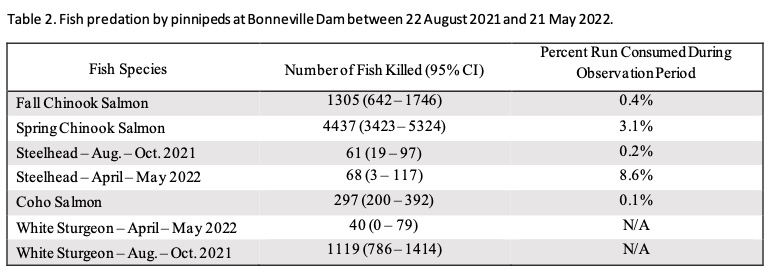
An annual report by the U.S. Army Corps of Engineers found that 2.8 percent of last year's spring Chinook and 3.8 percent of steelhead migrating during the agency's sampling period last spring were consumed by sea lions at Bonneville Dam.
Except for in 2023, those percentages are mostly lower than prior years, before three states and four tribes received the expanded permit with fewer restrictions to kill both California and Steller sea lions in the Columbia Basin below McNary Dam.
The report notes that the daily peak abundance at Bonneville Dam decreased in 2024 compared to the previous year, and to the 10-year average. For the second consecutive year, no Steller sea lions remained at the dam through the winter.
The Corps found that there continues to be short periods of time when California sea lions are in high abundance, but the agency documented a decrease in their numbers between Jan. 1 and May 31. Data from the last five years suggests that removing California sea lions has resulted in fewer of them coming to Bonneville dam, even if large groups continue to come for short periods of time, the report says.
It also says that removing California sea lions at Bonneville Dam has contributed to a reduced impact on fish listed under the Endangered Species Act.
And removing Steller sea lions--which has occurred for just four years--"shows promise as a management tool" as their impact on all fish species has started to decline.
"Future management actions for CSL and SSL are warranted to further reduce the impact to ESA listed salmon and sensitive stocks of other fish," the report concludes.
Ransford said that during the first four years of the current permit, Steller sea lion abundance at Bonneville Dam dropped by 36 percent during the spring and by 82 percent during the fall.
He noted that by focusing on removing individual sea lions that are targeting at-risk fish runs--especially where pressure is highest, like dams and fish ladders--has been an important strategy for reducing their impacts.
With a renewed permit, WDFW hopes to focus some future work on lower Columbia River tributaries, including the Cowlitz and Lewis rivers, and potentially the Kalama River, he said.
"Currently, WDFW is pursuing funding to establish a mobile team to conduct removals in tributaries, but to date, WDFW has not secured new appropriations to do so," he said.
But until additional state or federal funding can be secured, expanding the removal program to new locations in the Columbia Basin will be limited, he added.
learn more on topics covered in the film
see the video
read the script
learn the songs
discussion forum