forum
library
tutorial
contact

Columbia River Fish Managers Prepare
for Potentially Dismal Sockeye Run
by StaffNW Fishletter, June 30, 2026
|
the film forum library tutorial contact |
|
Columbia River Fish Managers Prepare
by Staff |
Sockeye trapped at Bonneville Dam provides a significant
bump in abundance and serve as a guard against extinction
 Unless returns pick up soon, the Columbia Basin could be looking at a disappointing year for sockeye returns, with current projections for the total run coming in at less than half of preseason estimates.
Those early estimates expected roughly 274,900 sockeye to return to the mouth of the Columbia River.
Through June 25, just 41,492 sockeye have passed Bonneville Dam compared to a 10-year average of 128,751 sockeye by the same date.
Last year's total returns were also significantly lower than predicted, with just 167,549 sockeye returning to the mouth of the Columbia River.
This year, poor migration conditions combined with low returns would be a blow to recovery efforts for Columbia River sockeye just two years after the run hit a modern-day record of more than 755,000 fish passing Bonneville Dam.
Fish agencies in Washington, Oregon and Idaho are already taking precautions.
The Washington Department of Fish and Wildlife on June 18 announced recreational fisheries in the upper Columbia River will not open until July 1 due to the low number of early returns. The Hanford Reach sockeye fishery, which had opened June 16, closed June 20.
"While still early in the return, passage through June 17 totals just over 8,900 fish which is roughly 30-40 percent of expected for this timeframe given the preseason forecast," the Oregon Department of Fish and Wildlife said in a statement.
ODFW said delaying the start of upriver sockeye fishing will reduce the expected harvest by about 40 percent and gives salmon managers more flexibility to adjust the season later in the summer.
"Columbia River sockeye harvest is managed to provide protection for the endangered Snake River component of the run, so we always manage fisheries very carefully. Given the uncertainty in the run size at this point and recognizing the potential for challenging migration conditions this summer, we are taking a precautionary in-season approach to this year's sockeye fishery," said Jeff Whisler, ODFW's Columbia River fisheries manager.
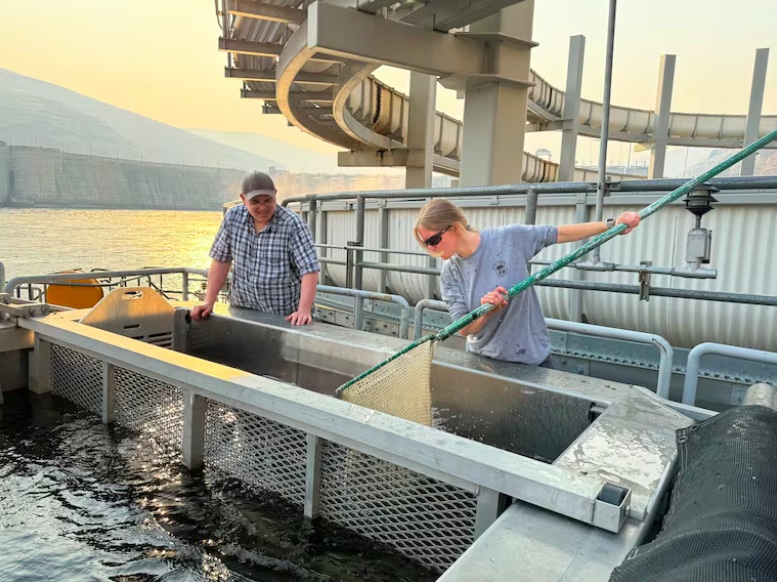
In Idaho--where Snake River sockeye are listed as endangered under the Endangered Species Act--the Idaho Department of Fish and Game began trapping sockeye at Lower Granite Dam on June 29 to ensure a broodstock for next year.
IDFG found that the quality of eggs from sockeye that were trapped and hauled to a hatchery is much higher than eggs from sockeye that swam upstream to Idaho's Stanley Basin, said Jonathan Ebel, a fisheries biologist at IDFG.
"We are making the decision to hedge the bets in terms of brood collection," Ebel told fellow members of the Columbia River Technical Management Team on June 24.
Since 2021, IDFG has used a trap-and-transport program for Snake River sockeye in years when low flows and high temperatures create lethal conditions in the Snake River for sockeye trying to make the arduous journey from Lower Granite Dam to spawning areas in the Stanley Basin.
Ebel said river conditions through the hydro system--particularly upstream of the four lower Snake River dams--are expected to challenge sockeye again this year, prompting the early decision to implement the trap-and-transport program through July 23.
The water supply in the Snake River at Anatone, Washington, is expected to be the 10th driest on record since 1949, he said.
Conditions aren't great in the lower Columbia River, either.
The Northwest River Forecast Center is predicting the volume of water passing Bonneville Dam from April through September to be 83 percent of average.
Low flows generally bring higher water temperatures in the summer, since hot weather will warm a small amount of water more quickly.
A June 10 report from the U.S. v. Oregon Technical Advisory Committee (TAC) on summer fisheries reported that outflows at Bonneville Dam were 221,000 cfs on June 9 compared to a five-year average of 272,000 cfs on the same day.
The five-day average water temperature was 61.3 F in Bonneville Dam's forebay, which was 0.8 F higher than the five-year average for the same period.
Based on the average run timing for the last 10 years, roughly half of the sockeye run should be completed on July 28, according to the report.
TAC noted that harvest limits for sockeye are determined by in-season run sizes. The committee expects to begin updating the run sizes by early July.
Related Pages:
Snake River Sockeye Solutions by Eric Barker, Moscow-Pullman Daily News, 6/21/26
learn more on topics covered in the film
see the video
read the script
learn the songs
discussion forum