forum
library
tutorial
contact
Snake River Sockeye Solutions
by Eric BarkerMoscow-Pullman Daily News, June 21, 2026
|
the film forum library tutorial contact |
|
Snake River Sockeye Solutionsby Eric BarkerMoscow-Pullman Daily News, June 21, 2026 |
Some of the highly endangered fish will hitch a ride upriver;
others will return to hatchery at Bonneville Dam
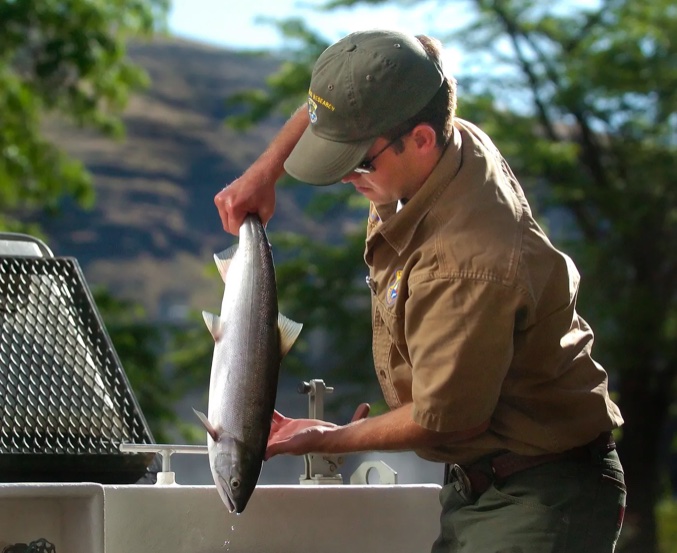 Fisheries managers aren't waiting for water levels and temperatures in the Columbia, Snake and Salmon rivers to become perilous to Idaho-bound sockeye salmon.
Given poor mountain snowpacks, they see that development as inevitable. In the coming days, they will proactively implement a trap-and-transport strategy at Lower Granite Dam designed to help some of the highly endangered fish reach their central Idaho destination.
The Nez Perce Tribe and Idaho Department of Fish and Game are teaming up to reduce wear and tear on transported fish and the people responsible for moving them.
Fisheries managers operate a sampling trap at the dam that is designed to intercept about 20% of chinook salmon. The fish are quickly measured and DNA samples are taken before they are returned to the river.
When water conditions are deemed hazardous, they often pluck any endangered sockeye that end up in the trap, remove them from the river and truck them to an Idaho Fish and Game hatchery at Eagle.
This year, the trucked sockeye will be held temporarily at the tribe's Sweetwater hatchery facility before completing the trip. Becky Johnson, production director of the Nez Perce Tribe's Department of Fisheries Resources Management, said the arrangement will cut down on windshield time.
Fisheries workers at the tribe will move sockeye from the dam to Sweetwater on Mondays, Tuesdays and Wednesdays. Fish and Game workers will move fish from the trap to Sweetwater on Thursdays and Fridays, and then truck them to Eagle at the end of the week. In the past, Fish and Game workers drove from Boise on Mondays to pick up sockeye trapped on Mondays and Tuesday mornings before turning around and driving them to Eagle. They would repeat that cycle on Wednesdays and Thursdays.
"We think it's going to help us trap and haul more sockeye that are really going to need the help," Johnson said.
Johnson is optimistic that Snake River sockeye that are part of a pilot project at Bonneville Dam will see good returns this year. The tribe and Idaho Fish and Game partnered in the project that sees a small number of Snake River sockeye eggs raised and released from Bonneville Hatchery on Tanner Creek below the dam.
The idea is to help preserve the genetics by having some Snake River sockeye avoid the hydrosystem on the Snake and Columbia rivers all together. They are released into the lower Columbia and return to the hatchery as adults. They are then trucked to Idaho and used in its captive breeding program that is trying to keep sockeye from going extinct.
The tribe plans to eventually use its share of adults that return to Bonneville Hatchery for release into northeastern Oregon's Wallowa Lake. But that won't happen until changes are made at the Wallowa Lake dam to accommodate fish passage. The lake historically had a sockeye run that went extinct in the early 1900s.
The first cohort of 50,000 juvenile sockeye were released from the dam in 2024 and last year a surprising number of them returned as jacks.
"We didn't know if it would work. The fish coming back to Columbia have to smell water from Tanner Creek instead of keep going up the river," Johnson said. "When 400 one-ocean-fish came back, we were ecstatic."
Sockeye usually spend two years in the ocean but some return a year early. Based on last year's higher-than-expected return, fisheries managers believe they could see many more this year.
Related Pages:
Count the Fish Data sources of Adult Sockeye Returns, 1977-2025
learn more on topics covered in the film
see the video
read the script
learn the songs
discussion forum