forum
library
tutorial
contact

Energy Secretary Praises Hydropower, Slams
Environmental Agenda 'Climate Craziness'
by Annette Cary
Tri-City Herald, December 5, 2025
|
the film forum library tutorial contact |
|
Energy Secretary Praises Hydropower, Slams
by Annette Cary
|
He praises hydro power as reliable, on demand electricity production method.
Environmental groups disagree, say dams harm salmon.
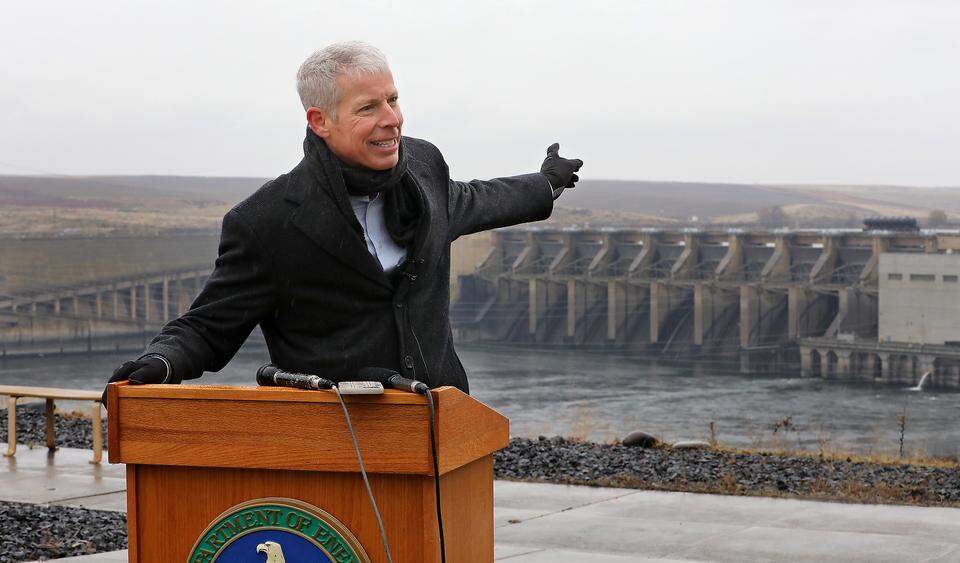 Pasco, Wash. -- Energy Secretary Chris Wright stood against a rainy backdrop of the Ice Harbor Dam to praise the value of hydroelectric power to the Northwest during his first visit in office to the Tri-Cities on Thursday.
"Hydro is a different kind of electricity," he said. "... Dispatchable power that is there when you need it is high-value power."
His remarks in a short news conference came after decades of proposals to tear down the four lower Snake River dams in Eastern Washington -- from Ice Harbor Dam near Pasco to Lower Granite near Lewiston, Idaho.
His planned aerial tour of Washington state's Snake River dams had to be canceled because of the weather.
In June, President Trump signed a memo intended to save the lower Snake River hydropower dams, reversing Biden administration actions that helped support efforts to remove the hydroelectric dams.
Hydropower is the reason that Northwest electricity prices are below the national average, Wright said.
In contrast, he said, Washington state "has done most everything wrong" related to gasoline. Gas prices are higher only in two states, Hawaii and California, he said.
Criticism of 'environmental agenda'
Wright criticized unnamed environmental groups, saying, "the environmental agenda has been hijacked by just climate craziness. People that don't understand climate change and don't understand the energy system have hijacked all the energy and all their sources away from real environmental issues and have gone in an unproductive direction."
He said the Trump administration is trying to bring back commonsense and better environmental outcomes, affordability and job opportunities.
Asked about the administration's support for wind and solar development as energy storage batteries become more efficient, Wright said that dams are the main source of energy storage for the nation.
States that have renewable energy standards have 30% higher electricity rates on average than other states, he said.
"Our vote is for lower electricity prices, not higher electricity prices," but if a way can be found for solar production to compete in the marketplace and deliver reliable, affordable electricity, he would be all for it, Wright said.
Now wind and solar have had 33 years of subsidies, he said.
Wright said his preference is to have as little subsidization of electricity as possible.
However, the One Big Beautiful Bill signed into law by Trump does have eight years of subsidies to revitalize the nuclear energy industry and launch the next generation of geothermal power, he said. Wind and solar subsidies are scheduled to end, he said.
Permitting possibilities for wind and solar are not being undercut, he said in response to a question. But there has been some rushed permitting of those projects over the objections of locals, he said.
He said the Trump administration is trying to have a fair and reasonable permitting process for all energy sources.
In anticipation of Wright's visit and an expectation that he would discuss the Trump administration's strong support for hydroelectric dams, a coalition of 15 environmental groups and others, including the Nez Perce tribe, released information saying the lower Snake River dams have been a primary obstacle to recovering endangered salmon in the Snake River.
They also disputed the value of the dams for electricity production, saying that the electricity could be replaced with "modern clean energy alternatives."
Hanford site questions
Wright did not answer a question about a plan proposed under the Biden administration to construct one of the largest, if not the largest, solar and battery projects in the nation on unused land on the Hanford nuclear site in Eastern Washington. He said he was not aware of the project. He is scheduled to tour the Hanford site and meet with its leaders on Friday.
Wright also took a question about his reported hesitation to begin treating radioactive waste for disposal at the Hanford nuclear site's vitrification plant in October, more than two decades after construction on the plant started.
Sen. Patty Murray, D-Wash., said in September that Wright told her that he was planning to curb the start of glassification of radioactive waste at the huge plant because of safety concerns.
"We are committed to cleaning up the nuclear legacy across the United States from World War II and post-war efforts," he said.
Hanford nuclear site adjacent to Richland was used from WWII through the Cold War to produce nearly two-thirds of the plutonium for the nation's nuclear weapons complex.
Among the contamination and waste left from that work, is 56 million gallons of radioactive and hazardous chemical waste stored in underground tanks, many of them prone to leaking.
The vitrification plant was built to turn much of that tank waste into a stable, but still radioactive, glass form for disposal.
Related Pages:
New U.S. Energy Secretary Gives His Take on Removing 4 Eastern WA Dams by Annette Cary, Tri-City Herald, 5/13/25
The Lower Snake Dams have served their purpose. But let's face some facts here. The Dams were at the outset only marginally beneficial to the region when they were built. It was pretty clear at the outset that that there would be substantial harms to the salmon runs. In the 1950s, Republicans in the House of Representatives objected to funding the Dams due to their high cost which relied upon Federal dollars. It was only due to legislative shenanigans by Sen. Warren Magnusun that placed the funding into must-pass legislation that they were built.The Dams were among the last of those built in the west and as it has been documented the US Army Corps of Engineers and Bureau of Reclamation were at that point operating as organizations trying to justify their existence and were undervaluing the environmental costs of the projects. The proof here is obvious in the billions, estimated at $26 billion to-date, attempting to stabilize declining salmon runs caused by the dams. The last dam was built in 1975, which means that prior to that time farmers were relying upon trains and trucking to get grain to the ports at Portland and Kalama. There was zero barge traffic before completion of that last lock on Lower Granite. The costs of maintaining the locks and dredging the channels aren't paid for by the users; they are paid by the Federal government. As of today, the cost of train transportation is pretty close the cost of barge traffic because of efficiencies in how mainline rail has consolidated trains into 110-unit trains with automated safety features which remove the need for caboose and crew. This fact was just highlighted in the state Joint Transportation Committee hearing last week in Spokane.
As for electricity, when the dams were built we only had hydro, nuclear, coal and some natural gas. Today though we have options of solar, wind, natural gas, hydro, nuclear (small modular, conventional), energy efficiency, and smart technology demand response. Solar and wind are cheapest at the margins. The cost structure is different and we have more flexibility on how to generate electricity. Let's not forget either that the 40 year old turbines need repair and it will cost several hundred millions to refurbish.
It's time to take them down.
learn more on topics covered in the film
see the video
read the script
learn the songs
discussion forum