forum
library
tutorial
contact

Lawsuit Parties Wait for Details
on High-Spill Injunction Motion
by K.C. Mehaffey
NW Fishletter, October 8, 2025
|
the film forum library tutorial contact |
|
Lawsuit Parties Wait for Details
by K.C. Mehaffey
|
I think hobbling [the dams] can be just as dangerous and
impactful to both fish and power as breaching could be,"
-- Scott Simms, Public Power Councill
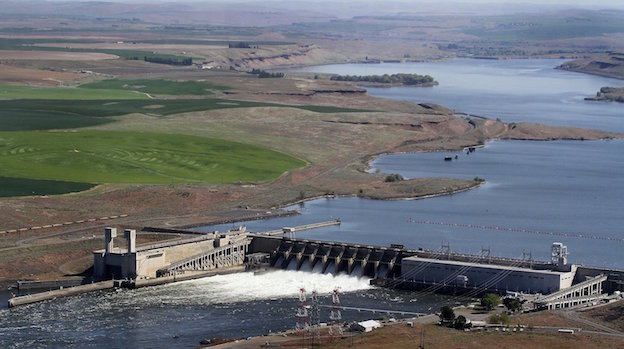 Parties in a decades-long lawsuit over Columbia River System Operations (CRSO) are bracing for a legal filing that -- if granted by the judge -- could be worse for irrigation and hydropower generation than breaching the four lower Snake River dams.
The National Wildlife Federation announced Oct. 2 that its upcoming request for a preliminary injunction in the reactivated lawsuit in the U.S. District Court for the District of Oregon will be similar, "with some modifications and updates" to a 2021 filing that called for high spill at the eight federal projects in the lower Snake and Columbia rivers along with reservoir drawdowns.
Plaintiffs were scheduled to file the new request for a preliminary injunction Oct. 8, but U.S. District Judge Michael Simon temporarily paused the case until he can review arguments over whether to grant a motion by federal defendants to stay the case until after the federal government shutdown has ended.
The defendant's Oct. 6 request for a stay says that Justice Department appropriations lapsed at the end of the day on Sept. 30, and that the DOJ does not know when its funding will be restored by Congress.
"Absent an appropriation, U.S. Department of Justice attorneys and many employees of Federal Defendants are prohibited from working, even on a voluntary basis, except in very limited circumstances, including 'emergencies involving the safety of human life or the protection of property,'" the request states.
Although the request for an injunction is temporarily postponed, it is still likely to be similar to a request for injunctive relief that Simon denied in 2021, after plaintiffs and defendants agreed to a five- to 10-year stay in the lawsuit, National Wildlife Federation et al. v. National Marine Fisheries Service et al..
The long-term stay was lifted Sept. 11 after federal agencies -- at the direction of President Donald Trump -- rescinded the settlement agreement that included a $1 billion investment in Columbia Basin salmon restoration projects over 10 years.
"Now that the Trump administration has withdrawn from the Columbia Basin agreement, we have no other choice than to return to court to seek commonsense and tried-and-true measures to prevent salmon and steelhead extinction," NWF said in announcing the upcoming filing.
NWF is one of 10 environmental and fishing plaintiffs represented by Earthjustice in the case. The group declined to share specifics about how the filing will differ from the prior request by plaintiffs.
The 2021 motion by plaintiffs sought increased spill at the eight lower Snake and Columbia river dams through Aug. 31, continuous spill through fall and winter, and reservoir drawdowns to minimum operating pools.
Public Power Council CEO and Executive Director Scott Simms acknowledged that the impact to power generation under an injunction similar to the 2021 proposal would be significant. "I think hobbling [the dams] can be just as dangerous and impactful to both fish and power as breaching could be," he told NW Fishletter.
But Simms is still hopeful that the parties in the lawsuit can work out a compromise.
"I've said a few times: by the region, for the region, in the region. We have the talent, expertise and know-how in the Northwest through all the stakeholders and tribes to figure this out," he said.
Clark Mather, executive director of Northwest RiverPartners -- an intervenor-defendant in the case, agreed.
"Northwest RiverPartners has been actively reaching out to a number of folks, including sovereign tribes and states, to find solutions in the region. We are going to continue to do that because we care about salmon, too," he said.
Mather said there are also people invested in the Columbia River System concerned about clean energy, agriculture, transportation, flood control and other perspectives that need to be part of the conversation. "When you're in the courtroom, you can't have that conversation," he said.
He said with the Northwest facing a 9-GW shortfall of electric energy by 2030, the region can't afford to lose any generating source -- especially not a non-carbon-emitting source like hydropower.
"We need every megawatt of clean, reliable and affordable energy possible," he said.
Simms added that as intervenor-defendants, PPC is ready to defend the interests of public power, if necessary.
"One thing that's changed since the [2021] filing is the affordability concerns have increased. The reliability and resource adequacy concerns have increased. And, as well, we've seen an increase in positive fish returns," he said.
Simms said it won't be too late to bring all the interests to the table to seek a compromise even once the motion for a preliminary injunction is filed.
He said the entire Northwest should be involved in a discussion over the impact of the plaintiffs' preliminary injunction, and that all of the impacts to Columbia River salmon -- including nontribal fishing -- should be considered.
The 2021 motion for an injunction was comparable to an alternative analyzed by federal agencies in the 2020 CRSO environmental impact statement (EIS) -- Multiple Objective Alternative 4 (MO4) -- which included high spill, annual drawdowns, and augmentation of spring flow with water stored in upper Columbia Basin reservoirs.
According to the EIS, hydropower generation would decrease by 1,300 aMW under average water conditions, and 870 aMW under low water conditions compared to the "no action" alternative in the EIS.
"The primary reason for the reduced generation is the increase in juvenile fish passage spill, up to 125% total dissolved gas levels 7 days a week, 24 hours a day from March 1 to August 31, with most lower Snake and lower Columbia River projects operating at minimum generation levels in the majority of water conditions. This increase in spill, together with a measure that provides dry-year augmentation of spring flow with water stored in upper basin reservoirs, contributes to MO4 having the highest probability of power shortages of any of the MOs, with blackouts or emergency conditions in roughly one in three years," the EIS says.
Irrigators, too, would be highly impacted under an injunction similar to the one proposed in 2021.
"It's sad. Sad, sad, sad. The agreement was far better than this," Darryll Olsen, board representative for the Columbia-Snake River Irrigators Association, told NW Fishletter.
For irrigators, drawing down reservoirs to their minimum operating pools would affect about 300,000 acres of irrigated land served by pumping stations that would no longer reach the lowered pool. That compares to about 92,000 acres affected by breaching the four lower Snake River dams, Olsen said.
He noted that dam-breaching discussions were accompanied by offers to pay the cost of transitioning. But with a court-ordered injunction, he said, "I can see the argument being made that there's no legal obligation to compensate," he added.
He said CSRIA will do their best to object to the motion, but added, "I'm not looking for much sympathy from Judge Simon."
The lawsuit was reenergized after parties in the case -- which include the plaintiff nongovernment organizations along with the states of Oregon and Washington and the four Native American tribes with treaty rights to fish in the lower Columbia River -- filed joint motions to lift the stay.
Within hours of the filing, District Judge Michael Simon granted the request to reopen litigation but did not rule on the scheduling motion.
The long-term stay was put in place in the wake of the 2023 Resilient Columbia Basin Agreement, which took two years to negotiate. The settlement called for federal agencies to invest $1 billion over a 10-year period in restoration and salmon recovery projects in the Columbia Basin.
On June 12, the settlement was withdrawn by a memorandum from President Donald Trump and was formally rescinded by federal agencies two weeks later.
"The Trump administration's recent actions leave us with no choice but to return to court," said Amanda Goodin, supervising senior attorney with Earthjustice, which represents the 10 conservation and fishing groups.
"Since this administration has reneged on this carefully negotiated agreement -- with no alternative plan to restore our imperiled salmon and steelhead -- we find ourselves once again on a course towards extinction of these critically important species. Earthjustice and our plaintiffs, alongside state and tribal partners, have spent decades protecting Pacific Northwest salmon and steelhead -- and we won't back down now," she said in a news release.
A news release from Oregon Gov. Tina Kotek adds, "The state of Oregon will return to federal court and seek an injunction to address urgent needs for the fish, including requiring the federal government to operate the hydropower system to help salmon complete their downstream migration next spring, maximizing the chance that they will return as adults."
Simon later approved a schedule that could lead to new court-ordered operations at dams in the Columbia River System by the start of spring spill in March, but that schedule is now uncertain due to the pending motion to stay the case until the end of a federal shutdown.
learn more on topics covered in the film
see the video
read the script
learn the songs
discussion forum