the film
forum
library
tutorial
contact
DONATE
|

|
Techno-politics of Dam Building on
the Snake and Columbia Rivers
by Eva Hauksdottir-Neill, Victoria Freeman, Nova Killbourne, Sky Pasena-Littlesky
Walla Walla Union-Bulletin, June 14, 2025
|
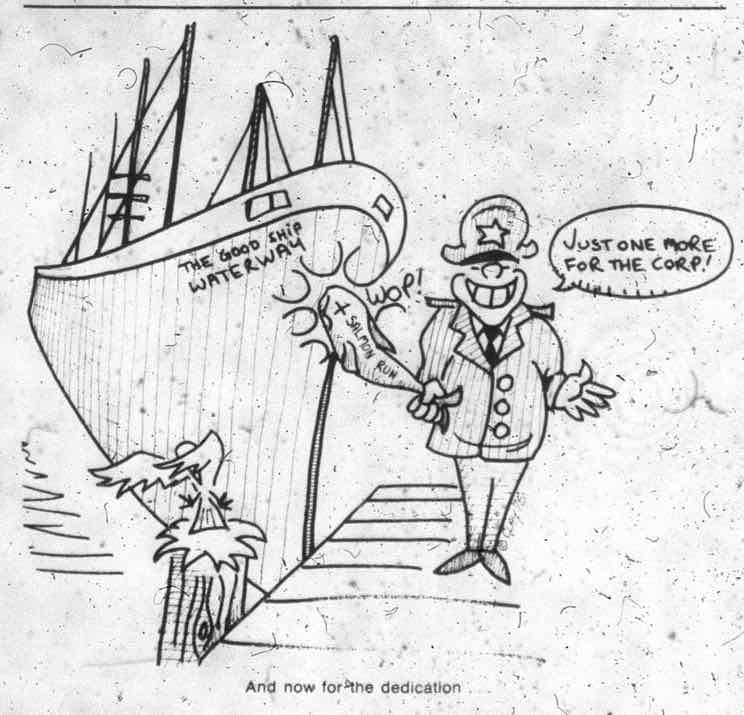 The Ice Harbor Dam is currently a major source of controversy in the Pacific Northwest. This controversy stems partially from the ecological impacts of the dams, clear by the growing body of research on salmon populations and carbon emissions.
During the construction of the Ice Harbor Dam, local municipalities were motivated to push rhetoric that these dams are necessary for developing the Columbia Basin region. However, they neglected to consider the voices of tribal representatives, thereby actively suppressing imperative perspectives.
The Walla Walla Union-Bulletin Newspaper was prolific in advertising the Ice Harbor Dam as an exciting new source of energy and development. Describing the dam construction as something to celebrate, the governors of Washington state had been working closely with the U.S. Army Corps of Engineers to push for congressional acceptance of the Dams.
They worked under an ethos of a "unity of purpose", and to reap "specific results for individual communities"; they worked closely with the Bonneville Power Administration (BPA), which was established in 1937 under the Bonneville Project Act. The BPA was created as a power agency to market and transmit power from the federal dams.
BPA played a critical role in increasing the number of dams built in the Pacific Northwest. They pushed for the construction of dams beyond the expansions of World War II energy production needs.
In attempts to establish the Pacific Northwest as a region that should "share the national industrial output," decrease labor shortages of the time and provide electricity to a growing population, the BPA claims that the dams are necessary to the Pacific Northwest region. Over time, the BPA became responsible for protecting fish and wildlife affected by the dams through the Pacific Northwest Electric Power Planning & Conservation Act of 1980. This is a notable conflict of interest as the BPA's Fish & Wildlife Program is under the same administration in charge of marketing and advocating for the necessity and prosperity of the dams.
The effects the Ice Harbor dam would have on salmon populations and the environment have been a concern since the declaration of its construction. Despite dams being portrayed as harmless, carbon-free energy sources, the material required to build them is not.
Cement production makes up about 8% of the world's total carbon emissions. The Ice Harbor dam requires a large amount of cement for its construction. This being said, the push for dam construction also demanded that concrete production be increased, further worsening our global carbon emissions and climate change.
Another point not talked about nearly enough is the importance of salmon in our rivers. Salmon populations have been significantly impacted by these dams due to the alteration of their habitat, changing natural water temperatures and interfering with their migration paths, to name a few. This is significant, as research has found that salmon migrating upstream from the ocean is vital for tree growth and the surrounding river ecosystem.
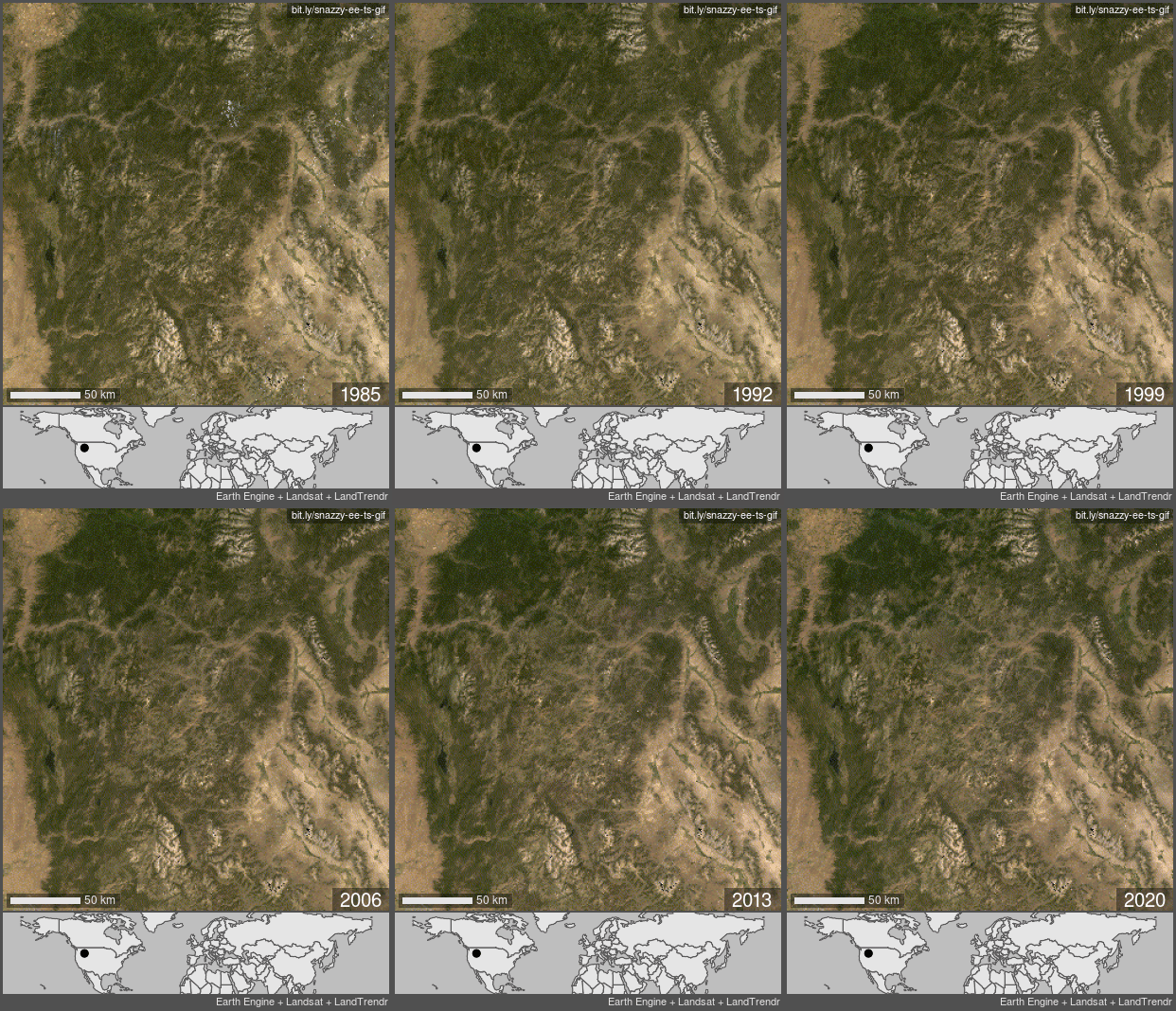 Trees specifically rely on the nutrient N15, sourced from the ocean and carried by salmon to freshwater river systems. Considering N15 is found in tree rings, we can estimate past salmon populations in the river. The dam's interference with this process has led to poorer tree and ecosystem health, which leads to further environmental problems.
Another concern that has been present since the declaration of the construction, but was suppressed, is the fishing rights of tribal nations surrounding the Columbia River. In the development of the Ice Harbor Dam, local tribes were excluded from participation in decision-making committees like the Ice Harbor Dedication Committee and the Columbia Basin Interagency Committee.
These committees, composed of federal and state representatives, scientists, and engineers, notably lacked tribal representation; even though the Confederated Tribes of the Umatilla Indian Reservation, Yakama Nation and Nez Perce Tribe had signed 1855 treaties affirming their sovereign status and guaranteeing fishing rights at their usual and accustomed places for cultural, spiritual and legal reasons along the Columbia River.
The absence of tribal voices on these planning committees not only fails to legitimize their sovereignty, but skews the public's opportunity to understand tribal nations' concerns. This lack of representation led to the framing of opposition to the development of the dam as being driven solely by ecological and commercial fishing concerns.
As a result, media surrounding the Columbia River focused on commercial fishing concerns without solidified perspectives. This is crucial to acknowledge, as newspapers prioritized the concerns of the commercial fishing industry and amplified pro-dam advocates' proposed solutions to address these specific issues.
Especially considering newspapers function as a form of public education, and in a time when public support was essential for dam development, public discourse could be curated to reflect pro-dam interests. In this instance, the upholding of the treaty-based fishing was diminished, and deeper cultural concerns were ignored.
This exclusion was not accidental; it functioned as a strategic erasure of sovereign voices and treaty rights for the benefit of economic progress.
For these reasons, it is important to recognize these environmental consequences now before the harm progresses. Today, the U.S. Army Corps of Engineers and the BPA are known to still be adamant in promoting the necessity of these dams. It is important for us to stay informed by listening to Native American voices and to be vigilant about the environmental impacts that these dams have, because the effects spread beyond single species and regions.
Related Sites:
The Snake and The Whale, must see feature documentary podcast by Wildlife Wire, Mark Surls and Samantha Miller 6/5/25
Eva Hauksdottir-Neill, Victoria Freeman, Nova Killbourne, Sky Pasena-Littlesky are students at Whitman College
Techno-politics of Dam Building on the Snake and Columbia Rivers
Walla Walla Union-Bulletin, June 14, 2025
See what you can learn
learn more on topics covered in the film
see the video
read the script
learn the songs
discussion forum