forum
library
tutorial
contact
Loss of Columbia River SAFE Gillnet
Fishing Program Would Ripple Far and Wide
by Peter Roscoe
Daily Astorian, July 20, 2026
|
the film forum library tutorial contact |
|
Loss of Columbia River SAFE Gillnet
by Peter Roscoe
|
The commercial fishermen, gillnetters, operate under the
most stringent and scrutinized fishery in the state.
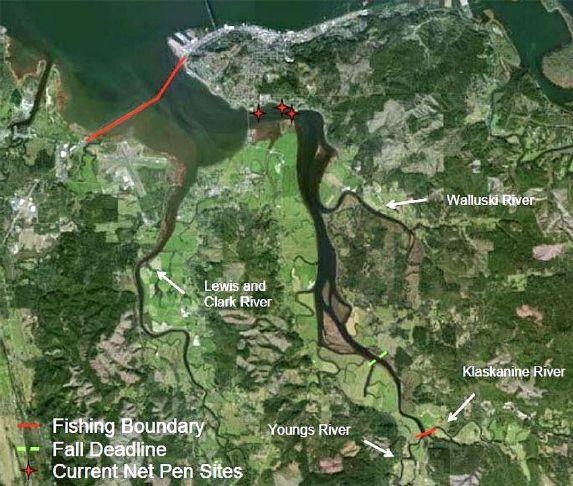 The recent decision by the Bonneville Power Administration (BPA) to pull out of their third of the funding for the Select Area Fisheries Enhancement (SAFE) program in the Lower Columbia has the potential of severely impacting not only some commercial and sport fisheries, but the general public as a whole. Consider this as a refresher course in the SAFE program. What it is, how it is managed and how it touches lives throughout the state.
Astoria was once known as the salmon capitol of the world because of the great runs of fish in the Columbia River. That is a well-known fact. A large portion of the public does not understand the breadth and complexity of the many runs of fish that enter the river. There are different species and different times of the year that the salmon return.
There are coho and king, spring, summer, fall and winter. There are fish called upriver brights, destined to waters above Bonneville Dam, and there are fish heading to tributary rivers like the Willamette and the Deschutes, as well as the south flowing rivers in Washington.
Management of all this falls on a joint task force headed by both the Oregon and Washington Departments of Fish and Wildlife. Also included on the task force are representatives from the engaged communities, sport, commercial and Native fishermen, as well as at large public sector members. I was one of those for over 10 years as both a city councilor for Astoria, and as a board member of the Oregon Restaurant and Lodging Association.
The math of salmon runs
The barometer for management of any given run is mathematical. It starts with a pre-run estimate. This is based on the number of salmon that returned four years previously. If there was a healthy return four years before, then the estimated return in the current year is expected to also be high. It is a sliding scale that has proven to have a high degree of accuracy after many decades of experience.
Whatever the number is, a new set of percentages come into play. For the sake of simplicity, call the expected return to be 100,000. Also, for simplicity, call the harvestable number to be 40,000. This would leave 60,000 fish to either spawn or be collected at a hatchery in order to ensure a sustainable number for a future run.
Of the 40,000 fish remaining, half are allocated to Native fisherman, based on the 1972 Judge Boldt decision that gave the tribes the right to half because it was an integral part of their culture and civilization. The remaining 20,000 fish are "privileged" to commercial and sport fisheries. The distinction between a right and a privilege was the fulcrum point in the Boldt decision.
There is still another stock split on the non-native fishermen. It is one of the most contentious battles in the state bureaucracy, sometimes called the salmon wars. Sport fishermen are allocated the majority, up to 70%, while the commercial fishermen get the remainder. These somewhat skewed numbers hide a fact from the general public. It is estimated that only 16 to 18% of the population actively sport fishes.
So while the entire population funds the salmon runs, less than 20% are allowed access to the majority of the catch. The general public is represented by the commercial fishermen, who sell their catch into the processing system, where it ends up in either a market or a restaurant. Which brings us back to the SAFE program.
Similar to hatcheries
Essentially this is a form of aquaculture similar to a hatchery, but with a bit of a twist. Dotted in some off channels to the mainstem of the Columbia, a series of net pens raise salmon in open water, tagging them with microchips and feeding them until they reach smolt size, then releasing them into the wild.
In the Youngs Bay pens, the brood stock for these fish are Rogue River Chinook. The salmon are hard-wired to return from whence they came, so for over 30 years, they have been coming back to Youngs Bay, where some of them are captured and developed for the next run.
This is what is known as a Select Area. The whole purpose of their existence is that commercial fishermen have the opportunity to harvest them and send them to market. This keeps a commercial fishery active, while minimizing pressure on mainstem salmon.
The commercial fishermen, gillnetters, operate under the most stringent and scrutinized fishery in the state. When and where they are allowed to fish, in either a select area or on the mainstem, is highly regulated. There are limited times, usually an eight-hour period several days running.
The mesh size of their net is a critical factor. A larger mesh means that smaller fish will swim through. They are also required to report the number of fish caught, which they must sell to a licensed fish buyer, who works with the state observers. Literally every fish is counted, and if and when the catch approaches the threshold of allowance, then the fishery is shut down.
The biologists always act out of caution. If there are no fish in the water during their allotted time, they may be given additional opportunity, but it is not assured. During their allotted time there is also a restriction called the soak time. This is the time that the net is allowed to be deployed before it is brought in and the catch taken. After running the gear, the net can be reset for another soak.
Some years the return is healthy, and the fishermen make decent money. There is never enough for anyone to make a living solely on fishing the Lower Columbia runs. To work year-round as a fisherman means switching it up from one season, one species, at a time. Winter crab gear gets switched to shrimp or black cod, the lucrative Alaskan seasons open up, tuna show up off the coast and the trolling begins. There are multiple opportunities in the industry.
No doubt that the permit holders in the Lower Columbia rely on the SAFE program as an important income stream, but all of them fish elsewhere throughout the year. The recent decision by BPA to withdraw their third of the funding for this program is both devastating and curious. It is curious because Bonneville Dam has always been one of the factors in the decline of the great salmon runs.
And, it is devastating because without the program in place, one of the area's important food products, the Columbia River salmon, could shrink in the marketplace. It could be a boon for the Native fishers, who do supply a good deal of the catch.
Impacts will spread
If the SAFE program drops away, then the entire landscape of fishing on the Columbia would change in ways that are yet to be determined. Since the majority of the population is represented by commercial fishermen, it would make sense that they would be allowed more access to the catch and the sports community's percentages would diminish. This would not sit well with them.
My guess would be that an injunction of some kind will be filed that forces the BPA to continue funding the program in the short-term future while the courts decide the long-term plan.
In the meantime, if you see 10 or so gillnet boats setting their gear in Youngs Bay, and wonder how in the world will any fish ever get by those nets, understand that the SAFE program was established so that most of those fish do get harvested. That is the point of it all.
Let's hope that there is a solution, and that the SAFE program will continue.
Peter Roscoe, a former Astoria City Councilor, is the previous owner of Fulio's Pastaria. He and his family have been in Astoria since 1956, and have been actively involved in both the city of Astoria and Clatsop County.
Related Sites:
Legal Settlement Reached to Protect Wild Salmon and Steelhead from Harm by Lower Columbia River Hatcheries Wild Fish Conservancy, 10/4/24
learn more on topics covered in the film
see the video
read the script
learn the songs
discussion forum