forum
library
tutorial
contact

Power Council Proposes Enhanced
Spring, Summer River Flow
by Matthew Weaver
Capital Press, December 22, 2025
|
the film forum library tutorial contact |
|
Power Council Proposes Enhanced
by Matthew Weaver
|
"This ramping and flow fluctuation can negatively impact fish."
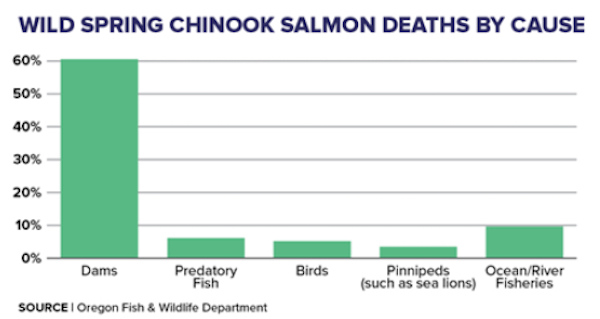 The Northwest Power and Conservation Council wants to enhance spring and summer flows to help juvenile fish move downstream through the Columbia River Basin hydrosystem more quickly, to gain higher survival to the ocean.
The council seeks public comment through March 2 for the draft of its updated Columbia River Basin Fish and Wildlife Program.
The program aims to protect, mitigate and enhance salmon and other fish and wildlife affected by the hydropower system of dams and reservoirs, while also assuring the Pacific Northwest "an adequate, efficient, economical and reliable power supply."
The Council is in the process of creating its next power plan, called the Ninth Plan, and aims to release a draft for public review and comment by mid-2026, and adopt the final version by November 2026.
Spring and summer
The draft plan proposes "long-term, consistent" operations in the Columbia and Snake rivers during the spring and summer:
"Ramping and flow fluctuation between projects in these stretches could increase significantly by 2029, primarily due to the flexibility of the hydrosystem and integrating increasing generation from renewable energy resources in the Northwest," the council states. "This ramping and flow fluctuation can negatively impact fish."
The draft proposal "would not be a major departure" from recent operations, the council says in a press release.
But it "proposes to bring consistency and stability" to hydrosystem operations over the next decade, so that effects and potential benefits of spill operations can be studied effectively and better understood.
Grid reliability
The states of Oregon, Washington and environmental and recreation groups currently have a lawsuit seeking emergency measures for endangered salmon and steelhead. That proposal calls for increased spill over the dams and maintaining reservoirs at minimum operating levels. Dam stakeholders have filed opposing briefs citing potential impacts to electricity affordability and grid reliability as a result of the lawsuit's proposed measures.
"There is certainly overlap," said Patty O'Toole, fish and wildlife division director, of the lawsuit proposal and the council's draft plan.
The council declined to respond directly to litigation, O'Toole said.
The council "lives at the intersection of both power and fish" on a long-term planning basis, she said.
"The forecasted load growth is certainly the biggest driver of needs and the needs for new resources in this region," said Jennifer Light, council director of power planning. "It wasn't necessarily one direction or the other. It's a complex system, how water moves through and trying to manage that and all of the other constraints, as well as meeting growth. It's a complex and nuanced answer."
5 million fish
The goal is to bring an average of 5 million adult salmon and steelhead back to the Columbia River Basin annually. The 5 million fish goal does not differentiate between wild and hatchery fish.
The current 10-year rolling average is 2.3 million fish. The average dipped to a low of 1.3 million in the 1990s and many stocks were listed under the Endangered Species Act. The total return of adult fish in 2014, 4.6 million, was closest to reaching the 5 million target, according to a council press release.
Survival for all adult species except Snake River sockeye has exceeded 80% since 2002, according to the council. Cumulative mortality for downstream juvenile migrants was 77% to 96% in 1986, and has improved to 48% to 50% from the Snake River to Bonneville Dam today.
Stakeholder response
Austin Rohr, deputy executive director for Northwest RiverPartners, said his organization is "disappointed" in the power council's proposed hydrosystems operations.
".. Operations like these would dramatically increase electric rates, expose millions of people to higher blackout risk and offer no guaranteed benefit to fish," Rohr said. The organization will work to provide the council "scientifically-based, balanced solutions," Rohr said.
"The Council's final plan must assure an 'adequate, efficient, economical and reliable power supply' in accordance with federal law," Rohr said.
Scott Simms, CEO of the Public Power Council, echoed Rohr's concerns, noting many elements coincide with the requested emergency measures in the lawsuit.
They would "spur unneeded electricity rate increases, increase fossil fuel emissions and increase the risk of blackouts -- all the while having dubious impacts on the health of salmon," Simms said. "We would remind the council and the region about the council's mission, which leads with ... 'to ensure an affordable, reliable energy system while protecting and enhancing fish and wildlife in the Columbia River Basin.'"
The Public Power Council will dive "more deeply" into the details of the power and conservation council's draft plan in the weeks ahead, Simms said.
Public hearings
Public hearing processes in Oregon, Washington, Idaho and Montana will begin in early 2026. Hearings will be held throughout the region, including in Bend and Portland in Oregon; Seattle, Spokane and Yakima in Washington; Boise and Lewiston in Idaho and Kalispell, Mont.
Bonneville Power Administration funds the program to fulfill its mitigation responsibilities under the Northwest Power Act of 1980. The U.S. Army Corps of Engineers, U.S. Bureau of Reclamation and Federal Energy Regulatory Commission also have responsibilities to implement provisions of the program. The program directs about $300 million annually in direct investment by BPA.
learn more on topics covered in the film
see the video
read the script
learn the songs
discussion forum