forum
library
tutorial
contact

How the Lower Snake River Dams
Protect Local Jobs and Industry
by Sponsored
Idaho Press, November 18, 2025
|
the film forum library tutorial contact |
|
How the Lower Snake River Dams
by Sponsored
|
Under the current policies, the chances
of securing a new water permit is small.
 For nearly five decades, the Lewis-Clark Valley has been shaped economically, culturally, and environmentally by the Lower Snake River Dams.
While hydropower often takes center stage in regional debates, local leaders emphasize that the benefits extend far beyond electricity alone.
A Foundation for the Local Economy and Lifestyle
The true importance of the dams begins with their most essential role: creating the conditions that allow river transportation and the Port of Lewiston to exist at all.
Scott Corbitt, General Manager of thePort of Lewiston and a former U.S. Naval Officer, said the dams play a critical role in supporting river commerce in the LC Valley.
"The series of locks takes a vessel from sea level to 735 feet above sea level and back again on a trip west," said Corbitt.
Barging of agricultural products, transport of wood fiber, and cruise ship tourism all depend on this system. And the benefits of the dams stretch far beyond transportation, shaping everyday life in the Valley.
"Since 1975, residents of the Valley have enjoyed having Lower Granite Pool five minutes from their house with its variety of recreational opportunities," Corbitt said.
The region's levees offer miles of walking, biking, and running trails, while salmon and steelhead runs support a thriving professional guide industry.
Just as importantly, the dams supply vital water volume for manufacturing and municipal systems.
"Our largest job creators, such as Clearwater Paper, rely on the current volumes in the rivers for intake and effluent management," Corbitt said. "Our local municipalities rely on the current level of the rivers for water supply and wastewater treatment."
 Supporting Regional Commerce and Global Agriculture
Without the dams, the Port of Lewiston's most basic function would be impossible.
"Without even one of the dams, safe navigation cannot occur," Corbitt emphasized.
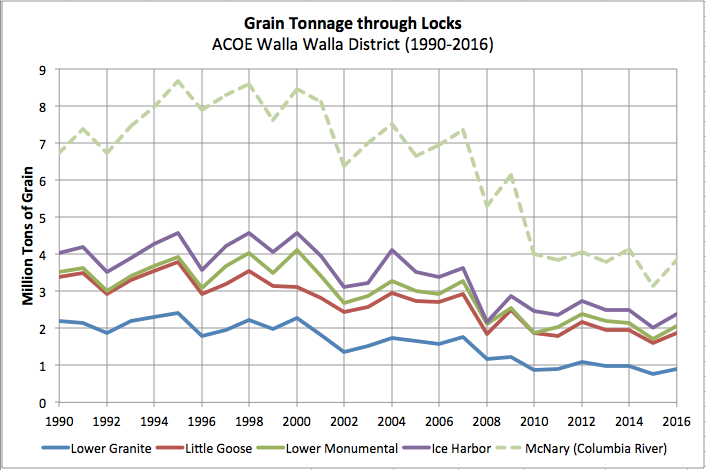
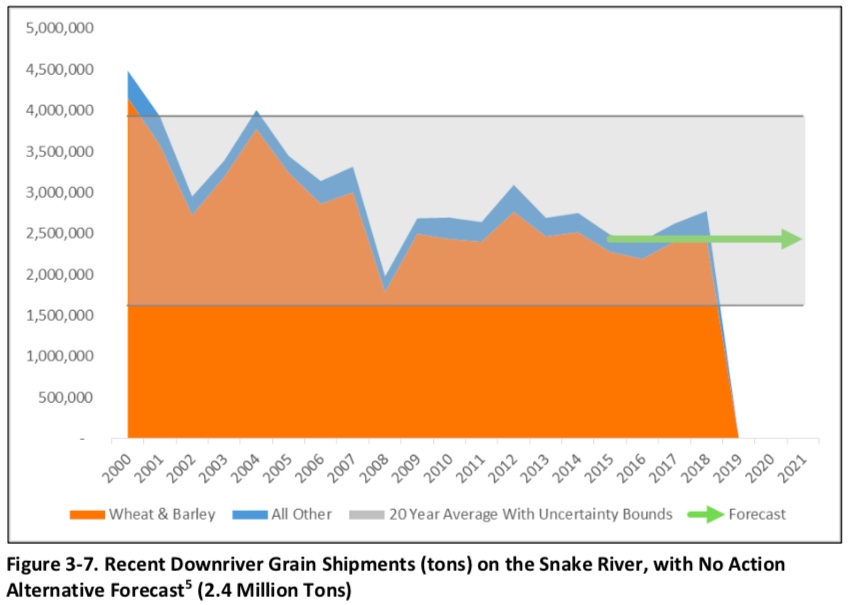
Lewiston is located among some of the best farmland in the world, which makes barge transportation extremely important. Each year, the port moves about 275 barges, 200 of which are used to move wheat.
"Our port allows this wheat to be reliably shipped to export at a price that provides a key advantage to our local farmers," said Corbitt.
This low-cost transportation method is the difference between profit and loss for many farms. Corbitt noted that wheat currently sells for $5.40 per bushel, but without the dams, "the transportation price to these export markets would go up by as much as $1 per bushel. Many of the wheat farmers could not absorb that cost and hope to remain in business."
Tourism, too, is flourishing thanks to accessible waters.
"This past season, we hosted 30 cruise vessels from American Cruise Lines at our new docking facility," Corbitt said, adding that the tourism industry brings about $16 million per year to the local economy.
And none of those boats could reach the Valley without the Lower Snake River Dams.
Critical but Often Overlooked Advantages
While hydropower is a significant talking point, Corbitt stressed that one of the most overlooked benefits is water reliability.
"North Central Idaho has created a lifestyle and an economy around Lower Granite Pool for the last 50 years," he said. "The current state of the river supplies the water to over 100,000 people."
Whether drawn directly from the Pool or the Grande Ronde Aquifer, this supply is critical to everyday life.
Local industries also depend on long-established water permits that reflect current river volumes.
If dam removal changed those volumes, Corbitt warned, "not only would those companies need to redesign/reconstruct their water systems, they would also need to re-permit those systems. Under the current policies, the chances of securing a new permit would be small. Thousands of jobs and a significant portion of the Regional Domestic Product would be lost."
What Happens if the Dams Are Removed?
The consequences would be immediate and severe, with agriculture, industry, and infrastructure all facing steep losses or closures.
"The moment one of the eight dams along the Columbia Snake System is removed, river commerce stops in Lewiston," Corbitt said.
Without Lower Granite Pool, Corbitt added, "the levies would no longer be supported by the water pressure of the Pool and would begin to erode. The narrow band of water remaining would move faster and begin to scour the pilings of bridges."
In 1992, a U.S. Army Corps drawdown test demonstrated these risks, resulting in dead fish and destroyed marinas and docks.
"The long-term impacts would likely be the death of our Valley as a choice place to live," Corbitt said.
Hydropower: The Hidden Advantage That Can't be Ignored
While hydropower may not be the only benefit,it is a critical one. Corbitt pointed to a recent study showing that the Northwest's energy grid would be short by 9,000 gigawatts by 2030 -- an impact on the public's power needs comparable to the amount consumed by the entire state of Oregon.
"Hydropower remains the stable and enduring power source necessary to ensure we have a chance to meet these needs," Corbitt said.
He also warned that political efforts to reduce generation threaten grid stability at a dangerous moment.
Balancing Ecology and Economy
The Port of Lewiston supportssalmon recovery efforts and works closely with ecological partners focused on preserving the salmon runs that pass by the docks. Port staff help search for balanced solutions and push for a full understanding of the science, including questions about ocean conditions, predation, and fishing pressure.
Ultimately, Corbitt said, the Port advocates for "the notion that fish and dams can coexist."
A Call to Community Action
Looking ahead, Corbitt stressed that public engagement will shape the Valley's future.
"The dams exist for the benefit of the community," he said. "Too many people take them for granted and assume their benefits are simply a given."
With growing pressure on the energy grid, he urges residents to speak up in support of preservation efforts.
"Lewiston and the LC Valley are truly Ground Zero for the dam removal debate, and we will take every opportunity to get the word out about the benefits of the Lower Snake River dams."
Related Pages:
What are the impacts to transportation if LSR dams are breached? by bluefish.org, Public Comment to Columbia River System Operations, 2018
Montana Grain Tonnage Barged on Lower Snake River by Montana Wheat & Barley Committee, 1985-2001
learn more on topics covered in the film
see the video
read the script
learn the songs
discussion forum