forum
library
tutorial
contact
Rep. Glusenkamp Perez Explores Lethal
Removal Options for Columbia River Sea Lions
by Amanda Rhoades
KOIN, December 5, 2025
|
the film forum library tutorial contact |
|
Rep. Glusenkamp Perez Explores Lethal
by Amanda Rhoades
|
She told the committee it costs more than $38,000 to remove a single sea lion
from the Columbia, which amounts to roughly $203 per salmon saved.
 PORTLAND, Ore. (KOIN) -- Washington Rep. Marie Glusenkamp Perez wants to explore more lethal removal options for sea lions.
She joined a House Committee on Natural Resources hearing on Wednesday, where she questioned experts about strategies to remove the tens of thousands of sea lions she said have invaded the Columbia River.
"As the name implies, sea lions are a species that belong in the sea," she told the committee. "Not in our rivers."
But sea lions, increasingly, have made themselves at home in Pacific Northwest rivers. The issue began to escalate in the 1990s, when California and Stellar sea lions started hanging out around the Bonneville Dam and Willamette Falls, according to the Oregon Department of Fish and Wildlife.
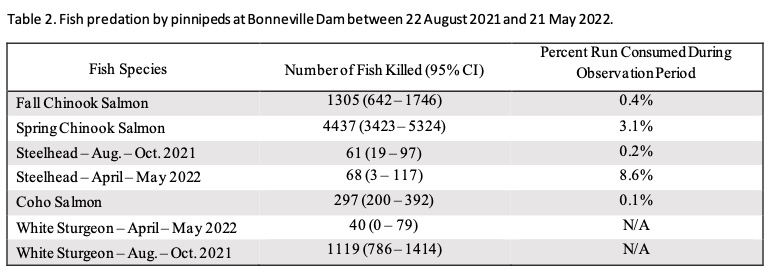
The sea lions found easy prey in the salmon and steelhead who were waiting to move up the ladders. As a result, the fish population plummeted. In a 2017 study, ODFW scientists found that native steelhead were at significant risk of extinction due to California sea lion predation on the upper Willamette River.
The sea lion population exploded from less than 75,000 in the 1970s to about 257,000. Meghan Dugan, a spokesperson for ODFW, said that it's tough to estimate just how many sea lions are in the lower Columbia River since they migrate in and out, but the number spotted in places like the Bonneville Dam and Willamette Falls has increased sharply since the early 2000s.
Wildlife officials tried everything from installing barriers to underwater fireworks and firing buckshot at the animals, but nothing worked. They even tried to relocate the sea lions more than 200 miles away, but they always found their way back.
"At one point, we did try to find space in zoos and aquariums, but that rapidly filled up," said Samuel Rauch with NOAA Fisheries.
"There is currently no better way to address predation than lethal removal," he told the committee.
Oregon, Washington, and Idaho, as well as the tribes, were previously authorized to apply for as many as 100 permits each year to lethally remove sea lions. In 2020, NOAA expanded that to allow states and tribes to kill sea lions in zones of the Columbia River where they are known to prey specifically on at-risk salmon and steelhead.
But even with those permits, progress has been limited. Last year, only 27 California sea lions and 21 Stellar sea lions were removed at Bonneville Dam. In 2025, as of July, only 26 California and 11 Stellar sea lions have been removed.
"We're very concerned with the lack of efficacy with the current removal process," Glusenkamp Perez said.
She told the committee it costs more than $38,000 to remove a single sea lion from the Columbia, which amounts to roughly $203 per salmon saved.
"One of the things we need to take into consideration is the simple fact that, you know, in Alaska, they do harvest such animals," Nisqually Indian Tribe Chairman Ken Choke told the committee.
"So can we work together with our brothers and sisters up north to do what we've done in traditional ways and barter with our brothers and sisters up north?"
learn more on topics covered in the film
see the video
read the script
learn the songs
discussion forum