forum
library
tutorial
contact

Adjusting on the Run
by Eric BarkerLewiston Tribune, June 21, 2026
|
the film forum library tutorial contact |
|
Adjusting on the Runby Eric BarkerLewiston Tribune, June 21, 2026 |
Hatchery goals altered to make up for state overshooting harvest share
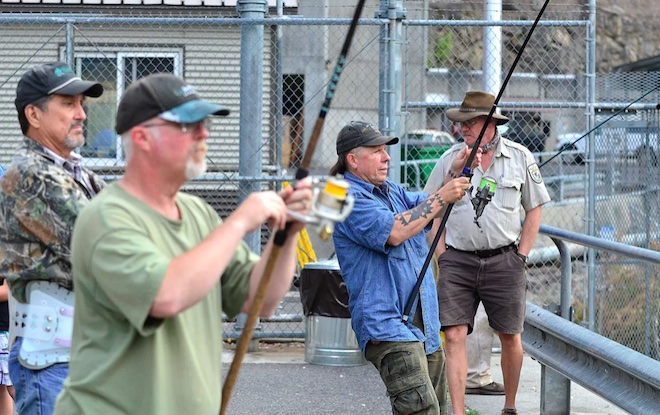 Fisheries managers for the Idaho Department of Fish and Game are optimistic they will collect enough adult spring chinook from the Clearwater River to fill hatcheries there.
But they are starting with an unusually deep hole dug by harvest that matched a preseason forecast even though the run fell well short.
Clearwater River anglers harvested roughly 1,100 chinook, close to double the state's harvest share. Regional fisheries manager Joe Thiessen said early on the run appeared to be in line with the preseason forecast. Then the fish started flashing mixed signals and what turned out to be red flags.
"We got word that there might be some concerns with conversion rates from essentially Ice Harbor Dam to Lower Granite Dam," he said.
That was during the third four-day fishing interval with meaningful harvest. When that interval was over and fisheries managers ran the numbers, the projected harvest share "tanked."
But in the next few days there was a surge of fish, the harvest share bumped back up. The agency closed the lower section of the Clearwater River downstream of Cherrylane Bridge but kept other sections and tributaries open.
Then fishing turned red hot on the North Fork.
"Never in my wildest dreams would I have imagined we would have harvested 500 fish from the North Fork in a four-day interval," Thiessen said.
Downriver, conversion of chinook moving up the Snake River dropped again.
"That little blip in the harvest share was a false positive and we ended up having the thing tank back down to 638 fish for our harvest share -- of which we had harvested 1,111 fish, which effectively shut down the fishery."
If there's a silver lining, Thiessen said the agency met its original harvest number.
"We set a fishery to harvest around 1,100 to 1,200 fish and hit the nail on the head."
But silver linings come on dark clouds. Thiessen said fish managers didn't fully recognize the red flags that caused the state to blow past the actual harvest share.
Conversion
Thiessen said as a general rule, about 76% of Idaho-bound spring chinook at Bonneville Dam make it to Ice Harbor Dam near the Tri-Cities which is just upstream from the mouth of the Snake River.
"And that is what we saw this year. It hit its average," he said.
From Ice Harbor to Lower Granite, conversion rates are generally much better, as high as 96%. This year it was 67%.
"That really reduces your harvest share in a hurry."
Fisheries managers are trying to figure out why. Thiessen said spill at the dams was suspected but water managers pulled back on spill at some Snake River dams without significant improvement. What's more, he said river flows are down this year, meaning spill volumes have been higher in the past. Downriver harvest doesn't explain it either. Conversion rates were normal between Bonneville and Ice Harbor.
"Everything from an accountability standpoint does not explain why we are missing fish," he said. "We are tracking down and investigating every possible mechanism."
Harvest vs. Hatchery
The state's overharvest threatened to curtail fishing by the Nez Perce Tribe. The state and tribe, following legal precedent, split the available number of returning chinook that are over and above hatchery spawning needs. Each group gets an identical harvest share, in this case some 600 fish.
To compensate, the state and tribe agreed to lower the spawning goal, also known as broodstock. For several years, the two sides have voluntarily agreed to take advantage of extra space in Clearwater River hatcheries by collecting more adult fish than is called for in official U.S. v. Oregon negotiations -- the court-based framework that guides everything from harvest to spawning goals. That agreement sacrifices some harvest for a 1.5 million bump in the number of juvenile spring chinook released each year.
Agreeing to use the lower broodstock goal this year bumped the harvest share to about 1,200.
The state and tribe believe hitting the U.S. v. Oregon broodstock goal is attainable. Thiessen thinks the higher-full capacity broodstock goal is also within reach.
Chinook in the Clearwater River are not protected under the Endangered Species Act. That allows both the tribe and state to backfill empty raceways with fish or eggs from other hatcheries like Rapid River near Riggins or Carson Hatchery on Oregon's Wind River.
Thiessen said genetic analysis of this year's run shows the tagged fish that fisheries managers used to track the run in real time under-represented actual fish returns by as much as 30%.
"We're still likely going to reach our full capacity goals because of that," he said.
Related Pages:
Count the Fish Data sources of Adult Sockeye Returns, 1977-2025
learn more on topics covered in the film
see the video
read the script
learn the songs
discussion forum