forum
library
tutorial
contact

F&W Program Input: From Dam Breach
Analysis to Nixing Salmon Return Goal
by K.C. Mehaffey
NW Fishletter, June 4, 2025
|
the film forum library tutorial contact |
|
F&W Program Input: From Dam Breach
by K.C. Mehaffey
|
The Bonneville Power Administration asked the Council to
abandon its long-standing goals to achieve SAR of 2 to 6 percent.
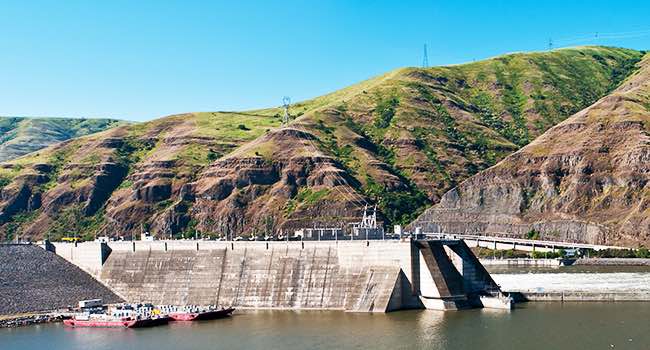 The Six Sovereigns and more than a dozen conservation groups want the Northwest Power and Conservation Council to include an analysis of breaching the four lower Snake River dams in its Ninth Power Plan.
The Bonneville Power Administration asked the Council to abandon its long-standing goals to return an average of 5 million adult salmon and steelhead to the Columbia Basin annually and to achieve smolt-to-adult return rates of 2 to 6 percent.
Those are just two out of hundreds of recommendations that the NWPCC and others will be reviewing in the next step of the Council's process to amend its Columbia River Basin Fish and Wildlife Program.
Forty-one entities and 18 individuals submitted recommendations by the May 19 deadline for amending the program. Those recommendations are now public and open to comments through July 3. NOAA Fisheries was notably absent from the list of state and federal agencies, Native American tribes, nonprofit groups, cities, individuals, utilities and utility organizations that submitted recommendations.
Some recommendations are lengthy, involving specific suggestions on several topics, while others stuck to a few general comments.
Roughly every five years, the Council invites public scrutiny of its Fish and Wildlife Program -- prior to completing a new power plan -- as required under the Northwest Power Act.
The last amendment was completed in 2020 as an addendum to the 2014 program.
In this round of recommendations, commenters presented different ideas about whether the program should retain a goal in place since 1987 of achieving an average of 5 million adult salmon and steelhead returns annually to the Columbia Basin by 2025.
BPA says the goal should be abandoned -- or at least clarified so it's not considered a legal obligation or a measurement of the program's success.
"While abundance-based goals may be appropriate in the context of broad sense restoration efforts, they are decidedly in excess as a goal, or metric of success, for a program that is meant to address only one of the many factors affecting abundance," BPA said in its recommendation to the Council.
The agency noted that many other factors -- including human development and climate change -- continue to contribute to the decline of salmonids in the basin. Yet the goal is increasingly misinterpreted to mean that Bonneville has a legal obligation to return an average of 5 million salmonids under the Northwest Power Act, as was suggested by parties in its 2024 power rate case.
BPA also pointed to significantly lower estimates of past salmon returns, noting that the 5 million fish goal is based on a historical average run size of 9.6 million salmon, which is "higher than the highest estimates of current sources, including those by the [Independent Scientific Advisory Board], the Pacific States Marine Fisheries Council, and the Columbia Basin Partnership Task Force."
BPA suggested, "If the Council opts to retain a numerical adult abundance goal in the Program, the Council must incorporate new information indicating that both historical abundance and the proportion of hydropower-caused losses were lower than the Council estimated in 1987."
Northwest RiverPartners, meanwhile, asks for a comprehensive scientific review of historical run sizes and the impact of hydropower on adult returns.
The group notes that the Council's estimate of 10 million to 16 million adult salmonid returns prior to development has not been evaluated since 1986. In that evaluation, the Council attributed annual losses from hydropower of 5 million to 11 million fish.
Yet the ISAB pointed out that four assessments now estimate maximum abundances of approximately 9 million fish, RiverPartners said.
Others recommended retaining the goal.
"While progress has been made toward the Program's goal to increase the total adult salmon and steelhead runs to an average of 5 million annually by 2025, we have yet to reach the goal or the targets for salmon and steelhead adult abundance by stock and subregion," a recommendation from a coalition of conservation and other groups said.
Retaining the goal but pushing the date for achieving it to 2035 was the first of four recommendations from the groups, led by Columbia Riverkeeper.
The Idaho Department of Fish and Game agreed.
"Despite falling short of the goal we maintain the goal is important and needs to remain in the Program with continued focus on salmon and steelhead returning upstream of Bonneville Dam," the agency's comment says.
Another recommendation likely to result in differing opinions is a request to include lower Snake River dam removal as a measure in the next Fish and Wildlife Program, and to include an analysis of energy resource needs without the dams in the Ninth Power Plan.
The letter from Columbia Riverkeeper and 16 other groups says that "No reasonable scientific debate exists about whether removing the four Lower Snake River Dams is necessary to restore healthy, abundant, harvestable populations of salmon and steelhead (not to mention white sturgeon or lamprey) in the Snake River basin."
The Six Sovereigns didn't go quite as far. Comprised of the four Native American tribes and two states which put forth a set of initiatives to help settle a lawsuit over Columbia River System Operations, the sovereigns each asked the Council in separate letters to plan for power needs without the four Snake River dams in the power plan.
After noting the tribe supports breaching the dams, the Nez Perce Tribe's recommendations state, "[T]he Tribe recommends that evaluation of long-term Columbia River System operations include breaching the four lower Snake River dams during energy planning for the Council's Ninth Power Plan. In coordination with appropriate entities, the Tribe recommends the Council build upon existing information to identify and advance investments and actions necessary to secure continuity of energy services provided by the lower Snake River dams to inform future conversations regarding lower Snake River dam breaching."
The tribe suggests that addressing the potential loss of energy and capacity should inform power and transmission planning; that investment should be in a clean-energy portfolio that would rely primarily on energy storage, energy efficiency and demand response; and that development of new energy projects and infrastructure should respect the sovereignty and rights of all parties.
The Six Sovereigns -- Washington, Oregon, the Confederated Tribes of the Umatilla Indian Reservation, the Confederated Tribes of the Warm Springs Reservation of Oregon, the Nez Perce Tribe, and the Confederated Tribes and Bands of the Yakama Nation -- collaborated with each other to develop the recommendations.
The recommendations from the Six Sovereigns, and many other entities and individuals, involve hundreds of other suggested changes to the Fish and Wildlife Program on topics ranging from predation to artificial production.
For example:
learn more on topics covered in the film
see the video
read the script
learn the songs
discussion forum