forum
library
tutorial
contact

'A Calling I Could Not Resist':
Kavulla Sworn In as BPA Administrator
by Stephen Ernst
Clearing Up, June 30, 2026
|
the film forum library tutorial contact |
|
'A Calling I Could Not Resist':
by Stephen Ernst
|
"Powering the [artificial intelligence] revolution is ...
about a national security that we need to win."
-- Travis Kavulla, CEO and administrator of Bonneville Power Administration
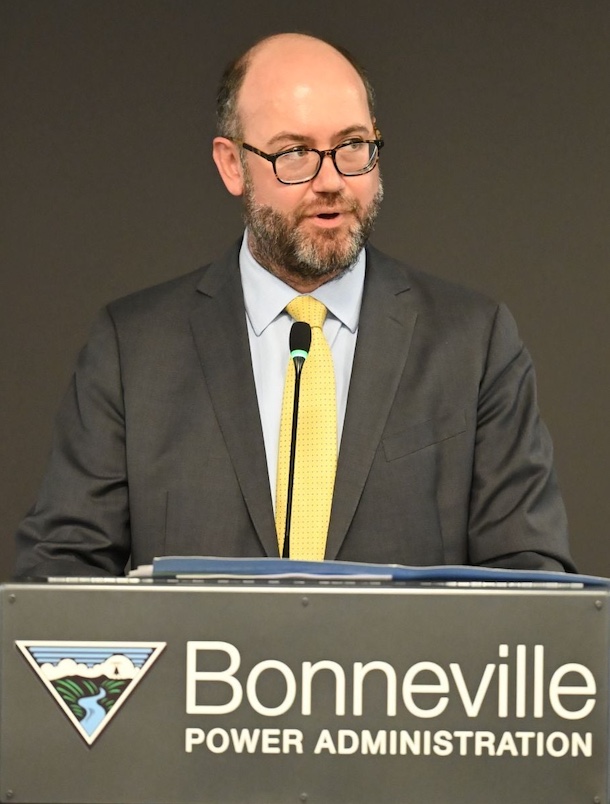 Travis Kavulla was sworn in as CEO and administrator of the Bonneville Power Administration in an afternoon ceremony on June 29 at BPA's headquarters in Portland.
Kyle Haustveit, U.S. undersecretary of energy, swore Kavulla in as the 17th administrator in BPA's 89-year history.
In opening remarks, Haustveit read a letter from U.S. Secretary of Energy Chris Wright that encouraged Kavulla to "bring your bold ideas forward and help us accelerate and expand energy production. This is a pivotal moment for America and for DOE."
Haustveit said BPA is "meeting the demand today, and the demand is changing at a pace we haven't seen in decades. Powering the [artificial intelligence] revolution is not just about getting the prompts answered that we all like to test and play with in the evenings. It's about a national security that we need to win. Second place is not an option for our country, and the power that Bonneville provides America and Northwesterners is absolutely critical."
After taking the oath of office, Kavulla spoke for the first time publicly about accepting the administrator position and his vision for BPA.
He thanked DOE for "the great honor and awesome responsibility of leading the Bonneville Power Administration at this pivotal moment for the industry."
Kavulla most recently was head of policy at Base Power Company, a residential energy and battery startup located in Texas, and a lecturer at the University of Chicago Harris School of Public Policy. He previously served as NRG Energy's vice president for regulatory affairs and led the energy program at the R Street Institute, a Washington, D.C.-based public-policy research group.
He grew up in Great Falls, Montana, and served on the Montana Public Service Commission from 2011 to 2018, serving as vice chair and chair of the commission at the end of his tenure there. Kavulla was also president of the National Association of Regulatory Utility Commissioners in 2015-2016.
In his opening remarks, Kavulla said he "served nearly a decade previously in public service, on behalf of the people of Montana; and to join the senior executive service of the United States government to serve the nation and this region feels like a continuation of that vocation--a calling I could not resist."
Kavulla thanked BPA employees "for your hard work. Your work is a public service, and it is a rare occasion that one can invoke patriotism in the context of the workings of an electric utility, but Bonneville is one of those times. I don't think it is lost on anyone in this room or online the essential role Bonneville played in America's race to win the last century's most serious conflict," referencing the role the region's aluminum smelters played in helping win World War II.
He praised BPA customers that "have expressed enthusiasm for BPA's Provider of Choice contracts," and said he was "thrilled" that many of Bonneville's customers have created retail rate designs that not only allow, "but require large users of power to take a direct assignment of costs for incremental supply."
"This framework of choice should provide the ingredients to facilitate growth in demand for power," he said, adding that after the 1970s, the region was able to meet demand growth primarily because of the closure of the aluminum smelters.
"We are all out of the headroom provided by the decline of that industry, just as we face a rising demand for power from a novel industry, artificial intelligence, which Secretary Chris Wright--who oversees our entire enterprise--has called the Manhattan Project of our time," Kavulla said.
The steps Bonneville staff have started through the investments of the Grid Expansion and Reinforcement Portfolio, and the ongoing Grid Access Transformation proceeding, are the beginnings of BPA's response to this "remarkable upward turn in demand," he said.
"My vision for the administration is for it to be bolder still. We cannot allow BPA to be a barrier to economic development. We cannot allow a backlogged interconnection queue to frustrate all power generators. By the same token, we cannot pretend as if all large-load requests can be accommodated. We must find a way to rationalize the additions of demand and supply to the system through a process that allocates scarce capacity to the highest-value uses of the system," Kavulla said.
The same policies should facilitate either a direct assignment of costs to new grid users, or "a market-based value with that access," while protecting existing ratepayers who live and work in the region, he said.
"Those are the twin goals I have in mind for major BPA initiatives in this space--facilitating growth while protecting legacy customers--and they are inspired from the lessons I take from BPA's history," Kavulla said.
He said BPA cannot be "complacent'" about reliability in the region, and said it is "extremely important that we not allow the Northwest's unique policy framework, which should be a source of strength, to instead become a liability or a source of underinvestment."
"Under my leadership, Bonneville will encourage the development of transmission, power generation and storage for or by those utilities who need it, and I will convey through the rates that I establish the value of saving a megawatt-hour of power at the margin when demand is soaring," he said.
As a nationally recognized expert on wholesale energy markets, Kavulla said he will have more to say "soon about BPA's intentions on wholesale markets, after discussing the matter with BPA staff and BPA's customers and stakeholders."
He described markets as "the software that runs the hardware," noting that it doesn't matter whether "the computer is in Vancouver, Little Rock or Folsom if the hardware is inadequate."
"But from my long and sometimes trying experience on the topic of electricity markets, what I can tell you now is that efficient markets must have trust in the durability of the rules that govern trade in the market; they must have adequate depth and liquidity; and they must not allow interactions with adjoining electrical regions, sometimes called seams, to compromise the value proposition they otherwise would offer," he said. "As in much of life, these variables trade off against one another. But I will make a studied, independent judgment on this matter, and will do so with the best interests of the region and the history of Bonneville in mind."
Kavulla expressed a "sincere commitment" as a "Westerner and a historian ... to give effect to tribal rights, including for those tribes who have a right to hunt and fish in usual and accustomed places."
"In the coming months, I look forward to getting to know Bonneville's customers, the region's members of Congress, and our state and tribal partners. I trust you will not be circumspect about your opinions, and as anyone who knows me can attest, I value an open dialogue, a good debate, and even friendly disagreements as we together work to accomplish shared goals," Kavulla said. "We have hurdles to overcome, and I am clear-eyed about the enormous task ahead of us. But I am also filled with optimism for BPA's and the region's future. My confidence stems in large part from BPA's workforce, which has a strong reputation for being highly skilled and deeply committed--driven intrinsically to succeed on behalf of the millions of people relying on you."
BPA announced a new administrator and CEO, Travis Kavulla,
currently working at Base Power, a Texas battery-focused utility company.Base Power is an Austin-based energy technology company that manufactures, installs, and operates massive home batteries (typically 25 to 50 kWh) to provide homeowners with whole-house backup power. By functioning as both a battery developer and retail electricity provider, the company offers affordable plans while using the batteries to support the electrical grid.
The company's vertically integrated model works by bypassing expensive upfront hardware costs. Instead of selling expensive batteries, Base Power charges homeowners a smaller upfront installation fee (often starting around $495 to $645 depending on the setup) and a low monthly service charge. They provide fixed, competitive electricity rates (sometimes as low as 9 to 14 cents per kilowatt-hour) and lock customers into plans.
In exchange, Base Power retains ownership of the battery and controls its dispatch. They charge the battery during times of surplus or low-cost energy and discharge it to the grid during peak demand. This network of distributed batteries acts as a "virtual power plant," selling energy back to the grid for profit.
For the homeowner, the setup offers reliable, silent whole-house backup protection that automatically switches on in less than half a second during power outages. Originally a Texas-centric model, Base Power has expanded its operations--including utility partnerships in places like CoServ in Texas and entering other regional markets. They are backed by major venture capital investors, including Andreessen Horowitz and Google-affiliated CapitalG.
learn more on topics covered in the film
see the video
read the script
learn the songs
discussion forum