forum
library
tutorial
contact

Judge Grants Injunction to Change Columbia-
Snake Dam Operations to Benefit Fish
by Matthew Weaver
Capital Press, February 26, 2026
|
the film forum library tutorial contact |
|
Judge Grants Injunction to Change Columbia-
by Matthew Weaver
|
"Given the current record, it is reasonable to conclude that the listed
species' prognosis is as bad as -- or worse than -- it has ever been,"
-- U.S. District Court Judge Michael Simon
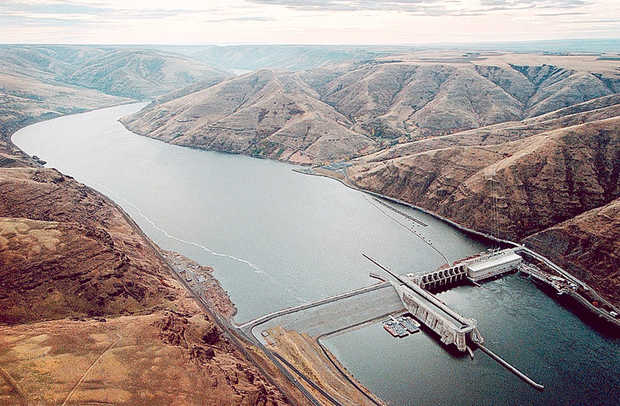 U.S. District Court Judge Michael Simon has mostly agreed to plaintiffs' requests to increase spill over dams and lower reservoir levels on the Columbia and Snake rivers, in an injunction issued Feb. 25 in Oregon District Court.
Stakeholders say the order will further hamper navigation on the rivers, but somewhat tempers impacts to power users and irrigators.
Environmental and recreation groups asked the court in October to order the emergency measures to benefit endangered salmon and steelhead.
The court on Feb. 6 asked parties to attempt to compromise within a two-week window on "practical implementation options" for the injunction, for 2026 operations.
"The changes to the hydropower system ordered by the court today are immediate and reasonable steps to prevent salmon extinction," Earthjustice attorney Amanda Goodin said in a press release. "Salmon need help now and we're encouraged the court has granted immediate, commonsense relief that will help protect imperiled Northwest salmon and steelhead."
Overall, the ruling increases the risk of harm to infrastructure, listed species, and public safety while failing to provide substantiated evidence that there will be benefits to listed salmon and steelhead, according to the Washington Association of Wheat Growers.
"We believe the court order to increase spill and lower reservoir elevations is simply manipulating the river system in a way that will appease environmental activists, but in the long term, threaten the overall viability of the Columbia-Snake River System," Michelle Hennings, WAWG executive director, said in a statement.
Fish survival
"Given the current record, it is reasonable to conclude that the listed species' prognosis is as bad as -- or worse than -- it has ever been," Simon writes in the injunction.
Many of the populations listed have reached the "quasi-extension threshold," with a population of 50 or fewer natural-origin spawners for four consecutive years, with others on trend to reach that threshold within a few years, he writes
"This places the species at an alarming risk for extirpation," Simon writes. ".. the Court rejects Defendants' arguments that a few intermittent strong returns means the species are improving or on the road to recovery."This places the species at an alarming risk for extirpation," Simon writes. ".. the Court rejects Defendants' arguments that a few intermittent strong returns means the species are improving or on the road to recovery. ... When returns and abundance levels are at historic lows, a slight increase for one or two years says little about a species survival or recovery."
Simon noted that defendants raised concerns relating to power system reliability, flood risk, transportation, irrigation and availability of water supplies and clean drinking water.
"Many of those concerns appear ameliorated by the Court's imposition of a injunction at Minimum Irrigation Pool, instead of Plaintiff's requested injunction at Minimum Operating Pool," Simon writes.
Navigator response
"By this judge ordering these conditions, it's further hampering and restricting our operations," said Neil Maunu, executive director of the Pacific Northwest Waterways Association. "This injunction limits the flexibility of the U.S. Army Corps of Engineers and the fish biologists to manage the system for what's best for navigation, fish and river users."
Plaintiffs "have failed to show quantifiable evidence that this regime will help salmon and steelhead," Maunu added.
River-users are concerned about potential safety problems for barges entering and exiting navigation lock chambers under the ordered spill conditions and levels, Maunu said.
Any operational changes ordered by the courts should be physically modeled at the U.S. Army Corps of Engineers research facility to ensure changes will be safe for navigation and actually benefit fish species, PNWA's Inland Ports and Navigation Group stated in a press release.
Maunu said it is "extremely likely" the federal government will appeal the order. IPNG is weighing its options.
"It is most definitely on the table," he said.
Electricity
The court's order incorporates "a few important reasonable operational approaches" proposed by the Public Power Council that serve to "somewhat temper" its ramifications, according to the council.
PCC's concerns were "partially reflected" in certain parts of the order, including limits on additional spill at specific cites, reliance on previously implemented operating levels and built-in flexibility for emergency conditions.
Scott Simms, council CEO and executive director, said the system could "potentially be hobbled" in terms of electricity production, with increased possibility of blackouts and higher rates for electricity users.
"The Northwest is already in a place where it needs more generating resources, not fewer," Simms said. "Any time we hobble or otherwise constrain a generating resource, we're talking about increasing the spectre of risk for a reliability event, otherwise known as a blackout."
The council is considering all of its options regarding an appeal and will coordinate with federal defendants, Simms said.
Minimum irrigation pools
Simon told stakeholders Monday that he intended to do a partial approval of injunctive relief in favor of the plaintiffs, but would not rule to minimum operating pools on reservoirs, instead ruling to minimum irrigation pools, said Darryll Olsen, board representative for the Columbia-Snake River Irrigators Association.
"That's all we asked for," Olsen said. "The minimum operating pool is not a normal operation. That is only used for emergency conditions, such as flood control. That's the only time it's ever been down at that level."
Olsen found Simon's potential ruling "favorable" for ag.
"It's a solid ruling where the judge paid attention to what we were telling him," Olsen said.
The judge noted that differences in fish survival appeared "negligible" between minimum operating and minimum irrigation pools, but that the minimum operating pool did cause damage to irrigators and others, Olsen said.
There have been no empirical measurements of fish survival in the pools, only under normal operations, Olsen said.
The University of Washington in the 1990s estimated survival increase could be between 0% and 2% within a particular pool, not across the entire system, he said.
Spill levels
Simon granted requests to set spring spill at the same levels as in 2024 and 2025 and extended the level of spill previously applied for eight hours at night at John Day Dam to the full 24 hours.
For summer spill, plaintiffs requested the same level implemented in 2024 and 2025, and more spill at John Day and Ice Harbor dams, rejecting objections and suggested revisions raised by the federal government.
For fall and winter spill, "Plaintiffs request more spill, spill for longer hours and spill for more days, in various combination, at the dams," Simon writes. "... the Court finds that expanding fall and winter spill will provide immediate benefit to the listed species."
Personal declarations
Simon rejected the federal defendants' argument that plaintiffs as individuals "would not suffer irreparable harm and thus cannot claim generalized harm to the species" by sharing several personal declarations submitted by the plaintiffs.
Liz Hamilton, the policy director of Northwest Sportfishing Industry Association, "described her long history of fishing on the Columbia River, and noted her ongoing harm from reduced salmon, including with bringing her grandchildren to fish and being required to take multiple trips before they got their first catch due to reduced salmon in the river, and needing to stay longer on fishing trips (with the associated extra cost) when salmon abundance is low," Simon cites. "She 'connected her injuries to the anticipated irreparable injuries to salmonids from dam operations,' by describing how operations are anticipated to reduce salmon populations and how fewer salmon make it difficult to fish."
In another submitted declaration, Joseph Bogaard, executive director of Save Our Wild Salmon, "explains that his family regularly boats, camps, and swims in and along the rivers within the Columbia Basin. He describes 'the immense beauty and power of seeing adult salmon and steelhead returning from the ocean in search of their natal spawning gravels.' ... He describes how the loss of the salmonids in the Columbia Basin affect his enjoyment of the area and that these fish represent a 'special and irreplaceable part of the fabric of the areas where I recreate.' He further notes that he used to fish but has not done so in years because of the decline in salmonid populations."
Bull trout
Simon noted that federal defendants voiced concerns about the injunction's effect on another endangered species, the bull trout.
"Simply weighing the number of species, the lone bull trout to the 14 listed species weighs in favor of protecting the many over the one," Simon writes. "More importantly, the relief sought for the salmon and steelhead tracks the best practices articulated in this case's quarter-century-long record. The record about the potential impacts to bull trout is limited, deeply contested, and less well-established. The Court also can infer from the bull trout's current existence that it has survived past dam operations that are similar to those that Plaintiffs now want the Federal Defendants to implement. ... Consideration of another listed species does not require denial of requested relief."
Trump revoke
Olsen noted that the litigation settlement agreement reached in 2024, approved by Simon, called for no Lower Snake River Dam breaching decisions for five to 10 years or other critical changes to mainstem operations.
Many stakeholders at the time protested that they had been kept out of negotiations between the Tribes, plaintiffs and the federal government under the Biden administration.
The Trump administration's revoking of that agreement in June 2025 was "an extremely bad decision and bad judgement," Olsen said.
"The other regional industries should not have been pushing for that," Olsen said. "This is what we got instead."
Related Pages:
Opinion and Order by Judge Michael H. Simon, February 25, 2026
learn more on topics covered in the film
see the video
read the script
learn the songs
discussion forum