forum
library
tutorial
contact

Irrigators Ask Judge to Deny
John Day, McNary Pool Drawdowns
by K.C. Mehaffey
NW Fishletter, January 7, 2026
|
the film forum library tutorial contact |
|
Irrigators Ask Judge to Deny
by K.C. Mehaffey
|
The reservoir drawdowns being sought would have irrigators spending $100 million to $200 million to retrofit pumps.
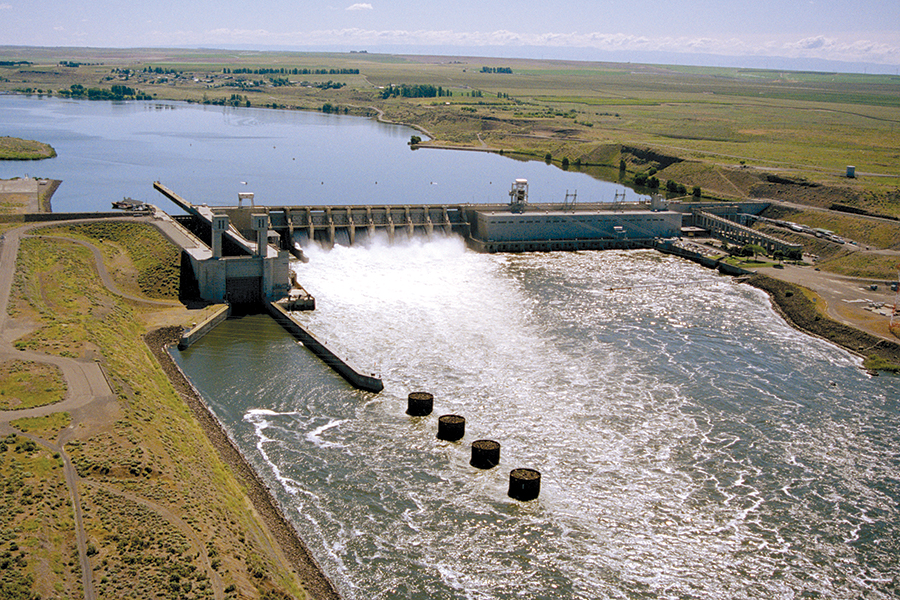 The Columbia-Snake River Irrigators Association claimed that dropping John Day and McNary reservoir elevations to minimum operating pools (MOP) would severely disrupt pumping at 40 stations serving 400,000 acres of farmland. CSRIA also said that the potential benefits of the drawdowns to fish have never been measured or demonstrated.
In a filing submitted Dec. 11, the group asked District Judge Michael Simon of the U.S. District Court for the District of Oregon to deny the drawdowns requested by plaintiffs through a motion for preliminary injunction in the revived lawsuit over Columbia River System Operations.
CSRIA, an intervenor-defendant, is the first to file an opposition memo to the Oct. 14 motions for preliminary injunction sought by 10 nonprofit organizations and the State of Oregon in the decades-long lawsuit, National Wildlife Federation et al. v. National Marine Fisheries Service et al.
In addition to higher spill and other measures, the plaintiffs are asking Simon to reduce the operating elevations at John Day and McNary reservoirs, which would lower the levels at all the pumping stations by 6 feet or more, Darryll Olsen, CSRIA board representative, said in a declaration filed with CSRIA's request to deny the drawdowns.
With that level of drawdowns, irrigators would have to spend $100 million to $200 million to retrofit pumps and an additional $10 million to $20 million annually to compensate for increased costs of pumping and maintenance. Engineering and economic analyses are needed to more closely assess the costs, Olsen said.
"[T]he purely theoretical benefits to listed species from changes in operating levels should not outweigh the definite harms that will result to human interests from changes to reservoir elevations," the irrigators argued.
In his declaration, Olsen said that dropping reservoirs to elevations that are 2 or 3 feet below the current minimum irrigation pool levels would have far fewer impacts.
CSRIA's response said that it would take until 2029 to develop a plan to address irrigation issues that would arise if the reservoirs are lowered to the requested minimum operating levels, and it suggested that it may be possible to develop an interim plan with smaller drawdowns more quickly.
In its filing, CSRIA noted that it supported the Dec. 14, 2023, memorandum of understanding between the plaintiffs and federal defendants, which led to a stay in litigation for between five and 10 years. "The President's ill-advised decision to repudiate the MOU has understandably caused Plaintiffs to reactivate their request for preliminary injunctive relief concerning dam operations," CSRIA said.
Olsen noted that CSRIA was the only industry group to support the MOU, and that the group did not support President Donald Trump's decision to withdraw from the agreement.
"[T]he renewed litigation simply 'punishes' all parties, including a key stakeholder who supported the litigation stay," Olsen said.
He said the potential incremental benefits to salmon of lowering the reservoirs from irrigation pool levels to MOP are based on assumptions about water particle travel times that are correlated to survival within pools. "There have never been empirical observations to validate the 'correct' correlations or survival improvements -- none," he said.
Olsen said that estimates of the possible improvements to juvenile salmon survival were developed through modeling between 1990 and 2000, with a range of improvement to survival rates in the John Day pool alone of between 0 and 2 percent.
The potential for improved survival may also be offset by other factors in the hydro system. "Smolts avoiding predators in the John Day pool may be eaten downstream, changes in rearing areas (for both fish and birds) may have adverse effects, and there may even be stranding losses as reservoir levels fall -- all highlighting the importance of gathering empirical data on changes in survival associated with the specific remedy requested by Plaintiffs," CSRIA's filing states.
Olsen also noted that the difference in salmon and steelhead survival rates in these two reservoirs at MOP levels are overshadowed by other factors in their life histories, especially the ocean environment.
"Finally, should this Court consider ordering relief addressing operational levels -- and it should not -- the Court should recognize the complexity and time required to address impacts to irrigated agriculture," CSRIA's response concludes.
learn more on topics covered in the film
see the video
read the script
learn the songs
discussion forum