the film
forum
library
tutorial
contact
|

|
More Briefings Filed in Support of Injunction Calling for
Operational Changes at Columbia/Snake Dams to Protect Salmon, Steelhead
by Staff
Columbia Basin Bulletin, November 5, 2025
|
11% of Idaho's Spr/Sum Chinook have abundance levels at or below Quasi-Extinction threshold;
a third were below 50 natural origin spawners in 2023 and 2024. Half have already been extirpated.
 The state of Washington and Columbia River tribes are lining up in U.S. District Court to support a request for a preliminary injunction filed Oct. 14 by Earthjustice seeking emergency operational changes at federal Columbia and Snake river dams aimed at protecting endangered salmon and steelhead from harms caused by dam operations.
Earthjustice said the proposed "science-based measures" will improve salmon survival as they migrate past dams and reservoirs in the Columbia and Snake rivers. The changes include increased spill, which allows juvenile fish to pass over the dams instead of through turbines, and lowered reservoir elevations, which decreases the time salmon spend migrating through stagnant, overheated waters.
"This case is not just about salmon -- it's also about justice and a way of life," Earthjustice wrote in a recent online briefing. "The Trump administration's decision to tear apart this carefully crafted agreement is another dark chapter in the federal government's history of betraying Tribes. The salmon populations our lawsuit seeks to restore are key to the region's ecosystem, economy, and Tribal culture."
Earthjustice represents plaintiffs National Wildlife Federation along with the state of Oregon and Nez Perce Tribe. Washington filed an Amicus brief in support of the plaintiffs' preliminary injunction on Oct. 22.
Earthjustice and the plaintiffs are also asking the court to approve a set of emergency conservation measures for what they say are some of the most imperiled populations that are on the brink of collapse. These include removing passage barriers slowing the migration of Tucannon River spring Chinook, a population that is rapidly approaching extinction, as well as increasing federal efforts to control predators like invasive walleye and some birds that prey on salmon and steelhead.
The preliminary injunction with its emergency measures would likely not have been needed if the federal government had not altered course and reneged on a Biden-era Memorandum of Understanding between plaintiffs and the U.S. government, according to court documents.
The MOU, signed in December 2023, known as the Resilient Columbia Basin Agreement (RCBA), was to be effective through 2028 and was designed to restore Columbia River basin salmon and steelhead runs to "healthy and abundant levels."
Oregon District Court Judge Michael H. Simon had approved a stay in the original and long-running lawsuit that challenged NOAA Fisheries' 2020 biological opinion and U.S. Army Corps of Engineers' Environmental Impact Statement and Record of Decision as long as the agreement was in place.
However, the Trump Administration on June 12 revoked the agreement and notified the partners in the MOU in a June 24 letter. Plaintiffs in the case went back to the U.S. District Court in Oregon to ask the court to lift the stay and resume the court case that had been on pause for nearly two years
"For the Nez Perce Tribe--for the Nez Perce people--the circumstances necessitating a return to this Court are disgraceful," the Nez Perce Tribe wrote in its memorandum to the court supporting the emergency injunction. "Endangered and threatened Snake River salmon and steelhead are essentially no better off today than when they were listed under the Endangered Species Act (ESA) over thirty years ago. A distressing number of populations are at or below critical abundance thresholds and others are on the literal brink of extinction."
Although it has the power to help solve the problem, the Tribe said that the federal government instead "cynically returned to past games and tricks that this Court and the Ninth Circuit squarely rejected in prior BiOps."
"Rather than make good on the hopeful commitments of the 2023 Resilient Columbia Basin Agreement, which took all river users into account, the United States has withdrawn from the agreement and once again broken its word to the Tribe and the entire Pacific Northwest, both of which are defined by the very salmon and steelhead at the heart of this lawsuit."
There is no time left, the Nez Perce memorandum said, calling on the court to intervene and supporting the plaintiffs in their call for a preliminary injunction for new operational changes at dams.
Jay Hesse, the Tribe's Director of Biological Services, said in testimony that "the abundance of ESA-listed wild-origin salmon and steelhead returning annually to the Snake River Basin has not appreciably changed since their ESA-listing in the 1990s."
Half have already been extirpated and nearly all the remaining populations remain below minimum abundance thresholds with no indication of reaching those thresholds anytime soon, he said.
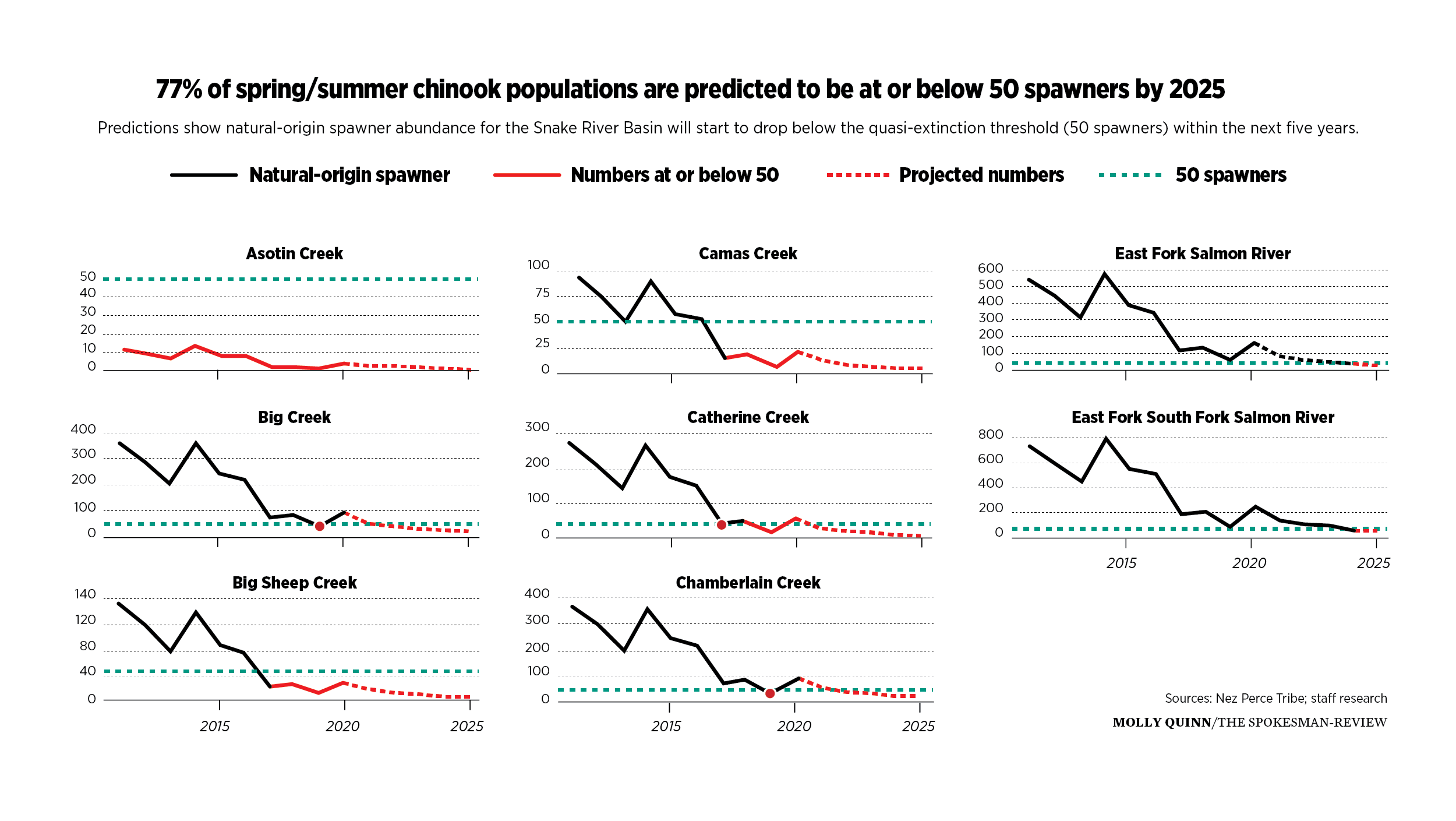
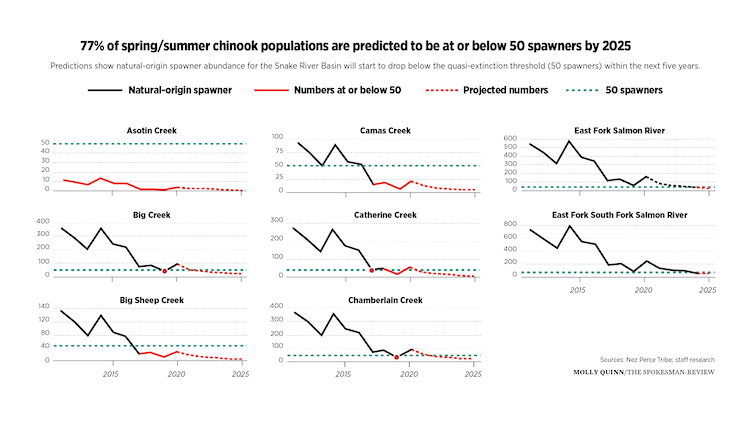
In its quasi-extinction thresholds (QET) analysis, the Tribe concluded that 11 percent of Snake River spring summer Chinook already have abundance levels at or below QET (50), and a third of the existing Snake River spring-summer Chinook populations were below 50 natural origin spawners in 2023 and 2024.
The QET describes a population that is at a point where its persistence is uncertain and its extirpation is possible; the threshold is met when the population has 50 or fewer natural-origin spawners for four consecutive years, the Tribe said.
"But the situation is that much more dire because abundance trends show an average annual rate of decline of six percent (-6%) across all Snake River spring-summer Chinook populations over the past ten years, with many on even more calamitous trajectories (e.g., annual rate of decrease of fourteen percent (-14%) for Lower Snake Major Population Group (MPG) (Tucannon Group))," the Tribe said. "With these trends, by 2029, 41% of Snake River spring-summer Chinook populations are predicted to be at QET (50) or to have begun the 4-year count for QET(50).
"Due to these disturbing abundances and downward trends, the prognosis is bleak for ESA-listed Snake River salmon and steelhead without urgent action."
Although it has not challenged the preliminary injunction in court, nearly two weeks ago the Inland Ports and Navigation Group said the changes to spill and reservoir levels that plaintiffs are calling for are a danger to people and navigation that would result in disruptions in the flow of commerce "that has a highly destructive impact on our communities and economy."
"This injunction is short sighted; increasing spill comes at an incredibly steep cost to navigation, freight movement, agriculture and the communities dependent on this river system," said Executive Director Neil Maunu.
Plaintiffs are forcing people to trade safety, reliability, and the climate against a highly debated strategy of increasing spill on a system that already sees a high percentage of fish survival rates through the dams, IPNG said.
Filing as a friend of the court participant lining up with the plaintiffs, the state of Washington said in an Oct. 24 brief that it is fully-supportive of the preliminary injunction filing. The current BiOp "fails to adequately address the substantial impacts of the federal hydropower system on salmon and steelhead, and it would likely lead to the extinction of some populations while irreparably harming others."
"When Federal Defendants removed themselves from the MOU they upended a comprehensive basin-wide approach to salmon and steelhead recovery through a whole-of-federal-government approach aimed at restoring healthy, abundant salmon and steelhead populations ..."
Washington said that there are actions the federal hydro system operators must take now to protect ESA-listed salmon and steelhead from this higher risk of extinction.
"The hydropower operation changes and essential conservation actions requested by the Plaintiffs will improve survival of all ESA-listed interior Columbia River salmon and steelhead species," Washington concluded in its brief. "With these changes, key ESA-listed salmon and steelhead have a better chance at persisting until this case is resolved and an effective, long-term recovery strategy is back in place."
A week prior to Washington's filing, the Public Power Council, an organization representing most of Washington's public utilities, urged Washington Gov. Bob Ferguson in a letter to oppose both the reopening of the BiOp litigation case and to oppose the emergency operational changes at the dams proposed in the preliminary injunction. PPC said that "The federal court case could set back clean energy transformation and we believe there are better ways for the state and region to advance the cause of salmon recovery than in a courtroom."
It added that just in the past few years, Washington utilities have gone from having the lowest retail electricity rates in the nation to "barely remaining in the Top 10."
"The region's backbone for maintaining affordability and reliability, as well as meeting Washington state's greenhouse gas emissions targets, is our fleet of hydroelectric resources," PPC's letter says. About 60 percent of Washington's electricity is generated from hydropower and "reliable, clean, and affordable hydropower, provide essential irrigation and cargo transportation, support municipal water and wastewater treatment facilities, and have helped establish a significant recreation economy."
Although the Resilient Columbia Basin Agreement did not call for the removal of the four lower Snake River dams, it did provide for the studies and economic underpinnings that would have made their removal possible.
And Earthjustice seems to believe that would have been the eventual outcome. In its online briefing, it said "Put simply, the agreement brought all the stakeholders together and was a promising step toward breaching the four dams on the Lower Snake River, where every salmon population is currently threatened or endangered."
Filing as amicus curiae, the Confederated Tribes and Bands of the Yakama Nation, which owns and operates Yakama Power, which delivers electricity to more than 3,000 customers within the Yakama Reservation, and is the only tribal electric utility in the regional Public Power Council, takes another view of public power and the need for the lower Snake River dams.
The "Yakama Nation understands the challenges of competing interests in our modern world, even as it works tirelessly to protect its fundamental First Foods from extirpation," the Tribe said in support of the plaintiffs' preliminary injunction.
Citing their Treaty-reserved fishing rights obtained in 1854 to retain half the salmon and steelhead in the Columbia River system (a portion affirmed in a 20th century court decision), the Yakama Tribe said that "Courts have also affirmed that Treaty-reserved fishing rights carry an inherent right to protection of the fish from man-made despoliation because a fundamental prerequisite to exercising the right to take fish is the existence of fish to be taken."
However, those fishing rights are now constrained by non-tribal development, such as the federal Columbia and Snake river dams, and runs of salmon and steelhead are in steep decline.
"Although Yakama Nation is not responsible for the decline of Columbia River fisheries, its Members are made to bear this conservation burden," the Tribe said.
"Today, in light of the federal government's abandonment of the Fish Accords (the Bonneville Power Administration notified tribes that the Fish Accords would expire in Sept. 2025) and RCBA, the continued deterioration of ESA-listed salmon and steelhead populations, and Yakama Nation's substantial concerns regarding the sufficiency of the 2020 BiOp and 2020 ROD, Yakama Nation appears before this Court in alignment with the Plaintiffs," the Tribe said in its court filing.
"Yakama Nation supports Plaintiffs' claims that the 2020 BiOp and 2020 ROD fail to satisfy ESA requirements, and concurs that the preliminary injunctive relief requested by Plaintiffs is both necessary and appropriate to prevent further irreparable harm to Columbia Basin fish and to Yakama Nation Treaty-reserved fisheries resource," the Tribe concluded.
The debate via court briefs began over a month ago when Simon lifted the two-year old stay on long-running litigation challenging the federal EIS and BiOp (Sept. 11) and set a court schedule that again sets the legal battle in motion.
However, a day after the federal shutdown went into effect, federal defendants filed a motion to stay or pause the court's schedule, saying that the appropriations act that had been funding the Department of Justice, which is representing NOAA Fisheries and the U.S. Army Corps of Engineers in the case, had expired and Department of Justice funding had "lapsed." The government shutdown began Oct. 1 and has continued through October.
Simon denied the request Oct. 14 to delay the proceedings and set a new schedule to continue the court case. On the same day, plaintiffs filed the motion for the preliminary injunction.
In that order, Simon said that "the potential harm from granting a stay is substantial. As this Court is aware, salmon and steelhead in the Columbia Basin are in "a perilous state" and have been so for many years now."
The new schedule includes: Oct. 15 -- Any motions for a preliminary injunction filed by a party, and all supporting papers; Oct. 22 -- Any amicus filing in support of such motion, and all supporting papers, shall be filed.
To: Committee on Natural Resources Republican Members
From: Subcommittee on Oversight and Investigations Staff
Subject: Oversight Hearing titled "Examining Systemic Government Overreach at CEQ"
Date: Thursday, September 14, 2023
The Subcommittee on Oversight and Investigations will hold an oversight hearing titled, "Examining Systemic Government Overreach at CEQ" on Thursday, September 14, 2023, at 10:00am EDT in room 1324 Longworth House Office Building.
Member offices are requested to notify Cross Thompson by 4:30 p.m. on September 12, 2023, if their Member intends to participate in the hearing.
I. KEY MESSAGES
President Biden has transformed the once small Council on Environmental Quality (CEQ) staff from their core mission of ensuring compliance with the National Environmental Policy Act of 1969 (NEPA) into a legion of frontline warriors for implementing radical social change and eco-justice initiatives across the federal government.
CEQ's role in implementing executive orders and rulemaking vastly exceeds its statutory role and prescribed authority.
It is imperative for CEQ to abide by the Fiscal Responsibility Act's significant NEPA and permitting reforms -- reforms that will make it faster and easier to build critical infrastructure projects and reduce the burden on taxpayers by creating efficiencies in the permitting process.
The recent NEPA Phase Two Proposed Rulemaking issued by CEQ ignores significant NEPA reforms of the Fiscal Responsibility Act -- specifically those aimed at reducing the scope of NEPA reviews -- and undercuts the White House's agreement with Congress.
CEQ was invited to testify at this hearing but declined to appear. CEQ's willful disregard for Congress and the rule of law impacts all Americans -- from the cost of heating and cooling our homes to small and large businesses, their impact has no bounds.
. . .
f. CEQ's involvement in the Lower Snake River Dams
The Lower Snake River Dams in the Columbia River Basin and Washington state were authorized by Congress in 1945 and have the capacity to supply 3,000 megawatts of carbon- free energy. Particularly during periods of high demand, the Lower Snake River Dams help to keep the Pacific Northwest power system reliable, even during emergencies. Additionally, the Lower Snake River Dams play a critical role in reducing transportation emissions. Between 50 and 60 million tons of cargo are transported through barges along the river each year and forty percent of America's wheat transits through the system.
Despite the immense importance of the Lower Snake River Dams, and continuous work to improve fish passage rates, radical eco-activist groups have abused the litigation system for decades in pursuit of dam removal. Simultaneously, the Biden administration has attempted to circumvent Congress by betraying previous federal actions supporting the continued operation of the Lower Snake River Dams and is instead heeding calls for breaching the dams.
Those in favor of breaching the Lower Snake River Dams often fail to recognize, and/or ignore, the value of the Lower Snake River Dams and the cost of replacement. In 2016, the Bonneville Power Administration (BPA) estimated that replacing the dams would increase power costs by $274 million to $372 million per year. Six years later, in 2022, BPA commissioned a study by a San Francisco environmental consulting firm, Energy + Environmental Economics ("E3"), which found that the cost of replacing the output from the Lower Snake River Dams ranges from $415 million to $860 million per year through 2045. Moreover, under assumptions from litigants supporting breaching the Lower Snake River Dams, up to 1.2 terawatts (or 1,200,000 MWh) would depend on technologies not yet readily available, such as hydrogen-fueled combustion turbines.
In 2020, the federal government released a Record of Decision (ROD) on the operations for the Columbia River System, which includes the Lower Snake River Dams. The ROD did not endorse dam breaching, stating that while breaching may benefit "some species of ESA-listed fish, it would achieve those benefits at the expense of not meeting the other components of the agencies' Purpose and Need Statement for certain EIS objectives." Shortly thereafter, Earthjustice, the National Wildlife Federation, and other eco-groups, sued the federal government to challenge the ROD.
Instead of aggressively defending the official position of the federal government, the Biden administration, notably CEQ, has sought to appease the calls to breach the Lower Snake River Dams and has shown favoritism to the plaintiffs in confidential negotiations. In 2021, the federal government, the State of Oregon, the Nez Perce Tribe, and plaintiffs to the litigation filed an agreement with the U.S. District Court that outlined how dam operations would be altered in the coming year while allowing for parties to reach further agreement on long-term operations.
Shortly thereafter, in March 2022, CEQ published a blog outlining a "path forward" for the Columbia River Basin following a consultation between agencies and Tribes of the Columbia River Basin. The blog post specifically supported a policy of breaching the four dams on the lower Snake River, contradicting the 2020 ROD on the operations of the Columbia River Basin system. At the same time, CEQ engaged the Federal Mediation and Conciliation Service (FMCS) to "mediate and facilitate between the parties in the litigation and the regional sovereigns, including Tribal Nations and states." FMCS, on behalf of CEQ, announced public listening sessions for the public.
While the mediation process is confidential, many of the defendants have expressed deep reservations and considerable disappointment regarding the overall mediation process. Of particular concern is the Biden administration's apparent push to forgo trying to reach a "consensus" resolution and instead advance a predetermined outcome of dam removal. At the end of August, the U.S. District Court extended the stay in the long-running litigation to allow the mediation to continue until the end of October. Stakeholders expressed dismay with the mediation process, the Biden administration's favoritism towards the eco-activist plaintiffs, and the role of CEQ.
IV. CONCLUSION
President Biden has transformed CEQ's role from overseeing NEPA compliance to the entity charged with implementing his radical eco-agenda, remaking federal agencies as vehicles of social change, and leading the war on domestic energy production. A bureaucratic morass of various agencies, offices, and councils report to and take directions from CEQ. At the same time, CEQ's role in implementing executive orders and rulemaking vastly exceeds its statutory role and prescribed authority. It is imperative for CEQ to abide by the Fiscal Responsibility Act's significant NEPA and permitting reforms -- reforms that will make it easier to build in America, speed up timelines for critical infrastructure projects, and reduce the burden on taxpayers by creating efficiencies in the permitting process. Sadly, the recent NEPA Phase Two Proposal from CEQ ignores significant NEPA reforms of the Fiscal Responsibility Act, specifically those aimed at reducing frivolous environmental lawsuits and betrays the White House's agreement with Congress.
Staff
More Briefings Filed in Support of Injunction Calling for Operational Changes at Columbia/Snake Dams to Protect Salmon, Steelhead
Columbia Basin Bulletin, November 5, 2025
See what you can learn
learn more on topics covered in the film
see the video
read the script
learn the songs
discussion forum