forum
library
tutorial
contact

Indirect Effects of Impoundment
on Migrating Fish
by Christopher Caudill et al.
PLOS Water, December 2013
|
the film forum library tutorial contact |
|
Indirect Effects of Impoundment
by Christopher Caudill et al.
|
Subtitle:
Temperature Gradients in Fish Ladders Slow Dam Passage
by Adult Chinook Salmon and Steelhead
 ABSTRACT
Thermal layering in reservoirs upstream from hydroelectric dams can create temperature gradients in fishways used by upstream migrating adults. In the Snake River, Washington, federally-protected adult salmonids (Oncorhynchus spp.) often encounter relatively cool water in dam tailraces and lower ladder sections and warmer water in the upstream portions of ladders. Using radiotelemetry, we examined relationships between fish passage behavior and the temperature difference between the top and bottom of ladders (deltaT) at four dams over four years. Some spring Chinook salmon (O. tshawytscha) experienced deltaT >= 0.5 oC. Many summer and fall Chinook salmon and summer steelhead (O. mykiss) experienced deltaT >= 1.0 oC, and some individuals encountered deltaT > 4.0oC. As deltaT increased, migrants were consistently more likely to move down fish ladders and exit into dam tailraces, resulting in upstream passage delays that ranged from hours to days. Fish body temperatures equilibrated to ladder temperatures and often exceeded 20oC, indicating potential negative physiological and fitness effects. Collectively, the results suggest that gradients in fishway water temperatures present a migration obstacle to many anadromous migrants. Unfavorable temperature gradients may be common at reservoir-fed fish passage facilities, especially those with seasonal thermal layering or stratification. Understanding and managing thermal heterogeneity at such sites may be important for ensuring efficient upstream passage and minimizing stress for migratory, temperature-sensitive species.
River impoundment has strong direct and indirect effects on river corridors used by migrating fishes. The most direct effect is blocked passage of migrants. However, fishways provide upstream routes at many dams, and a large body of research has focused on attracting fish to fishway openings and providing suitable hydraulic conditions to allow dam passage [1-4]. Dams additionally affect fish behavior and physiology in the migration corridor by altering water temperature [5-7], dissolved gas concentrations [8,9], and other physiochemical conditions both upstream and downstream from the dam [10]. Temperature alteration is of particular concern because temperature plays a central role in regulating fish physiology, behavior, and survival [11-13]. Relative to free-flowing systems, upstream-migrating fish in impounded systems may encounter much warmer or cooler thermal environments, increased thermal heterogeneity, and potential thermal barriers.
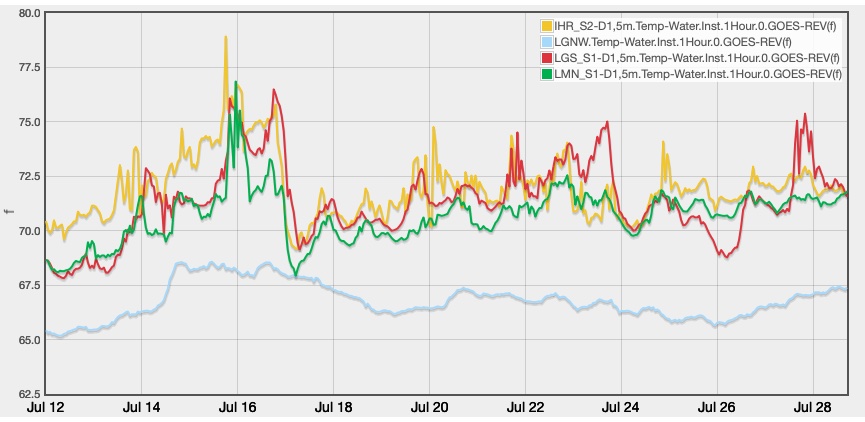
Reservoirs can increase water residence time and solar gain, accelerate spring warming, and delay fall cooling [14,15]. Importantly, reservoirs may also create vertical gradients in temperature caused by thermal layering or stratification in an otherwise well-mixed water column [16]. Thermal conditions in dam tailraces and reaches farther downstream can primarily be determined by reservoir surface water if releases are made over the dam spillway, or may be cooled by the release of hypolimnetic waters, as is the case for many hydroelectric dams drawing water through turbines [17]. Vertical temperature gradients in the reservoir result in thermal stratification that prevents mixing between layers or less distinct “thermal layering”, a precursor to full stratification. Such thermal gradients affect the temperature environment of fishways and fish ladders (the portions of most fishways that gain elevation) at dams. At most run-of-river Columbia and Snake River dams (Washington-Oregon), well-mixed water from dam tailraces is pumped into lower fishway segments, but upper sections of ladders are gravity-fed from seasonally warmer surface water in dam forebays (Figure 1 inset).
Dams in the Snake River basin (Figure 1) have altered the overall thermal environment of the lower Snake River in several ways. Based on limited pre-dam data, it appears that mean annual temperatures and maximum temperatures have not dramatically changed, but the timing of spring warming has advanced and fall cooling has been delayed. The larger dam-related alteration of the summer thermal regime is produced by cold water released from the hypolimnion of Dworshak Reservoir on the Clearwater River, Idaho [16]. The Dworshak releases have occurred since 1991 in an effort to improve passage conditions for migrating juvenile and adult Pacific salmonids (Oncorhynchus spp) and have reduced summer mean temperatures. However, these releases have contributed to thermal layering in the reach between the Snake River-Clearwater River confluence and Lower Granite Dam [16]. In all four lower Snake River reservoirs, increased water residence times and solar heating cause additional thermal layering, especially in dam forebays. Prevailing upstream summer winds reinforce the layering by further slowing the movement of surface water masses. Such wind setup events can result in stratification and net transport of warm masses upstream over a deeper water mass moving downstream. The strongest stratification has been observed at Lower Granite Dam in summer, where forebay surface waters are often several degrees warmer than relatively well-mixed tailrace water. This pattern repeats at the dams farther downstream, but generally with smaller thermal gradients between the forebay and tailrace [18].
In this study, we examined the relationship between fish ladder temperature gradients at the four lower Snake River dams and passage behavior of several thousand radio-tagged adult Chinook salmon (O. tshawytscha) and steelhead (O. mykiss). Our primary objectives were to: (1) characterize water temperature differences (deltaT) between base-of-ladder and top-of-ladder segments; (2) test for associations between deltaT and adult salmon and steelhead passage times through fish ladders; and (3) examine the relationship between internal fish body temperatures (estimated with combination radio-temperature logger tags) and fish ladder water temperatures. The collected data were sufficient to affirm our two principal hypotheses: (1) that fish passage time would increase as deltaT increased; and (2) that fish body temperatures would equilibrate to ambient temperatures prior to fish ladder exit into a dam forebay.
. . .
Results indicate that ladder temperature gradients can create a migration obstacle that slows adult salmon and steelhead passage at Snake River dams. While many adults passed during periods of low deltaT, approximately one quarter to one third of the adults in some runs experienced deltaT > 1.0oC. Positive deltaT > 1.0oC was consistently associated with longer radio-tagged fish passage times, confirming our first hypothesis. Fish body temperatures also increased with deltaT during ladder passage, confirming our second hypothesis and suggesting that some adults experienced a departure from their acclimation temperature during dam passage. During the warmest mid-summer river conditions, the additional thermal exposure associated with high deltaT may introduce a heat shock risk [34,35] for adult migrants. This risk may be elevated at Lower Granite Dam, where the frequency and magnitude of positive deltaT was highest.
The passage delays we recorded were primarily linked to fish exiting the fishways back to the tailrace and then re-entering. Similar behavior was observed in radio-tagged Chinook salmon, sockeye salmon, and steelhead at John Day Dam (lower Columbia River) as ladder water temperatures increased (this study, unpublished data). Both cases suggest that adult salmonids perceive a cost to ascending ladders when encountering high ladder deltaT because they slow or reverse upstream movement or search for other routes.
The general correlation between river temperature and deltaT suggested that river temperature rather than ladder deltaT might explain a portion of the observed behaviors, i.e., that adults were responding to the overall temperature environment and not to ladder temperature gradients per se. For example, passage rate through ladders may have slowed at temperatures above the thermal optimum. Clearly, unequivocally separating these effects in an observational study is impossible. However, at least two lines of evidence suggest that mean river temperature was not solely responsible for the slowed migration rates observed at dams. First, ladder deltaT values frequently exceeded 1oC at the 15-18oC river temperatures thought to be optimal for adult swimming [11,32]. Second, examination of tailrace passage times prior to ladder entry in relation to deltaT (results not shown) provided no evidence of spurious correlations. If high river temperatures were correlated with both large deltaT and slowed swimming/dam passage, we would expect to observe both relatively slow tailrace passage and slow ladder passage during large deltaT conditions. Instead, the only significant associations between deltaT and tailrace passage time suggested that swim speeds increased and tailrace passage times decreased during conditions causing higher deltaT (spring Chinook at Little Goose). Operation of the adult trap at Lower Granite Dam may also have affected adult passage behavior at this dam, but the trap was not operated at the warmest ladder temperatures. Trap operation was a potentially confounding factor, but we would expect faster fish passage when the trap was idle, and hence our conclusions at this site were conservative.
How ladder deltaT affected adult physiology, survival, or reproductive success remains unknown. The body temperature of adults during many passage events at individual Snake River dams occurred at temperatures thought to be physiologically stressful to adult salmonids [12,13]. The additional time fish spent passing dams also may have had adverse effects including increased potential for expression of heat shock protein [34], disease susceptibility [36,37], impaired ovulation [38], increased levels of stress hormone [39], and decreased migration success [24,40]. During the warmest periods, additional passage time and increased temperatures at the top of ladders probably combined to increase potential effects as adults swam near metabolic thresholds, further stressing fish and potentially increasing susceptibility to disease. It remains unknown whether the short-term increases in body temperature (Figure 6) or exposures to high temperature at multiple dams affected subsequent migration success to spawning tributaries, survival during holding and spawning periods or other aspects of the fitness of delayed fish because our monitoring was focused on the impounded system. The potential for cumulative effects of slowed migration and physiological stress seems plausible because nearly all adults entering the Snake River must pass four dams prior to reaching natal tributaries. For example, results of the GLM modeling suggest that an early-run fall Chinook salmon encountering a +1.5oC deltaT at each of the four dams could require several additional days to pass through the four-dam reach, potentially doubling total passage time through the impounded lower Snake River and substantially increasing exposure to stressful temperatures relative to fish that were not delayed. Again, such cumulative delays may contribute to prespawn mortality or other fitness reductions by directly increasing the energetic costs of migration [41], or the indirect effects of additional thermal exposure on disease risk, physiological stress and/or sexual development, all of which may act in a non-linear fashion with rapid increases in mortality beyond threshold values (e.g. 40). We have observed reductions in migration success to spawning tributaries associated with increases in passage time in this system [31], but to what degree slowed passage caused by ladder temperature differences contributes to this pattern is unknown. Currently, migration success through the impounded Federal Columbia River Power System in adult stages is relatively high, but annual estimates do not consistently meet the recommended rates in the Biological Opinion for recovery under the Endangered Species Act. A first step in assessing the physiological effects of hydrosystem passage during high ambient conditions and ladder passage during large deltaT conditions may be to test for elevated heat shock proteins or biomarkers of stress in adults under different temperature exposure levels [42].
The cool water releases from Dworshak reservoir are intended to improve flow and thermal conditions for migrating juvenile and adult salmonids. Indeed, available evidence suggests that the releases reduce summer temperatures throughout the lower river, at least below the surface waters [16]. Additionally, adult Chinook salmon [43,44] and summer steelhead [45] appear to select cooler water when available during warm summer conditions. How the local negative effects of Dworshak releases on ladder deltaT at Lower Granite Dam balance against the potential benefits of cooler refugia habitats to migrating adults remains unknown. Although the strongest thermal layering observed was influenced by Dworshak Reservoir releases, layering within other reservoirs resulted from more typical physical limnological processes (solar heating, wind mixing, etc.). Therefore, ladder deltaT may be expected at any gravity-fed passage facility. In fact, ladder deltaT may be greater at dams with larger reservoir storage capacity, longer water residency times, full summer stratification, or characteristics that differ from run-of-river Snake and Columbia River projects (e.g., depth, fetch, transparency, productivity, etc.).
The local effects of ladder temperature gradients could potentially be alleviated by directing cooler water into the top-of-ladder exit pools. However, modification of water sources and temperature in the forebay just upstream of ladder exits will probably be necessary to ensure that a sharp thermal gradient does not form at the exit and cause migrants to accumulate at the ladder top or retreat downstream in search of more favorable routes. One potential strategy would be to provide a corridor of cool water from the ladder exit through the immediate forebay using suspended water diffusers or some mechanism to create upwelling that would allow adults to exit and sound to deeper, cooler water. Such modifications are currently under consideration at Lower Granite Dam.
Concerns over fish handling and health prevented radio tagging during the warmest periods of the year. Unfortunately, this constraint resulted in under sampling in the warmer summer months for summer and fall Chinook salmon and steelhead. Consequently, the values presented probably underestimate the true percentages of these runs-at-large that experienced deltaT >= 0.5oC. Overall, the under sampling in summer probably led to an underestimation of the true effects of ladder deltaT on the migrating adult populations and was unlikely to have created false associations. Comparisons of the relative effects among dams within run were also unlikely to have been compromised.
The combined effects of the Dworshak Dam cold-water releases, solar heating, and wind setup events collectively explain why ladder deltaT were greatest in frequency and magnitude at Lower Granite Dam. During summer releases from Dworshak Reservoir, ~6o C water released from Dworshak reservoir warms to ~ 10-14oC in the Clearwater River before reaching the confluence with the Snake River where the relatively cool Clearwater River water meets 20-24oC Snake River water. The warmer, lighter Snake River water flows over the Clearwater River input. The thermal stratification created at the confluence persists throughout the Lower Granite Reservoir, with temperature differences of >= 5.0oC common between surface and bottom waters through the late summer. Despite considerable vertical mixing at Lower Granite dam, thermal layering again develops in downstream reservoirs. Finer scale circulation patterns in dam forebays also appear to contribute to ladder deltaT, creating differences in ladder deltaT between ladders at individual dams, particularly at Ice Harbor Dam. These differences are likely the result of bathymetry, channel configuration, and circulation patterns in the forebay.
In conclusion, climate projections for the interior Pacific Northwest are for higher summer temperatures, lower winter snowpack, and consequently, longer, warmer summers with reduced river discharge [46-48]. These projections suggest that management of the Columbia-Snake hydrosystem thermal regime will become increasingly important to the recovery and persistence of Snake River salmon and steelhead, particularly late spring and summer runs (e.g., summer Chinook salmon, sockeye salmon) and early fall-run populations that currently experience the highest water temperatures. Beyond the Snake River, dams worldwide have reservoirs that layer or stratify and potentially create thermal gradients inside downstream fishways. These types of thermal barriers are most likely to disrupt behaviors of cold and cool water migratory species. However, temperate and tropical species could also be at risk when near-surface water temperatures exceed thermal preferences or reach acute levels. In particular, there is potential for a mismatch between cues stimulating migration behavior and the conditions encountered in fish passage facilities. Currently, impoundment-related temperature effects on warm-water species are poorly understood relative to effects on salmonids, but such effects are likely [49,50]. Examination of thermal regimes and related effects on migrant fishes at existing structures may help managers identify modifications that could improve fish passage, whereas consideration of both thermal and hydraulic features should be integral to new fish passage design.
learn more on topics covered in the film
see the video
read the script
learn the songs
discussion forum