forum
library
tutorial
contact

Idaho Drops Claim on Snake Dam
Breaching in CRSO Lawsuit
by K.C. Mehaffey
NW Fishletter, December 10, 2025
|
the film forum library tutorial contact |
|
Idaho Drops Claim on Snake Dam
by K.C. Mehaffey
|
In other matters, on Dec. 1, Simon approved a request
by Scott Levy to file an amicus brief in the case.
(excerpt below)
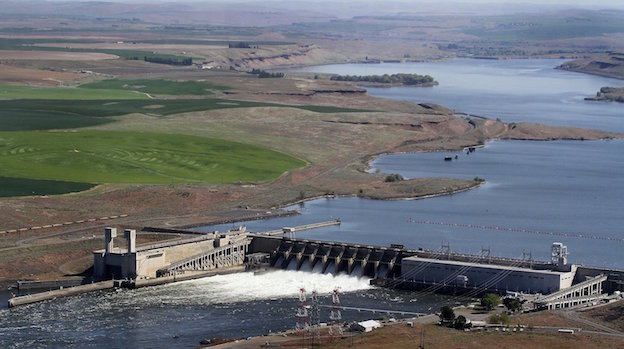 The issue of whether a federal judge can order federal agencies to breach the four lower Snake River dams under provisions of the Endangered Species Act will likely be dropped from the long-standing lawsuit over Columbia River System Operations.
On Nov. 25, the State of Idaho joined plaintiffs in an agreed stipulation to dismiss Idaho's counterclaim, which argues that breaching is not an available remedy under the ESA since the dams were built prior to its enactment.
District Judge Michael Simon has not yet ruled on the issue, which is part of a decades-long lawsuit in the U.S. District Court for the District of Oregon revived after President Donald Trump rescinded the Resilient Columbia Basin Agreement with states and Native American tribes to help restore salmon, steelhead and other native fish populations in June.
Plaintiffs--including 10 environmental groups and the State of Oregon--recently filed motions to dismiss the claim, noting the requested relief does not seek a court order to breach the dams.
"Idaho seeks adjudication of a purely hypothetical question: whether, as a remedy under the ESA, Oregon may seek breach of Lower Snake River dams," Oregon's Nov. 7 motion states.
It adds, "And while it is true that Oregon's representatives have made statements, in various contexts, both in and out of court, supporting the science showing breach of the Lower Snake River dams is necessary to avoid the current extinction crisis, Oregon has never sought such relief from this Court against Idaho or any other party."
The motion notes that federal courts can enter declaratory judgements when there's actual controversy within their jurisdiction, but to do so, the party seeking a declaratory judgement must establish it has been injured, that the injury is traceable to the challenged action, and that the injury would be addressed with a favorable decision.
Oregon said that Idaho will not suffer substantial hardship if the court does not resolve the question and would suffer no hardship if its counterclaim is dismissed.
Idaho agreed to the dismissal without prejudice, which allows the state to refile the claim later.
In other matters, on Dec. 1, Simon approved a request by Scott Levy to file an amicus brief in the case.
Levy advocates for wild salmon and steelhead online, and has participated in public forums involving issues related to the four lower Snake River dams for more than 25 years, his brief states.
In his brief, filed Nov. 15, Levy wrote that he has unique knowledge about the CRSO environmental impact statement that will aid the court in considering issues.
The brief provides a legal argument on why the court can order breaching the dams.
It claims that the federal agencies' 2020 CRSO environmental impact statement fails to keep Snake River salmon and steelhead out of jeopardy. "Federal action agencies' abandonment of adaptive management proves that salmon and steelhead cannot recover, unless the dams are breached," the brief states.
Related Pages:
Plaintiffs in Salmon BiOp Case Seek to Dismiss 2-Year Old Idaho Request that Judge Rule Out Dam Breaching as Remedy by Staff, Columbia Basin Bulletin, 11/22/25
Amicus Brief of Scott Levy 11/15/25 (excerpt below)
V. FEDERAL ACTION AGENCIES' ABANDONMENT OF ADAPTIVE MANAGEMENT PROVES
THAT SALMON AND STEELHEAD CANNOT RECOVER, UNLESS THE DAMS ARE BREACHEDYears ago, Snake River Steelhead runs triggered the Early Warning Indicator.
Not following the prescription of a Biological Opinion is oftentimes deemed as a violation of ESA Prohibited Acts, Section 9. Out of public view, Action Agencies may have proceeded as prescribed, but from here it seems unlikely. The triggering was acknowledged by USACE leadership, but were long-term actions prepared?----------- 2014 FCRPS Supplemental Biological Opinion, page 419 ----------
The 2009 AMIP required that NOAA Fisheries and the Action Agencies develop biological indicators and contingency actions in case the status of an interior Columbia basin Chinook salmon ESU or steelhead DPS reaches a pre-defined warning level during the term of the RPA. This is a precautionary approach to RPA implementation that reduces the risks associated with the scientific and technical uncertainties inherent in a 10- year mitigation program: climate change, impacts of invasive species and predators, and interactions among the listed species.NOAA Fisheries and the Action Agencies have completed the contingency planning elements of the AMIP, including the development of early warning indicators and both rapid response and long-term contingency actions (USACE et al. 2012). The expanded contingency process establishes an annual review by NOAA Fisheries and the Action Agencies to evaluate two biological indicators of species decline, the Early Warning Indicator and the Significant Decline Trigger. These two indicators are described briefly below. If the Significant Decline Trigger is tripped, the Action Agencies (in coordination with NOAA Fisheries, the RIOG, and other regional parties) will implement rapid response and, if needed, long-term contingency actions to minimize and mitigate for the decline.
Surprisingly, NOAA Fisheries' CRS Biological Opinion of July 2020 tells us that the Action Agencies are proposing to no longer abide by these important triggers. Reasoning is that nothing has worked or can be implemented to recover salmon with the dams in place: LSR dams put salmon in jeopardy of extinction.
With one Rapid Response Action untried, Remove Snake River Embankments, the final CRSO EIS has moved arbitrarily and capriciously with an abandonment of AMIP contingency triggers. Moreover, NOAA Fisheries is steadfast in asserting a "no jeopardy" opinion for ESA-listed salmon, despite evidence to the contrary.----------- NOAA Fisheries' 2020 CRS Biological Opinion, page 91 ----------
The Action Agencies do not propose to use specific abundance or trend triggers as previously set forth in the 2009 Adaptive Management Implementation Plan (USACE et al. 2009) because they have become outdated (e.g., they were based on adult returns through 2007 or 2008), because many identified contingency actions are already being implemented (e.g., substantially higher spill levels due to the proposed flexible spill operation, refined transportation operations, hatchery reform, etc.), and because several contingency actions (e.g., reducing harvest, some elements of predator control, etc.) were outside their authority to implement. Instead, they propose to work with NMFS, USFWS, federal, state and tribal sovereigns and other appropriate parties in any region-wide diagnostic efforts to determine the causes of declines in the abundance of naturally produced salmon and steelhead and to identify and operationalize potential contingency actions should the need arise (emphasis added).
learn more on topics covered in the film
see the video
read the script
learn the songs
discussion forum