forum
library
tutorial
contact

Washington State Wants Another Dam Study
-- But it Doesn't Want an Honest Answer
by Chris Cargill
Seattle Red, July 20, 2026
|
the film forum library tutorial contact |
|
Washington State Wants Another Dam Study
by Chris Cargill
|
Taxpayers shouldn't fund research designed to validate
a conclusion politicians have already reached
 The State of Washington is about to spend taxpayer dollars again studying the future of the Lower Snake River dams. Unfortunately, the question it wants answered isn't the one that matters.
The Washington Department of Commerce recently issued a Request for Proposals seeking an independent contractor to determine how the electricity generated by the four Lower Snake River dams could be replaced. At first glance, that sounds like prudent planning. Before removing a critical piece of the Northwest's infrastructure, we should understand the consequences.
But look closer.
Removing dams would come at a terrible price
The study isn't asking whether removing the dams is wise. It's asking how to replace them after they're gone. That's not an honest analysis. It's an attempt to justify a predetermined political objective.
If state leaders genuinely wanted an objective answer, they would ask a different question: What are the costs and benefits of keeping the dams compared with removing them? They would examine reliability, electricity prices, agriculture, transportation, irrigation, navigation, carbon emissions, and salmon recovery under both scenarios. Then they would let the evidence lead where it may.
Instead, Olympia has already accepted the premise that the dams should eventually disappear. Ironically, a truly independent analysis would likely demonstrate exactly why removing them would be one of the most expensive infrastructure mistakes in Northwest history.
Dams are a dependable source of energy
The four Lower Snake River dams provide much more than electricity. They are a cornerstone of the Northwest economy. Together they have more than 3,000 megawatts of generating capacity and produce roughly 6 to 8 million megawatt-hours of carbon-free electricity each year. Just as importantly, they provide flexible power that grid operators can quickly dispatch when demand suddenly spikes during winter cold snaps or summer heat waves.
That reliability is becoming increasingly valuable as more intermittent renewable energy comes online. So what would replacing the dams actually require?
Depending on the technology, you're looking at roughly 1,000 to 1,200 modern wind turbines or millions of solar panels, spread across thousands of acres, along with billions of dollars in new transmission infrastructure and massive battery storage systems.
Anyone who has lived in the Pacific Northwest knows we experience calm winter inversions, cloudy weeks, wildfire smoke, and prolonged stretches with little renewable production. Those aren't political opinions; they're weather patterns.
The Lower Snake River dams don't simply generate electricity. They provide dependable, dispatchable electricity precisely when families and businesses need it most.
Dams do more than provide reliable power
The dams also allow barges to move wheat and other commodities to market at low cost, provide irrigation to farms, create recreational opportunities, support local economies, and help keep electricity affordable throughout the Northwest. Replacing all of those benefits isn't simply an engineering challenge. It's an economic one.
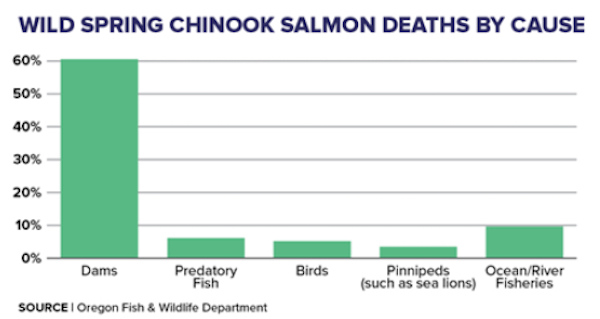
Supporters of breaching often suggest the dams are the primary obstacle to salmon recovery. The reality is considerably more complicated. Ocean conditions, predators, habitat quality, hatchery management and numerous other factors all influence salmon populations. Billions of dollars have already been invested in fish passage improvements, and salmon returns today are far better than many of the catastrophic predictions made decades ago.
None of that means we should stop working to improve fish recovery. It does mean we should stop pretending the dams are the sole villain in the story. Unfortunately, that's exactly what has happened.
The environmental scapegoat
For years, politicians in Olympia and bureaucrats in Western Washington have treated the Lower Snake River dams as a convenient bogeyman. When salmon numbers disappoint, blame the dams. When environmental groups demand action, promise another study. When political pressure mounts, commission another report examining how to replace infrastructure that has reliably served the Northwest for half a century.
It's far easier than confronting the harder realities of predator management, habitat restoration, ocean survival and the complex tradeoffs that accompany every environmental decision. The dams have become less of an engineering question and more of a political symbol. That's why Washington's latest study deserves careful scrutiny.
Taxpayers shouldn't fund research designed to validate a conclusion politicians have already reached. They should expect a study willing to ask difficult questions--even if the answers aren't politically convenient. Science begins with curiosity, not conclusions.
A credible analysis would compare keeping the dams with removing them. It would measure not only replacement costs but also lost navigation, increased transportation expenses, impacts to agriculture, changes in electricity prices, grid reliability, and the uncertain biological benefits of breaching. If policymakers are confident the evidence supports removing the dams, they shouldn't fear an honest comparison.
We will miss dams when they are gone
After more than 50 years, the Lower Snake River dams have proven themselves to be one of the Northwest's greatest public investments. They produce reliable carbon-free electricity, move crops to market, support family farms, strengthen regional commerce, and provide flexibility that no collection of wind turbines and solar panels can fully replicate.
Mother Nature doesn't care about political talking points. When the wind isn't blowing, the clouds settle over the Columbia Basin, and families crank up the heat on a freezing January morning, ideology won't keep the lights on. Reliable power will.
If Washington truly wants to study the future of the Snake River dams, it should begin with the right question--not the politically convenient one.
Related Pages:
Political Push for Electric Vehicles Might Not Make Sense, or Cents by Chris Cargill, The Chronicle, 4/6/22
learn more on topics covered in the film
see the video
read the script
learn the songs
discussion forum