forum
library
tutorial
contact

Energy Leaders Asked to Manage
for an Abundance of Salmon
by K.C. Mehaffey
NW Fishletter, September 10, 2025
|
the film forum library tutorial contact |
|
Energy Leaders Asked to Manage
by K.C. Mehaffey
|
"I think we're already managing for an abundance of power,
and I really can't say that the same is true for fish."
-- Zach Penney, Columbia River Inter-Tribal Fish Commission
 Near the end of NewsData's 2025 Western Energy Summit in Boise, Idaho, Aug. 20-22, two speakers pointed out how energy industry leaders had spoken in depth about meeting the growing demand for electricity in the West.
Then they put that quest under a different spotlight.
Zach Penney, director of strategic initiatives for the Columbia River Inter-Tribal Fish Commission and a member of the Nez Perce Tribe, said Native American tribes in the Columbia Basin are often asked how many fish they need. He flipped the question, asking conference attendees, "How much energy do you need, or do we need? ... My sense from yesterday is, as much as we can possibly produce within the capabilities of the infrastructure and systems that we have."
Penney acknowledged that the loss of salmon in the Columbia Basin isn't all because of hydroelectric dams.
However, he said, "I think we're already managing for an abundance of power, and I really can't say that the same is true for fish."
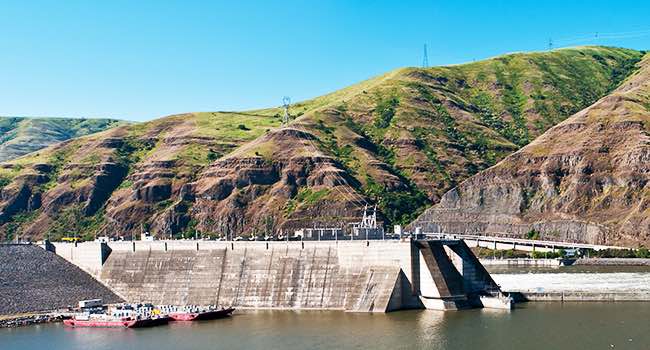
Jay Hesse, director of biological services for the Nez Perce Tribe's Department of Fisheries Resources Management, relayed that the four lower Snake River dams produce an average of 1,000 MW of power or less. He said 27 percent of the time they provide roughly 300 to 400 MW, and for peak energy needs -- like the winter peak in 2024 over Martin Luther King Jr. holiday weekend -- they generate up to 1,500 MW.
"What I've heard from you all is that there is a looming shortage of 30,000 MW or more in the very near future," he said. "The bold leadership is for you all to figure out -- not how to fill the 30,000-MW gap -- but to fill a 31,000-MW gap and do it in a way that works for fish."
Hesse asked energy executives to accept the analyses by numerous salmon managers showing the impacts that the four lower Snake River dams have on salmon runs. He pointed to a 2022 NOAA Fisheries report conclusion that a whole suite of actions -- including removal of the four lower Snake River dams -- are necessary to restore salmon runs to healthy and harvestable levels in the Columbia Basin.
"It's a hard discussion, but it is one of adequacy in trying to meet and keep the lights on, if you will, for salmon and steelhead at that adequate level through the Snake Basin," Hesse said.
Penney suggested, "Dams don't last forever, so, what's our end-of-life plan? It's not tomorrow, but someday."
Other speakers on the panel titled, "Finding Common Ground: Managing for an Abundance of Fish & Power," included Scott Simms, CEO and executive director of the Public Power Council; Clark Mather, executive director of Northwest RiverPartners; and Scott Corbitt, general manager of the Port of Lewiston.
 Moderator Stephen Ernst, managing editor of NW Fishletter, asked panelists to talk about areas of compromise or collaboration.
Corbitt said it's difficult for the Port of Lewiston, Idaho's only seaport, to compromise on the future of the four lower Snake River dams, since without them there would be no port. He noted the many impacts to infrastructure, tourism and the cost of transporting goods to and from the region if the dams are taken out. "We shouldn't be disregarded, the folks along the river," he suggested.
Corbitt added, "I'm right in the heart of Nez Perce country, and I want nothing more than to partner with the tribe on economic development [and] on different aspects of making life better."
Simms suggested, "There are so many areas we absolutely have commonality and there's only a few that we don't. And if we work on areas of commonality, eventually we can handle those tougher issues."
He said he'd like to work together on reducing the impacts that bird, fish and marine mammal predators have on salmon, and on investing in fish hatcheries.
Investing in the region's hatcheries -- while continuing work to boost wild salmon runs -- is another area of agreement, he noted.
Mather said in addition to predation issues, he'd like to work with tribes and other salmon managers on bringing more federal funding to the Columbia Basin, noting its national significance and ties to fishing rights promised to tribes by the federal government.
Mather also suggested that addressing reduced staffing at the agencies that manage the Federal Columbia River Power System could be another place to collaborate.
Staffing levels at federal agencies, including the U.S. Army Corps of Engineers, have been reduced by 20 to 40 percent compared to last year, he said. "There's all sorts of anecdotes where you have senior biologists working on the weekend to get the juvenile barging operation to work. And these are fish that are going to come back to our region and benefit everyone in four or five years," he said.
Mather added, "The people run this system -- these are not just like systems that run themselves. They're people that help keep the lights on, that help run the fish mitigation system, that help do the maintenance on these programs."
Simms and Mather also said they agree that Northwest tribes are sovereign entities with treaty rights to fish.
"I absolutely 100-percent believe personally -- and I know our organization does as well -- that the tribal sovereignty, the rights of tribes, their historic rights to fish are paramount in this region. It's an identifying factor of the first people," he said.
One area of clear disagreement -- other than the future of the four lower Snake River dams -- is the relative abundance of current salmon returns, and how those returns should be portrayed to the public.
In opening remarks, Hesse noted that when Columbia River tribes entered into treaty agreements with the U.S. government in 1855, about a million spring-summer Chinook returned to the Snake River basin.
When dams were built in the Snake River, hatcheries were constructed to replace lost fishing opportunities, with a promise of 90,000 returning spring-summer Chinook. Hesse said that the hatchery mitigation program has met this goal just three times.
The Columbia Basin Partnership Task Force, led by NOAA Fisheries and involving tribes, states and all the stakeholders, set a goal to restore the Snake River spring-summer Chinook to about 235,000 returns. In 2024, just 8,500 spring-summer Chinook returned to the Snake River, Hesse said.
"The fish are in dire straits. I could go into more stats about how close we are to extinction. I think the point is, we are nowhere near our goals," he noted.
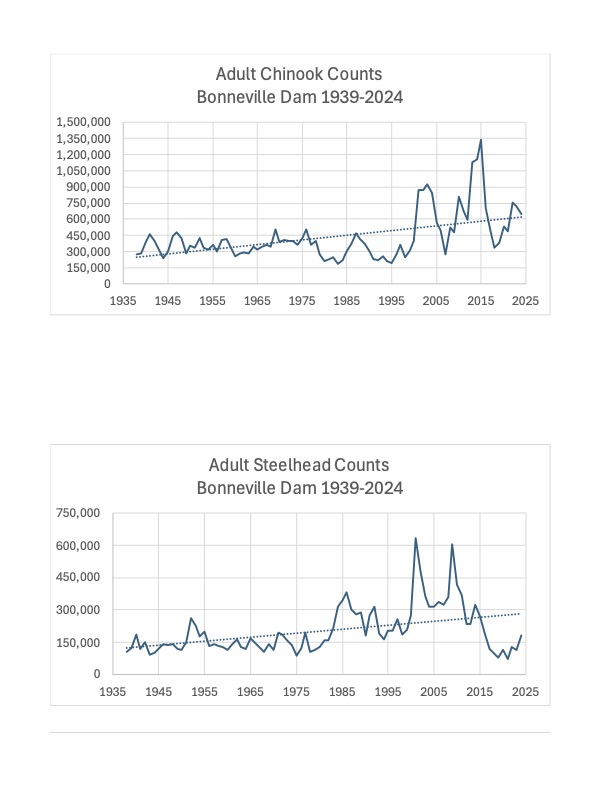
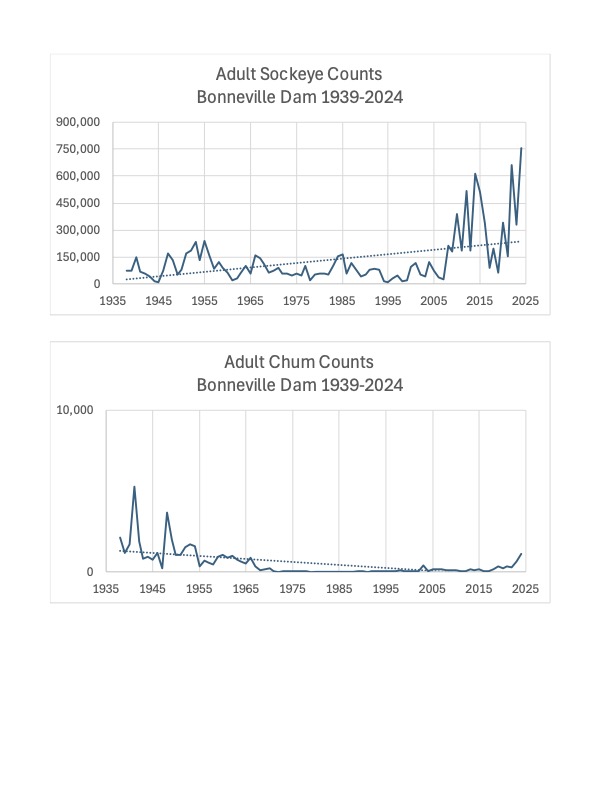
Mather, conversely, said that fish returns have tripled over the last 15 years, and in 2024, 1.77 million salmon and steelhead passed Bonneville Dam. He said 10 times as many fish passed Lower Granite Dam on the Snake River compared to returns in 1999.
"We think we're actually having some success with some of the mitigation measures we're taking," he said.
Mather said returns to Bonneville Dam in 2014 -- before flexible spill operations -- were the highest since Bonneville Dam construction was completed in 1938, with more than 2.3 million fish passing the dam.
"We were generating hundreds of megawatts of additional energy at the time," he said. "So why can't we go back and look at an operation that supports additional hydropower and also has been demonstrated to support strong adult fish returns?"
Hesse said he thinks salmon managers and hydroelectric proponents could work on finding a way to not confuse the public on the status of salmon and steelhead in the Columbia Basin.
He said messaging should include important details and should not "cherry pick" the data on fish returns.
"The two years that Clark mentioned were predominantly fish going to the upper Columbia [River], not the Snake Basin. That's a really important detail that can't be overlooked," he said.
Simms said he'd like to collaborate on harvest and evaluate how fishing impacts salmon returns. "We have to have an understanding of where our fish are going and where they're returning to and how they're not making it and what are the causes," he suggested.
He also said that the Bonneville Power Administration and its public-power ratepayers have embraced hydropower's mitigation responsibility, spending $900 million in the last five years on Columbia River Basin Fish and Wildlife Program projects and on lost power generation costs.
He noted that hydroelectricity is a vital energy resource that can be counted on during winter and summer peak events -- such as the unprecedented heat dome of June 2021 and the extreme cold snap in January 2024.
He said that -- through current flexible spill operations -- BPA has been able to provide more spill for juvenile salmon in April and receive about 300 MW of extra energy in August. "Those are the kinds of things we should be focusing on," Simms said.
learn more on topics covered in the film
see the video
read the script
learn the songs
discussion forum