forum
library
tutorial
contact

Three Commercial Fish Traps Begin
Operating in Columbia River
by K.C. Mehaffey
NW Fishletter, October 8, 2025
|
the film forum library tutorial contact |
|
Three Commercial Fish Traps Begin
by K.C. Mehaffey
|
Studies by Wild Fish Conservancy found 99.5% of Chinook
and 94.4% of steelhead survived their fish traps after release.
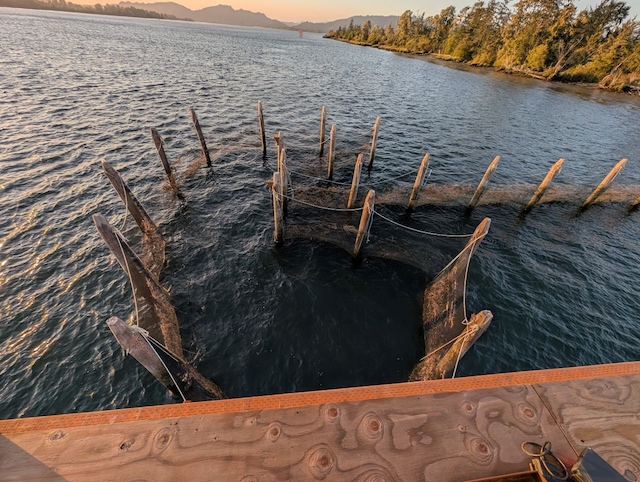 After demonstrating that fish traps in the lower Columbia River can successfully catch hatchery salmon and release virtually all wild fish unharmed, Wild Fish Conservancy is working with commercial fishing outfits this fall to show that these traps can also be economically viable.
Also known as pound nets, fish traps have been illegal in Washington since 1934--except for the experimental traps that WFC has constructed in the lower river for research purposes since 2015.
This year, the Washington and Oregon departments of fish and wildlife are implementing an emerging commercial fishery (ECF), which allows commercial fishing outfits to use pound nets, purse seines or beach seines as part of a five-year test.
The results of this new fishery will inform the Washington State Legislature about whether there are viable fishing methods that could replace gillnets, which are used in the lower Columbia River and kill significant numbers of wild fish.
The fish traps have been operating since August in three locations in the lower Columbia River, catching hatchery coho and fall Chinook while releasing wild salmon.
"We've been working for nearly a decade to try to get these traps up and running. And now, it's finally come alive on the river as a fully fledged commercial fishery," WFC Executive Director Emma Helverson told NW Fishletter. "For our staff and for the fishers we've been working with, it's been kind of unbelievable."
Helverson said years of research that included publishing research papers in peer-reviewed journals showed that the vast majority of wild fish released from the traps continue to migrate upstream without harm.
"Now, we're trying to demonstrate that fishers are using them, that they can make money off them, and they can release 100 percent of the wild fish," she said.
According to a July Columbia River Compact report, the ECF has six available permits, and the participants selected by lottery include three seines and three pound nets.
This year, the six commercial fishers in the ECF will be allowed to harvest a total of 4,980 adult hatchery Chinook and 8,706 adult hatchery coho. The numbers were based on return forecasts, impacts to Endangered Species Act-listed fish, and release mortality rates, the report says.
Each individual fishing outfit will be allowed to harvest up to 830 hatchery Chinook and 1,451 hatchery coho, and to handle as many as 75 steelhead.
According to the report, release mortality rates are 7 to 9 percent for pound nets; 21 to 29 percent for purse seines, and 33 to 38 percent for beach seines. Published studies by WFC found 99.5 percent of Chinook and 94.4 percent of steelhead survived their fish traps after release.
For gillnets, between 40 and 50 percent of the wild fish die after release, Bill Tweit, then-Columbia River fishery coordinator for Washington Department of Fish and Wildlife, told NW Fishletter in 2020.
The high mortality rate is one reason the state Legislature directed WDFW in 2022 to test alternative commercial fishing gears and buy back commercial fishing licenses from outfits that used gillnets in the lower Columbia River.
But while the state bought back gillnet licenses, the benefit to wild fish intended by the Legislature has not yet been realized.
Until now, gillnets have been the only option for commercial fishing in the lower Columbia River during the fall months, according to a letter from WDFW Director Kelly Susewind to the Legislature that was attached to a December 2022 report on the agency's efforts to diversify fishing gears used in commercial fishing.
At the time, Susewind said there may not be a viable replacement for gillnets.
"Having a diverse suite of gears that can be deployed tactically in the times, places and manners that are most appropriate will position the Department to promote salmon conservation while also making the best use of harvestable salmon resources for the fishing industry and the public," he wrote.
In an email to NW Fishletter, WDFW spokesperson Britton Ransford said the ECF is a joint effort by Washington and Oregon to test the viability of alternative fishing gears that are otherwise prohibited.
"The fishery is designed to evaluate whether alternative gears can provide commercial economic opportunity in a manner that seeks to balance the catches of target species and stocks with the incidental mortality of non-target species and stocks," he said.
The agencies won't just be looking at the economic viability of fish traps and seines, Ransford added.
"WDFW and ODFW will continue to evaluate the Emerging Commercial Fishery's performance across multiple measures, including biological impacts, non-target survival, economic performance, and operational feasibility," he said.
Helverson is hopeful that the fish traps currently operating in the lower Columbia River will prove to be a viable option in all those areas when compared to commercial gillnet fishing.
She said fish caught in their fish traps may be more valuable since they won't have the scars of nets seen on gillnet salmon and fishers can market them as sustainably caught.
In addition, she said, if approved for use by commercial fishers, fish traps could help solve another problem in the Columbia Basin: too many hatchery fish spawning with wild fish and weakening their genetics.
WFC has sued state and federal agencies over Columbia Basin hatcheries that exceed their own limits for allowing hatchery fish to mate with wild fish. After settling a lawsuit last year, WFC recently filed a 60-day notice of intent to sue the National Marine Fisheries Service over its biological opinion for the hatcheries.
By releasing virtually all of the wild fish unharmed, the traps could be used to help remove hatchery fish before they reach those spawning areas, Helverson said. Their use in the lower river, she added, allows for a higher percentage of wild fish to escape the pressure of commercial fishing without the bycatch impacts.
To Helverson, this five-year test of alternative gears could be important not just for the Columbia Basin, but also for giving commercial fishers options to fish sustainably across the West.
"Today, the reality is we are losing fish, we are losing ecological value, we are losing abundance, and fishers are making less and less each year," she said.
Helverson said WFC chose the Columbia Basin as its research grounds for fish traps because it has so many ESA constraints and so many regulations.
"We knew that if you could get these into the Columbia River, you could do this anywhere, because it's the hardest," she said.
Helverson added that WFC recognizes that it's difficult for commercial fishing outfits to learn to use a new kind of gear, and to change how they've operated traditionally.
"Our goal has been to demonstrate that it can work. We're really excited and hope this can be a model for other communities up and down the coast."
learn more on topics covered in the film
see the video
read the script
learn the songs
discussion forum