forum
library
tutorial
contact

Federal Judge Orders Increased Spill Over Columbia
and Snake River Dams in Renewed Court Case
by Samanth Wohlfeil
Pacific NW Inlander, March 4, 2026
|
the film forum library tutorial contact |
|
Federal Judge Orders Increased Spill Over Columbia
by Samanth Wohlfeil
|
Three decades of litigation over the operation of hydroelectric dams
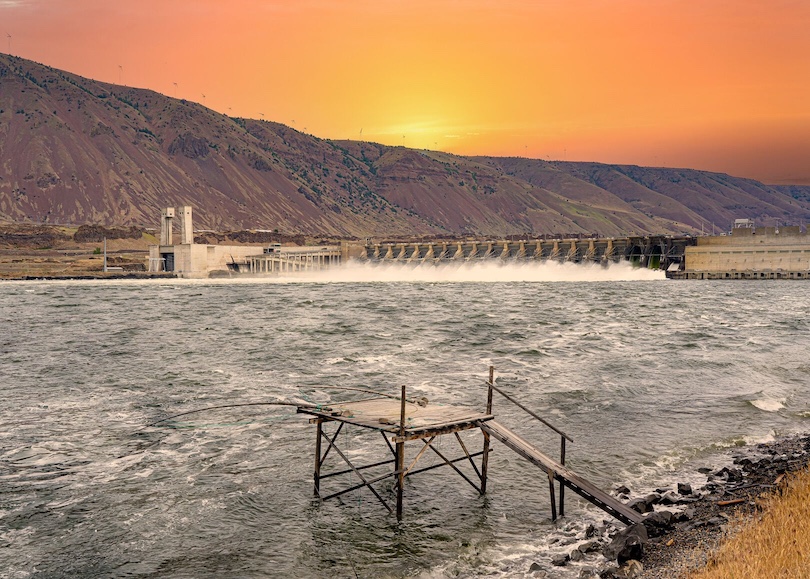 In February 2024, it looked like nearly three decades of litigation over the operation of hydroelectric dams on the Columbia and Snake rivers might finally be over.
That month, the Biden White House celebrated the Columbia River Basin Agreement (or Resilient Columbia River Agreement), which was finalized in late 2023 with the "six sovereigns" -- Washington, Oregon, the Nez Perce Tribe, and the confederated tribes and bands of the Yakama Nation, Warm Springs, and the Umatilla Reservation. The agreement promised more than $500 million in federal investments to restore healthy salmon runs and install clean energy to compensate for power lost from reduced dam operations, with the potential for even more regional investment to bring the total close to $1 billion.
Specifically, the agreement outlined a process to replace the energy, transportation, irrigation and recreation provided by the four lower Snake River dams (Ice Harbor, Lower Monumental, Little Goose and Lower Granite), with an eye to making it feasible for Congress to consider breaching them within a decade or so.
Meanwhile, the parties all agreed to pause federal litigation and let the investments promised in the plan come to fruition.
But President Donald Trump unilaterally revoked that agreement in June 2025 via a presidential memo titled "Stopping Radical Environmentalism to Generate Power for the Columbia River Basin."
So, Northwest states, tribes and environmental groups went back to federal court in Oregon last year. It's not what the plaintiffs, who've long fought the federal dam operators in court, wanted to do.
"Because the federal government threw out a comprehensive plan that would have restored the Columbia Basin while investing in the region, returning to court is the only tool we have left to prevent the collapse of imperiled salmon and steelhead populations," said Mike Leahy, senior director of wildlife, hunting and fishing policy for the National Wildlife Federation, in an emailed statement on Feb. 26.
The ongoing arguments in the case involve the most recent 2020 Biological Opinion, which was finished during Trump's first term, and related plans to operate the federal hydropower system.
The plaintiffs received good news in the resumed litigation last week, when Judge Michael H. Simon of the U.S. District Court of Oregon issued a preliminary injunction that directs more spill over some dams starting this spring and lasting through the end of August in the Snake and Columbia rivers to prevent the extinction of salmon and steelhead.
"For decades, the battle for the life of threatened and endangered salmon and steelhead has not been fought at the end of a hook and line, nor in the woven threads of a fishing net, nor even based on the appetites of sea lions, avian predators, or killer whales. Instead, the greatest battle has been waged in the courts," Simon's order starts. "Although people have debated various definitions of ‘jeopardy' and whether mitigation actions are sufficiently ‘certain' to occur, the abundance of these salmonids has dwindled to near extinction levels."
Joseph Bogaard, executive director of the nonprofit Save Our Wild Salmon, tells the Inlander the order is critical not only for the endangered anadromous fish in the Columbia and Snake rivers, but for other wildlife, the economy, recreational opportunities, and treaty promises to tribes that have not been upheld.
"The benefits and gifts salmon provide our region are irreplaceable and in some ways immeasurable. The ecological health and identity of our region is at risk as salmon decline," Bogaard says. "Without emergency actions, they will continue to decline toward extinction."
SPILL IT
Judge Simon granted several measures requested by the plaintiffs, including following the same spring spill levels at eight dams on the lower Columbia and Snake rivers that were used in 2024 and 2025, with the exception of the John Day Dam, which he ordered to operate 24/7 at spill levels that were only implemented at nighttime.
Spill is water let over or past dams without going through turbines to generate electricity. Scientists have argued in the case that it provides a critical route for juvenile salmon on their outmigration to the ocean, particularly as the reservoirs behind the dams, where water is significantly stilled, have dramatically slowed the natural process of riding the current out to sea.
For summer, the judge also ordered the same spill used in 2024 and 2025, except at John Day and Ice Harbor, which intervenor-defendants representing small power companies asked to match spill levels described in the system's 2025 Fish Operations Plan. Simon agreed to their request.
The summer spill was ordered to last through Aug. 31, though the power company defendants pushed back on that idea. Simon's order states the requested spill mirrors what was previously agreed to by the dam operators, and the order doesn't preclude changes in case of emergency to address power needs.
However, the utilities are concerned that dam operators aren't able to quickly change operations at the dams in case of emergency, and may be nervous about justifying such changes needed to prevent blackouts, says Scott Simms, CEO and executive director of the Public Power Council. The Portland-based nonprofit association is an intervenor-defendant in the case and represents about 100 consumer-owned electric utilities across Washington, Oregon, Montana, Idaho, Wyoming and Nevada.
"The practical reality is that emergency declarations are very problematic," Simms says. "There are many, many eyes on why it's done, making folks nervous to take the action of declaring an emergency."
The preliminary injunction also extends fall and winter spill for longer hours and more days. The ordered spill is important because the government's draft 2026 Fish Operations Plan included significant changes "in the wrong direction," i.e., reducing spill from what it was in recent years, Simon wrote in the order.
"The Court recognizes the dire situation these species are facing. The Court agrees that doing nothing during the pendency of this litigation would not effectuate the congressional purpose behind the [Endangered Species Act]," the order states. "Many of the populations have reached the quasi-extinction threshold (meaning that the population has 50 or fewer natural-origin spawners for four consecutive years) ... Others are on trend to reach this threshold within a few years. This places the species at an alarming risk for extirpation."
OTHER CONCERNS
In a statement issued last week, the Public Power Council said it was disappointing to see many of the plaintiffs' requests adopted in the order, while acknowledging that a few of the council's proposed compromises were accepted.
"PPC is disappointed that the court adopted a sweeping operational injunction that will materially affect the region's clean hydropower system and the millions of people who depend on it," Simms wrote. "The Columbia River system already operates under some of the most protective fish measures in the nation, and public power utilities have invested billions of dollars over decades to support salmon recovery while producing reliable and affordable electricity."
In addition to specific spill and reservoir levels, the plaintiffs also requested various investments in infrastructure and maintenance, habitat restoration and other conservation measures, but Simon did not grant those requests in the preliminary injunction, noting that some of those measures are already included in long-term plans that Bonneville Power Administration has for the dams, while others may be determined as the case continues.
"Those limited acknowledgments, however, do not offset the broader impacts this decision could have on the region's power supply, transmission operations, greenhouse gas emissions, and customer costs," Simms wrote in his statement last week. "Lasting progress for fish and communities will come from durable regional agreements and congressional direction, not from repeated litigation cycles."
In an interview on Monday, Simms adds that the potential for summer spill in August to help juvenile fish is fairly reduced, while it's one of the times of year that's most concerning for utilities trying to ensure the power stays on during extreme weather, when demand spikes.
Republican U.S. Sen. Jim Risch of Idaho issued a statement condemning the order.
"Once again, an activist judge is trying to dismantle the infrastructure Idahoans rely on by legislating from the bench," Risch said. "Congress authorized these dams, and only Congress has the authority to determine how they are managed. This decision disregards the essential role the lower Snake River dams play in our communities, and I will continue fighting to protect these vital resources."
(bluefish notes: Congress does not 'manage' the federal dams. The task of managing operations is left for the operating government agency (e.g. US Army Corps of Engineers) to accomplish according to their own guidelines, including the Public Trust Doctrine of Navigable Waters")Meanwhile, Bogaard, of Save Our Wild Salmon, says the order still doesn't go far enough to ensure the survival of the endangered fish, though it is an important step since the federal agreement that was in place was rescinded by the current administration.
"The order is not sufficient to protect and rebuild these populations, but it does buy time for the fish, and thus buy time for our region to work together," Bogaard says. "It will implement enhanced spill through the end of August, which is what all the fisheries experts in the region recognize is sort of a key element of what these fish need in the near term."
Simms says the Columbia River Basin Agreement did appear promising in that it put a halt to litigation, but he notes that not everyone (including the utilities represented by the council) was allowed a seat at that table. He's hopeful that similar work outside of court could bring everyone back to negotiate a compromise that works for utilities as well as fish.
"We've been adamant about getting folks back to the table and using building blocks from that agreement to get back to a place of regional cohesion," Simms says. "I'm a fourth-generation Washingtonian, and I would hope that we all, in different capacities -- whether you're involved in river commerce or tribal representatives who have a deep, deep history in this space before anybody else arrived in the region -- that we could find ways to support the future of salmon and hydropower."
learn more on topics covered in the film
see the video
read the script
learn the songs
discussion forum