forum
library
tutorial
contact
Decades-Old Salmon Enhancement Program
Faces Uncertain Future After BPA Exit
by Michael Williams
Columbia Community Connection, July 7, 2026
|
the film forum library tutorial contact |
|
Decades-Old Salmon Enhancement Program
by Michael Williams
|
BPA's removal of funds puts more than 7 million hatchery salmon at risk
 In a decision that has left wildlife officials and anglers reeling, the Bonneville Power Administration (BPA) is ending its share of funding for the Select Area Fisheries Enhancement (SAFE) Program in the Lower Columbia River, effective at the end of September.
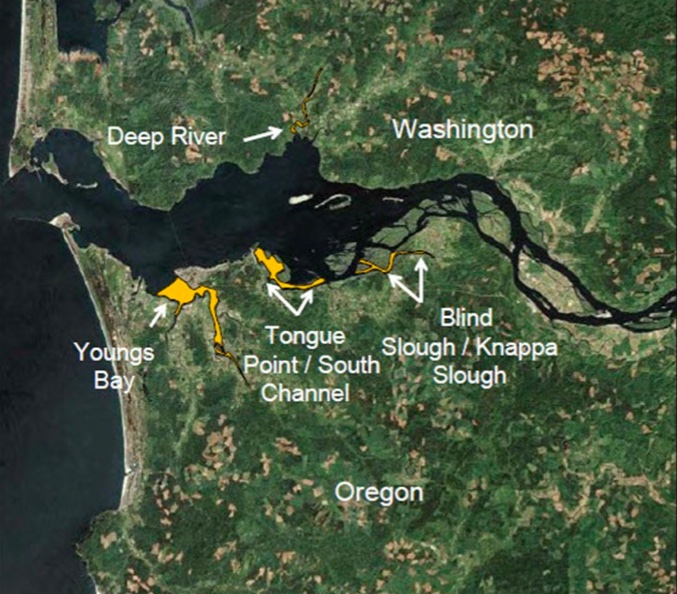
The SAFE program produces fish for commercial and recreational anglers at off-channel locations in Youngs Bay, Tongue Point, Blind Slough, and Deep River along the lower Columbia River. The purpose of the program is to produce fish in off-channel sites to reduce the pressure on fish populations in the Columbia's mainstem. Commercial fishermen and recreational anglers harvest fish in the SAFE area, which limits their impact on threatened species elsewhere.
The Oregon Department of Fish and Wildlife says BPA's removal of funds puts more than 7 million hatchery salmon at risk and leaves a $2.4 million funding gap.
The SAFE partners affected by the change are the Oregon Department of Fish and Wildlife (ODFW), Washington Department of Fish and Wildlife (WDFW), and Clatsop County.
"This decision by BPA caught us by surprise. It puts decades of fishery reform work at risk and goes against the recommendation of the regional fish and wildlife managers and the Northwest Power and Conservation Council to fund this work," said ODFW director Debbie Colbert.
The change has left many wondering how the program will manage to fill in such a substantial funding gap. ODFW officials believe the elimination of funds from BPA will cause major disruptions for commercial and recreational fisheries.
The SAFE program began in 1993 as the Columbia River Terminal Fisheries Research Project. It was originally launched as a decade-long BPA-funded feasibility study that focused on investigating the feasibility of growing stock fisheries in off-channel areas, but later transitioned into establishing full-scale production sites for Chinook and coho salmon.
SAFE now has three hatcheries, and each one releases juvenile Chinook and Coho salmon from net pens in side channels and backwater areas. These are known as the "select area sites," and the managed fisheries are known as "select area fisheries."
According to BPA's 2024 SAFE Program Draft Assessment: "the SAFE program's overall objectives include protection of endangered species and minimizing negative impact of SAFE fisheries and production on the environment."
The stocks reared by the SAFE program are not meant to directly contribute to natural populations or recovery of species; they are purely for harvest. The goal of the program is to provide stocks of salmon for commercial and recreational fishermen that are outside of the mainstream of the Columbia River. Instead of capturing natural populations, anglers have the opportunity through the program to catch Coho and Chinook salmon reared at the sites when they return after spending years living in the ocean.
The locations potentially affected:
learn more on topics covered in the film
see the video
read the script
learn the songs
discussion forum