forum
library
tutorial
contact

Judge's Order on Columbia-Snake River
Emergency Measures Expected Shortly
by Matthew Weaver
Capital Press, February 25, 2026
|
the film forum library tutorial contact |
|
Judge's Order on Columbia-Snake River
by Matthew Weaver
|
The Trump administration's revoking of that agreement
was "an extremely bad decision and bad judgement,"
-- Darryll Olsen, Columbia-Snake River Irrigators Association
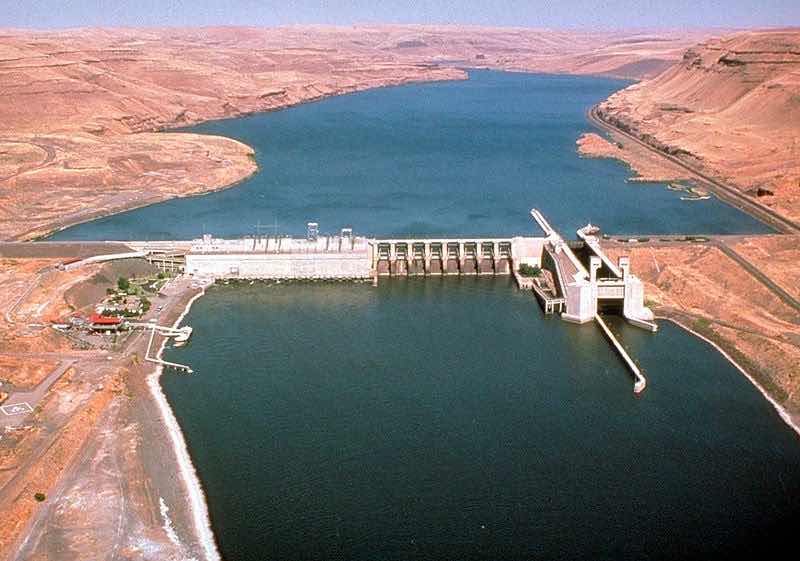 Stakeholders expect a full order to come shortly on a proposed preliminary injunction on Columbia-Snake river system operations from U.S. District Court Judge Michael Simon.
Earthjustice, the state of Oregon and various Tribes filed a moition for a preliminary injunction in October 2025, calling them "science-based" emergency measures to protect endangered salmon and steelhead. The request came as part of ongoing litigation over the operation of dams on the river system.
Among the requested measures are spill increased to maximum levels that meet state water quality standards at the four lower Columbia and four lower Snake River federal dams for the spring spill seasons; continuous 24-hour spill at all eight dams and that reservoirs above the four lower Snake River dams be kept at minimum operating pool elevations from March 1 through Aug. 31.
'More complex'
Simon's decision was originally anticipated Feb. 23 "or soon thereafter." Intervenor-defendants are uncertain as to the reasons for the delay.
Simon may be taking longer because the order is "turning out to be more complex than (he) anticipated," said Neil Maunu, executive director of the Pacific Northwest Waterways Association. He may be working through to make sure there are "no extra appealable items."
The PNWA's Inland Ports and Navigation Group is an intervenor-defendant in the case.
"Ideally, our hope is that he does not issue an order," Maunu said. "IPNG strongly opposes any time of injunction on this river system … Our hope is that he's seriously considering the substantial negative impacts to navigation, irrigation and hydropower."
Appeals likely
One or more more of the parties to the litigation could appeal the order to the U.S. Court of Appeals for the Ninth Circuit, and litigation before the District Court is likely to continue as well, the Public Power Council stated in a press release upon filing their proposed framework.
The council expected review "underlying legal justification, specific provisions and their practical impacts" if the court orders a preliminary injunction.
"PPC's view is that near-term operational decisions must be informed by recent system performance, scientific data, and the practical needs of communities that depend on the Columbia River system," CEO and executive director Scott Simms stated. "Our group's filing builds on themes PPC has consistently emphasized inside and outside the courtroom: the importance of science-based fish recovery actions, the need to protect electric system reliability, and the obligation to safeguard affordability for Northwest families, farms, and businesses that depend on hydropower."
Minimum irrigation pools
Simon told stakeholders Monday that he intended to do a partial approval of injunctive relief in favor of the plaintiffs, but would not rule to minimum operating pools on reservoirs, instead ruling to minimum irrigation pools, said Darryll Olsen, board representative for the Columbia-Snake River Irrigators Association.
"That's all we asked for," Olsen said. "The minimum operating pool is not a normal operation. That is only used for emergency conditions, such as flood control. That's the only time it's ever been down at that level."
Olsen found Simon's potential ruling "favorable" for ag.
"It's a solid ruling where the judge paid attention to what we were telling him," Olsen said.
The judge noted that differences in fish survival appeared "negligible" between minimum operating and minimum irrigation pools, but that the minimum operating pool did cause damage to irrigators and others, Olsen said.
There have been no empirical measurements of fish survival in the pools, only under normal operations, Olsen said.
The University of Washington in the 1990s estimated survival increase could be between 0% and 2% within a particular pool, not across the entire system, he said.
Trump revoke
Olsen noted that the litigation settlement agreement reached in 2024, approved by Simon, called for no Lower Snake River Dam breaching decisions for five to 10 years or other critical changes to mainstem operations.
Many stakeholders at the time protested that they had been kept out of negotiations between the Tribes, plaintiffs and the federal government under the Biden administration.
The Trump administration's revoking of that agreement in June 2025 was "an extremely bad decision and bad judgement," Olsen said. "The other regional industries should not have been pushing for that," Olsen said. "This is what we got instead."
learn more on topics covered in the film
see the video
read the script
learn the songs
discussion forum