forum
library
tutorial
contact

Oral Arguments Set for Dismissal,
Injunction Requests in CRSO Lawsuit
by K.C. Mehaffey
NW Fishletter, February 5, 2026
|
the film forum library tutorial contact |
|
Oral Arguments Set for Dismissal,
by K.C. Mehaffey
|
"Seriously considering what these lower Snake River dams are doing to salmon
in the Columbia River basin is inevitable, certainly under the Endangered Species Act..."
-- Rep. Jared Huffman (D-CA)
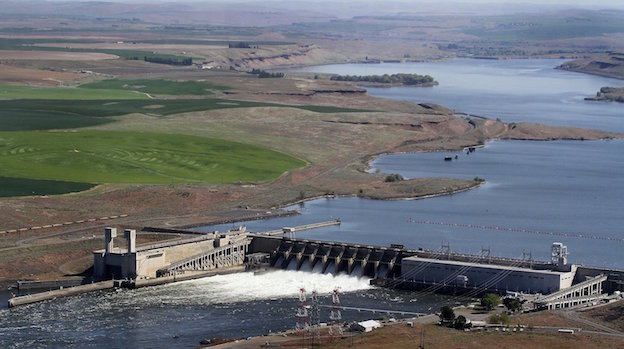 U.S. District Judge Michael Simon will hear oral arguments Feb. 6 in Portland on whether he should grant a preliminary injunction to operate eight federal dams in the lower Columbia Basin with more spill and deep drawdowns.
The judge will also hear why the U.S. Department of Justice believes he should dismiss the case for lack of jurisdiction, as requested in a Dec. 15, 2025, motion filed in the long-standing lawsuit, National Wildlife Federation et al. v. National Marine Fisheries Service et al.
The plaintiffs -- 10 conservation groups and the State of Oregon -- have asked the court to rule on the motion for an emergency injunction by March 1, so salmon managers have enough time to arrange for new hydro operations, if warranted, before the downstream migration of spring juvenile salmon and steelhead begins.
Plaintiffs say immediate action is needed to prevent the collapse of some salmon and steelhead populations in the Columbia Basin. They intend to seek a permanent injunction once the preliminary request is decided upon.
Defendants and several intervenors opposed the motion.
Many of the opposition briefs said that the benefits to salmon under the injunctive order are uncertain or would be minor, while impacts to energy reliability and cost, irrigation and river transportation would be great.
Simon scheduled the hearing for oral arguments as replies and some new motions in the case were still being filed in the U.S. District Court for the District of Oregon.
These are some of the topics tackled in briefs filed over the past several weeks:
Feds Ask for Dismissal
In a Dec. 15 motion, the federal defendants are asking the judge to completely dismiss the supplemental complaints by plaintiffs that question the adequacy of a 2020 record of decision (ROD) and biological opinion on Columbia River System Operations.
"This Court lacks subject matter jurisdiction because NWF Plaintiffs' and the State of Oregon's claims challenge the final actions and decision of the Bonneville Power Administration and thus are subject to the exclusive and original jurisdiction of the [9th U.S. Circuit Court of Appeals] under the judicial review provision of the Pacific Northwest Electric Planning and Conservation Act (Northwest Power Act)," the DOJ motion states.
Under the act, BPA, the U.S. Army Corps of Engineers and the Bureau of Reclamation share management responsibilities of the CRSO, and jointly adopted the ROD, the filing states.
Yet the plaintiffs did not name BPA as a defendant, despite challenging a joint decision made by all three agencies.
DOJ claims that the three agencies' actions are "inextricably intertwined," and that the court -- which has no jurisdiction over BPA actions -- is being asked to grant injunctive relief that would interfere with Bonneville's actions and decision.
"Many of these actions are ones that only Bonneville can take," including purchasing energy or reserves and requesting adjustments to transmission system maintenance.
On Jan. 15, Earthjustice -- which represents the 10 conservation groups -- filed a brief opposing the motion to dismiss the case.
"Subject matter jurisdiction does not hang on so slender a thread," the response states.
"Undaunted by the Ninth Circuit's prior jurisdictional decisions and apparently unconcerned that this case has proceeded for decades, with injunctions and intervening appeals to the Ninth Circuit, under the distinct jurisdictional framework the court cases establish, Federal Defendants put forward a tangled nest of reasons why the Court should re-examine its subject matter jurisdiction now," it adds.
The plaintiffs noted that BPA is not named in the lawsuit and said their supplemental complaint does not challenge any of the actions authorized under the Northwest Power Act.
"The core of the Proposed Order focuses on dam operations themselves, including spill rates and reservoir levels, not how power resulting from the operations may be marketed. This Court has considered and granted similar injunctions before," the response states.
The plaintiffs said the same court already rejected the same argument made by federal defendants in the same case in 2004. The filing quotes a prior decision, which says, "[T]he court also finds unpersuasive intervenors' arguments that the Ninth Circuit has exclusive jurisdiction and that a necessary and indispensable party [BPA] has not been joined by the plaintiffs."
The 9th Circuit also rejected the argument that BPA's decisions cannot be segregated from other federal agencies in decisions over CRSO, the plaintiffs said.
The filing states that each agency has different roles to play in managing the Columbia River hydropower system, and their joint decisions and analysis are actually separate decisions.
If the request implicates BPA or the request for relief is too broad, the court can limit or deny portions of the proposed injunction. "Indeed, that is precisely what this Court has done before," they said.
On Jan. 29, DOJ reiterated arguments that the case should be dismissed over jurisdictional issues.
Although BPA is not named in the lawsuit, the jurisdictional issue hinges on actions, not on the defendants named in a case, the DOJ argued.
"The Ninth Circuit has applied this principle repeatedly, holding that challenges to other agencies' actions -- including [U.S. Fish and Wildlife Service's and National Marine Fisheries Service's] biological opinions -- must proceed in the court of appeals when they are intertwined with the covered decision," the DOJ said.
The DOJ also argued that the long history of this lawsuit being heard in the Oregon U.S. District Court is unimportant.
"Courts instead must address jurisdictional defects whenever suggested -- even decades into litigation," the filing states.
DOJ also argued the case should not be transferred to the appeals court because the lawsuit was filed outside the Northwest Power Act's limitations period. "Dismissal is the only appropriate remedy," the filing states.
Plaintiffs Say Feds Plan to Reduce 2026 Spring Spill to 120 Percent TDG
The State of Oregon and 10 conservation groups say that absent a court order, federal agencies are planning to reduce spill this year at eight dams in the lower Columbia Basin to levels not seen since 2019.
"If not prevented by this Court, Federal Defendants will roll back spill caps to 120% [total dissolved gas] levels (decreased from 125% TDG), increase the number of hours per day where spill is constrained to benefit power revenue, curtail spill for the entire month of August, continue with elevated reservoir levels, and prioritize transportation of smolts at the expense of providing better conditions for in-river migrants," Oregon said in a Jan. 22 reply to the federal defendants' opposition to the injunction.
Each of those changes would be harmful to fish, Oregon said.
Oregon was responding to a draft 2026 Fish Operations Plan (FOP) attached as an exhibit to one of 15 declarations filed with the federal response to the proposed injunctive relief on Dec. 15, 2025.
The Fish Passage Center reviewed the draft 2026 FOP and concluded that the proposed operations for this year not only reduce protections for salmon compared to 2025 operations, they also fall short of operations analyzed in a 2020 CRSO environmental impact statement.
"Reduced spill in the Draft FOP will result in increased powerhouse passage (i.e., PITPH) and increased bypass encounters, which are associated with slower fish travel times, lower juvenile survivals, and lower smolt-to-adult returns (SARs)," the FPC memo states.
It says that both spring and summer spill operations in the draft FOP were not analyzed in the 2020 CRSO EIS and are inconsistent with the 2020 biological opinion by NMFS.
The memo states that the draft FOP was not developed through the regional process that includes state, tribal and federal fishery managers. "The development of the annual FOP is usually coordinated via the Regional Implementation Oversight Group (RIOG) and finalized as Appendix E of the Fish Passage Plan, typically in February or March," it says.
Matt Rabe, a spokesperson for the U.S. Army Corps of Engineers, said his agency could not comment on the FPC analysis since it's tied to the ongoing litigation.
"Regarding the Fish Operations Plan, we are following our established regional process and will work with our regional partners in the coming weeks," Rabe said in an email to Clearing Up.
On Jan. 30, plaintiffs filed supplemental information calling the judge's attention to new Fish Passage Center analyses of the U.S. Army Corps of Engineers' draft 2026 Fish Operations Plan and variables influencing adult salmon upstream survival. That draft had been circulated to RIOG members, and is "nearly identical" to the document filed with the court, with the exception of adding a variable minimum operation pool at Lower Granite Dam, the FPC said.
The draft 2026 FOP filed with the court shows operations from April 3 through June 20 at the four lower Snake River dams spilling to 120 percent of TDG saturation for 16 hours a day, and to the performance standard spill for eight hours a day.
For spring spill at the four lower Columbia River dams, from April 10 through June 15, McNary and Bonneville dams would also spill to 120 percent of TDG for 16 hours a day and to performance standard spill for eight hours a day, while The Dalles Dam would spill to performance standard for 24 hours a day, and John Day Dam would spill to 120 percent TDG during the night, and to between 32 and 40 percent of the flow in the day.
The proposed operations are similar to those used in 2019, during a flexible spill agreement between the parties. In 2020, after the states of Washington and Oregon increased their spring TDG limits in the Columbia Basin, most of the dams began spilling to 125 percent TDG for at least 16 hours a day. Since 2024, some have spilled to 125 percent TDG for 24 hours a day.
Oregon says these and other changes will negatively impact salmon. "With less spill and no reduction of fish travel time, juvenile survival rates will decline, as will smolt-to-adult returns," it said.
In its filing, Oregon said that under the draft 2026 FOP, "irreparable harm to the listed fish and Oregon would occur within the next year."
Oregon noted that NMFS's 2022 status report found a high risk of extinction among the majority of spring-summer Chinook, and an extreme risk of extinction for Snake River sockeye.
The state also countered federal declarations pointing out that some adult salmonid returns have dropped after increasing spill to 125 percent at dams in the lower Columbia Basin.
"The emphasis placed on short-term changes in abundance has little to do with the status of the species. The status of a species is a function of both abundance and productivity. Abundance can fluctuate up and down against a backdrop of good or bad environmental conditions. If a population is already at low abundance, there must be adequate productivity to avoid additional generational decline even during periods of poor environmental conditions," Oregon contended.
Washington, Nez Perce, Yakama Nation Support Plaintiffs
On Jan. 29, the State of Washington, the Nez Perce Tribe and the Confederated Tribes and Bands of the Yakama Nation filed briefs as amici parties, each supporting the plaintiffs' motions for a preliminary injunction in full. That injunctive relief could increase spill, lower reservoir levels, improve salmon migration and require federal agencies to institute several nonoperational measures to aid Columbia Basin salmon and steelhead.
In a Jan. 29 brief, the State of Washington agreed with plaintiffs and asked Simon to grant the preliminary injunction, saying, "Salmon and steelhead in the Columbia River Basin have been in decline for decades and immediate action is needed to stave off further declines and the potential of some species entering an extinction vortex."
The filing focused on some of the nonoperational measures in the Tucannon River requested in the preliminary injunction, including installing a weir and dredging at the mouth of the Columbia River tributary.
Washington argued that studies by the Corps found dredging is the best near-term option for improving conditions in other Columbia River tributaries with sedimentation issues, and that installing a weir on short notice is possible and could help the Tucannon Chinook run for generations to come.
The Yakama Nation also strongly supported both the scientific and legal positions of the plaintiffs, and the specific injunctive relief requested.
The tribe said that DOJ arguments rely on models, analyses and operational assumptions that exclude upper Columbia River salmon and steelhead populations listed under the Endangered Species Act. While questioning the benefits of transporting Snake River juvenile salmon downstream, the Yakama Nation noted that upper Columbia River populations are not transported and would not benefit from the assumptions made by federal agencies.
"Upholding tribes' access to their treaty-protected resources and their exercise of treaty-protected rights is undeniably in the public interest," Yakama tribal representatives also said.
The tribe rejected arguments that the judge should not grant the injunctive relief due to a potential increase in the cost of power.
"Maintaining low-cost power while driving Columbia and Snake River salmon and steelhead to extinction would be unlawful, culturally repugnant, and morally bankrupt – we cannot shortchange our generations yet unborn in order to save a buck today," the filing states.
Similarly, the Nez Perce Tribe submitted a brief supporting the proposed injunction, focusing on "some of the flaws, inaccuracies, and misstatements found in Federal Defendants' and Defendant-aligned amici's declarations," the brief says.
"Federal Defendants submit numerous declarations attempting to convince the Court that the status of the listed Columbia and Snake River salmon and steelhead is not really that bad, that their CRS operations are not really that harmful, and that Oregon's requested preliminary injunction would inflict harm on the fish and the region," it says.
These declarations downplay or deny the imminent risk to salmon based on a couple of years of returns, even though the abundance of many populations is dangerously low, the brief adds.
In addition to supporting more spill and lower reservoir levels, the Nez Perce Tribe argued for nonoperational conservation measures to support steelhead kelt reconditioning and actions to protect Snake River sockeye.
NRECA, Others Address Hydro Operations
The National Rural Electric Cooperative Association (NRECA) and two individuals were granted permission by U.S. District Judge Michael Simon to appear as amicus curiae, and filed briefs in the long-standing lawsuit over Columbia River System Operations (CRSO).
The parties are NRECA, a nonprofit national trade association representing roughly 900 consumer-owned electric cooperatives; Scott Levy, a wild salmon and steelhead advocate who developed the website bluefish.org; and Fred Mensik, a retired fish biologist for the Pacific States Marine Fisheries Commission.
Each provided the court with significantly different perspectives on the plaintiffs' request for a preliminary injunction.
NRECA claims that the Endangered Species Act does not allow the court to impose a new operation plan for the Columbia Basin dams since Congress authorized the dams to be operated by the federal agencies as multipurpose facilities.
The brief noted that in addition to the ESA, the agencies must simultaneously comply with the Flood Control Act, the Bonneville Project Act, the Rivers and Harbors Act, treaty obligations and water supply contracts.
"But for the past 25 years, Plaintiffs have attempted to co-opt the agencies' congressionally designated roles by engaging in a systemic legal attack on the Columbia River hydropower system," NRECA said.
The group suggested that the measures plaintiffs are seeking have never been proposed by the agencies, been evaluated by the National Marine Fisheries Service (NMFS), or undergone the consultation process mandated by the ESA.
"These are not modest adjustments to existing operations; they constitute a comprehensive redesign of how the federal government manages one of the nation's most complex river systems," the filing states.
Levy wrote that the federal agencies' own actions prove that Snake River salmon and steelhead cannot recover unless the four lower Snake River dams are breached.
In his brief, he contends that the 2020 CRSO environmental impact statement and biological opinion have failed to keep the Snake River salmon and steelhead out of jeopardy.
He points to a decision by the NMFS to abandon an adaptive management tool known as the "early warning indicator," which was included in the agency's 2014 BiOp, but was removed from the 2020 BiOp, after the threshold that required additional action was met for Snake River steelhead.
The early warning indicator used specific abundance or trend triggers developed in a 2009 adaptive management implementation plan to determine when further action needed to be taken to protect a salmon or steelhead population.
Levy argued that the reason NMFS decided to no longer abide by the early warning indicator and significant decline trigger is that "nothing has worked or can be implemented to recover salmon with the dams in place: LSR dams put salmon in jeopardy of extinction."
From the other end of the spectrum, Mensik contends that it is not the dams, but the high total dissolved gas (TDG) levels caused by increased spill that are killing juvenile salmon and steelhead as they migrate through the four lower Snake and four lower Columbia River dams.
Mensik said he conducted gas bubble trauma (GBT) disease exams on salmon and steelhead for two years, and supervised GBT exams at Lower Granite Dam for 17 years.
Referencing numerous studies, he wrote that 125-percent TDG is lethal to fish -- including Chinook salmon and steelhead.
Mensik argued that the current spill program is killing juvenile salmonids and reducing adult returns. He said that the voluntary spill regime creates eddies that contain lethal TDG at the lower Snake River dams.
Mensik also noted that the spill program has reduced the number of fish that are transported downstream by barge, and that transported fish return at higher rates than fish that migrate downstream in the river.
He asked the court to "End the 21 year court ordered spill for juvenile fish passage … Collect and transport as many juvenile fish as possible at collector dams. Transport them to the estuary in barges with a 98% survival rate. History has proven the most effective way to increase fish numbers is through fish transportation."
learn more on topics covered in the film
see the video
read the script
learn the songs
discussion forum