the film
forum
library
tutorial
contact
|

|
Though Columbia River Treaty on Pause, Additional Flow at McNary
Dam with Canadian Water Comes with Supplemental Agreement
by Staff
Columbia Basin Bulletin, June 21, 2026
|
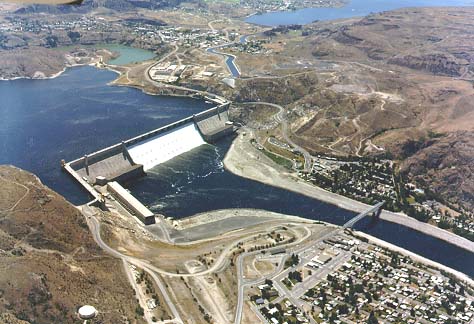 Federal dam operating agencies began an operation last week that provides a small burst of water from the upper Columbia River. Although the flow augmentation of a maximum of 8,000 cubic feet per day of additional flow at McNary Dam is not directly a remnant of the now-paused U.S.-Canada Columbia River Treaty, it is provided from Canada through a supplemental agreement. The additional flow augmentation began Saturday, June 13.
"Since the early 1990s, the United States and Canada have managed transboundary flow augmentation through a series of mutually beneficial supplemental operating agreements," Tom Conning, spokesperson for the U.S. Army Corps of Engineers explained in an email. "These agreements are not part of the Columbia River Treaty, instead they are allowed under the Treaty because they are mutually beneficial."
The total additional flow will amount to about one million acre feet of Canadian water. Generally, the annual request for this flow augmentation has been directed through NOAA Fisheries. However, this year the request came through the interagency Technical Management Team. It also is called for in the dam operating agencies' 2026 Water Management Plan
The Water Management Plan says: "The traditional Non-Power Uses Agreement is designed to provide non-power benefits in the U.S. (1 MAF of flow augmentation water stored in Canada) in exchange for non-power benefits in Canada (whitefish (Section 6.1.1) and trout (Section 6.1.2)). Each year discussions typically begin in the fall with Canada on a Non-Power Uses Agreement for the storage and release of the 1 MAF of flow augmentation. Canadian objectives for whitefish and trout protection will be determined by BC Hydro in consultation with Canadian regulators.
"These supplemental agreements coordinate reservoir operations to deliver seasonal flows that benefit fish species on both sides of the border, with actual flows adjusted in real-time during weekly coordination meetings based on river conditions," Conning said. "The timing of the release is usually informed by the salmon managers at FPAC, but discussion of the releases is not uncommon at TMT."
However, there is some uncertainty about when the modernized Columbia River Treaty will be completed and signed. Last year in March, after both the U.S. and Canada reached an Agreement in Principle in 2024, the Trump Administration paused negotiations with British Columbia on the Treaty. The U.S. told BC officials that it would be conducting a broad review of its international engagements, according to a March 2025 BC government press release.
The Columbia River Treaty governs flood control, water supply, hydropower and, in its newest iteration, would have provided more investment in ecosystem functions to restore salmon runs upstream of Grand Coulee Dam and into British Columbia.
Staff
Though Columbia River Treaty on Pause, Additional Flow at McNary Dam with Canadian Water Comes with Supplemental Agreement
Columbia Basin Bulletin, June 21, 2026
See what you can learn
learn more on topics covered in the film
see the video
read the script
learn the songs
discussion forum