the film
forum
library
tutorial
contact
|

|
Over 30 Briefs Filed in Federal Court Opposing Request for
More Spill for Fish, Lower Reservoirs at Columbia/Snake River Dams
by Staff
Columbia Basin Bulletin, December 19, 2025
|
"Officials are on thin ice legally when they assert salmon are 'trending toward recovery'
when actual salmon returns fail to show a sustainable recovery" -- Judge Simon in 2016 ruling.
 A proposed preliminary injunction calling for changes to Snake and Columbia river federal dam operations aimed at protecting endangered salmon and steelhead would lower the amount of electricity that could be generated by the dams, costing the region more for electricity, while also resulting in higher releases of carbon dioxide when making up for those losses, according to briefs submitted this week in U.S. District Court.
River users in opposition to the proposed preliminary injunction said the changes would provide negligible benefits to fish populations while increasing risks to navigation safety and river system reliability.
NOAA Fisheries said the measures proposed in the preliminary injunction, filed in July, would likely lead to a higher risk of salmonids listed under the Endangered Species Act falling below quasi-extinction thresholds than would the 2020 Columbia/Snake river biological opinion for salmon and steelhead.
The Bonneville Power Administration argued the plaintiffs don't have jurisdiction in District Court because it is unlawful to challenge a BPA decision in the lower court, although it can be argued in the Ninth Circuit Court of Appeals.
Although the power marketing agency has not been named a defendant by plaintiffs in the court case (National Wildlife Federation et al v National Marine Fisheries Service et al), BPA said the actions of the U.S. Army Corps of Engineers and the Bureau of Reclamation are "inextricably intertwined with Bonneville's final action and decision" and that the "Court cannot adjudicate claims over NMFS's Biological Opinion without attacking an essential ingredient of Bonneville's decision, rendering those claims subject to the Northwest Power Act's exclusive review provision."
" 'Careful Pleading' cannot overcome the Northwest Power Act's jurisdictional barrier," BPA said of plaintiff's choice not to include the agency in the lawsuit.
These were among the 30-some responses by defendants in U.S. District Court of Oregon filed this week in response to the request for the preliminary injunction seeking emergency operational changes at the dams. The changes include increased spill, which allows juvenile fish to pass over the dams instead of through turbines, and lowered reservoir elevations through restrictions on minimum operating pools, a change that Earthjustice says would decrease the time salmon spend migrating through stagnant, overheated water.
In addition to changes to dam operations to aid fish, Earthjustice and plaintiffs petitioned the court to approve a set of emergency conservation measures for what they say are some of the most imperiled populations that are on the brink of collapse. These include removing passage barriers slowing the migration of Tucannon River spring Chinook, a population that is rapidly approaching extinction, as well as increasing federal efforts to control predators like invasive walleye and some birds that prey on salmon and steelhead.
In his testimony on behalf of the Public Power Council, Joshua Rasmussen of Energy GPS said that the motion calling for more spill and restrictions on the minimum operating pools at the dams would impact the "total volume of carbon-free energy produced, but also the maximum megawatts ("MW") of electricity that can be instantaneously generated during emergencies."
Both, he continued, would have economic impacts for the region and impact the reliability of the federal power system, "as well as increase carbon emissions as the lost generation from hydro will be replaced by output from carbon emitting natural gas facilities." Rasmussen estimated that the cost to replace the energy (measured in MW hours) would be $102 to $111 million per year, and the cost to replace the lost capacity (MW) would be $50 to $58 million. In total, it will cost $152 million to $169 million in 2026 to replace the lost energy and capacity associated with the proposed spill and minimum operating pool rules, Rasmussen said.
 In addition, the proposed rules would result in the loss of about 2 million MWh of carbon-free hydroelectric energy production each year and between 1,240 and 1,439 MW of capacity which may be required during system emergencies, he said. The energy required to replace the lost hydroelectric production would come from natural gas generators and would add between 814,636 and 881,321 million metric tons in carbon emissions.
All of this is happening at a time when the Northwest capacity shortage (MW) is expected to worsen, he said, partly due to state laws requiring more renewable generation, retiring coal facilities and limited new natural gas facilities.
The Inland Ports and Navigation Groups, in its response to the proposed injunction, said that "science shows that the plaintiffs' requested measures will have negligible benefits to fish populations while increasing risks to navigation safety and river system reliability."
IPNG argued that current dam operations "already include substantial spill, adaptive management tools, and navigation-safety measures developed through years of collaboration. The plaintiffs' proposal would replace this flexible framework with rigid operational mandates that increase risk without meaningfully improving conditions for fish."
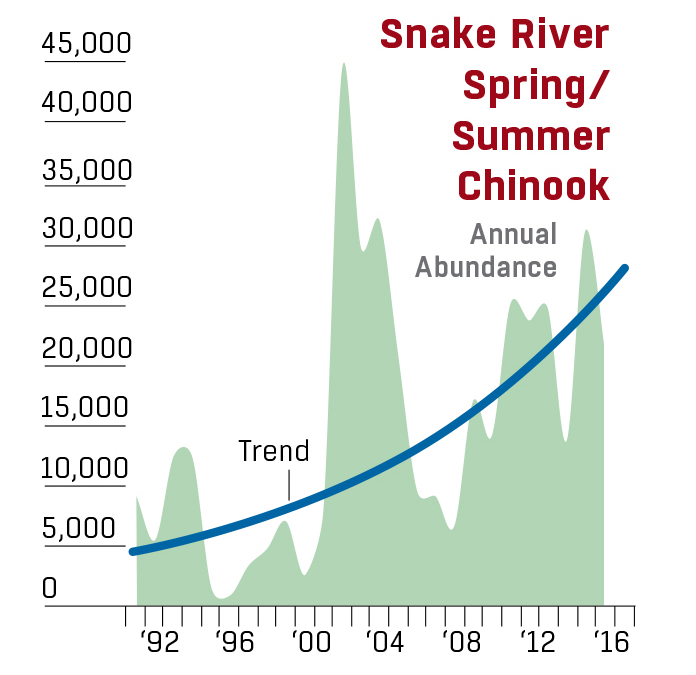
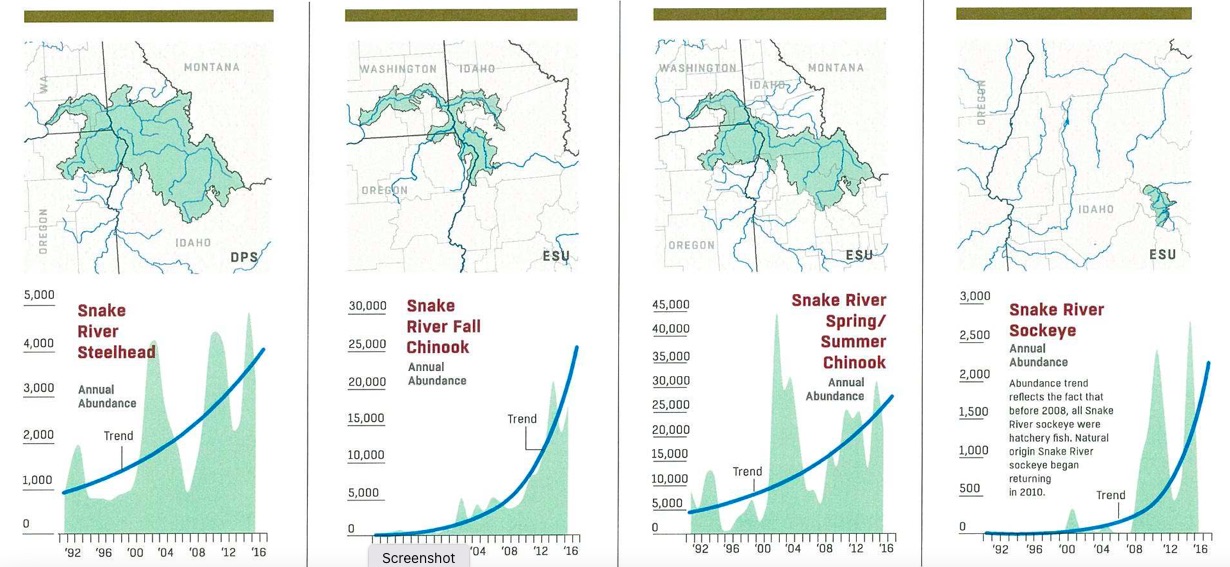
In addition, IPNG said that measures included in the 2020 Columbia River System Operations Biological Opinion are already avoiding irreparable harm to listed salmon and steelhead. And, IPNG added, plaintiffs ignore the increasing abundance trends of listed salmon and steelhead over recent years.
NOAA Fisheries' Kelsey Sweica's testimony supports IPNG's assertion about rising abundance trends. She said that adult abundance has generally increased for most stocks following the "synchronously low return period of 2017-2019, with two stocks experiencing returns within the top three highest abundance levels since ESA-listing." That includes Snake River fall Chinook salmon, which is one of the reasons plaintiffs in the case are advocating for additional and later summer spill.
"NMFS's most recent status review and the supporting biological viability assessment determined that Snake River fall Chinook were 'viable' and had a 'moderate to low risk' of extinction," she said in response to briefs filed by Oregon a month ago in District Court. The state of Oregon is a plaintiff in the preliminary injunction filing.
The Snake River spring/summer Chinook salmon ESU is also a focus of the proposed spring spill measures and two of the proposed emergency non-operational conservation measures contained in the proposed preliminary injunction, Sweica said. The non-operational measure for the spring/summer Chinook targets the Lower Snake River group, including the Tucannon River and Asotin Creek populations.
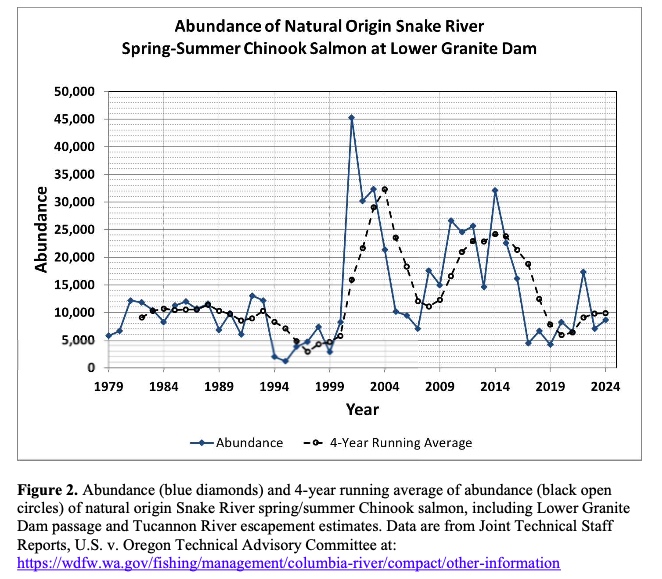
"Because the Asotin Creek population is considered to be functionally extirpated, the Tucannon River population is of particular importance to the resilience and recovery of one of the five MPGs of this ESU," she said (MPG is major population group). "While low, the abundance of natural origin adult Snake River spring/summer Chinook has not continuously declined since 2014. In fact, the data show a modest positive trend in abundance from 2019-2024. Numbers increased slightly in 2020 and to a much greater extent in 2022."
Snake River spring/summer Chinook were determined by NOAA Fisheries to be at moderate-to-high risk of extinction and the agency's latest status review found that a change in listing status had not been justified, she added.
The proposed preliminary injunction's fall/winter spill measures target Snake River basin steelhead, as does the spring spill measure.
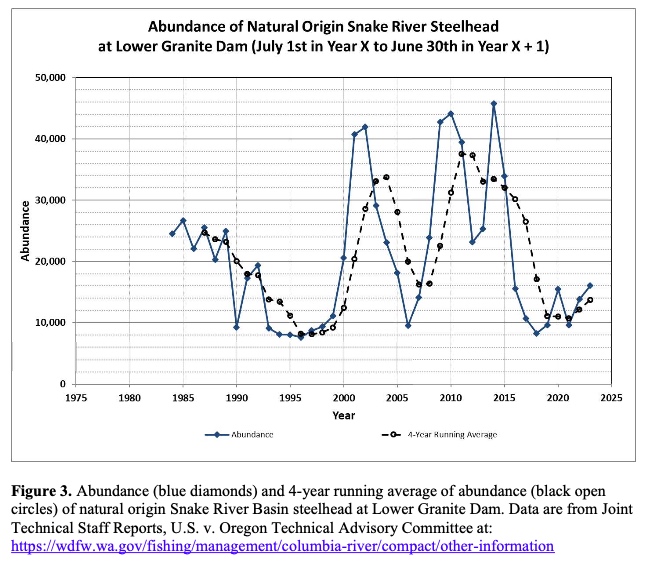 Sweica admitted that the recent abundance of natural origin Snake River steelhead has generally been lower than it was during the high return period of the 2010s and that the return years from 2017 to 2019 were "particularly concerning." However, the low adult returns have not persisted, and the data support a largely increasing trend in abundance (2020-2024) since then. NOAA's latest status review found the fish to be of moderate risk of extinction.
Counts of the fish at Lower Granite Dam (July 1 to December 1) were 20,678 in 2025, Sweica said. Although lower than 2024, it was higher than the numbers in 2016 to 2023, which ranged from 10,160 to 20,281 and averaged 14,821. "Based on the increasing number of total dam counts, it is reasonable to assume that the abundance of natural origin steelhead in 2025 will be somewhat lower than in 2024, but higher than the eight years previous to 2024."
"The most recent data at Lower Granite Dam suggest that the aforementioned declines in abundance have not persisted and some concern may be ameliorated," she said.
"Significant dips in Snake River sockeye abundance have occurred over the past decade. These events warrant extreme concern, as readily acknowledged in the 2020 CRS BiOp," Sweica said.
However, since the BiOp was issued, Snake River sockeye abundance has increased from hundreds to thousands per year. The 2024 return of 2,947 fish was the highest on record at Lower Granite Dam and was 308 percent of the 10-year average, according to Sweica. The period of higher adult returns from 2022 onward suggests a recent trend of increasing abundance.
Sweica explained that the Draft 2026 Fish Operations Plan operations are consistent with NOAA Fisheries' 2020 Columbia River hydro system BiOp. The Plan includes 120 percent gas cap spill for 16 hours per day and reduced spill for 8 hours per day at most projects in the spring to balance juvenile and adult passage concerns (i.e., increase juvenile spillway passage while minimizing negative impacts to tailrace conditions); summer spill operations up to 24 hours per day; fall/winter and early spring spill 3 to 7 days per week; and minimum operating pool elevations at the Lower Snake River projects and normal operating ranges at most Lower Columbia River projects.
"While there is no doubt that Columbia River Basin salmon and steelhead stocks have declined from their historic numbers, recent trends in species' abundances are highly nuanced," Swieca concluded. "Importantly, there is not unequivocal evidence to support claims that the abundance of Snake River salmon and steelhead has recently substantially decreased and will continue to precipitously decline if the requested injunctive relief is not granted."
She went on to conclude that the proposed preliminary injunction would likely lead to "lower spawner abundance and a higher risk of falling below quasi-extinction thresholds than the 2020 CRS Proposed Action and Draft 2026 FOP."
The proposed preliminary injunction with its emergency measures would likely not have been needed if the federal government had not altered course and reneged on a Biden-era Memorandum of Understanding between plaintiffs and the U.S. government, according to court documents.
The MOU, signed in December 2023, known as the Resilient Columbia Basin Agreement (RCBA), was to be effective through 2028 and was designed to restore Columbia River basin salmon and steelhead runs to "healthy and abundant levels."
Oregon District Court Judge Michael H. Simon had approved a stay in the original and long-running lawsuit that challenged NOAA Fisheries' 2020 biological opinion and U.S. Army Corps of Engineers' Environmental Impact Statement and Record of Decision as long as the agreement was in place. However, the Trump Administration on June 12 revoked the agreement and notified the partners in the MOU in a June 24 letter. Plaintiffs in the case went back to the U.S. District Court in Oregon to ask the court to lift the stay and resume the court case that had been on pause for nearly two years.
Related Sites:
Opinion and Order, by Judge Michael Simon, 5/4/16
Related Pages:
Judge Decides 2014 BiOp: Snake River Dam Breaching Not Ruled Out by Laura Berg, NW Fishletter, 6/6/16
Latest Ruling is Another Victory for Snake River Salmon and Steelhead
by Chad Shmukler, Hatch Magazine, 5/12/16
Judge: Salmon Recovery Requires Big Dam Changes by Staff,Chinook Observer, 5/10/16
Dam Changes Needed on Snake River to Protect Salmon by Kimberly Arsenault, Disaster Management Digest, 5/7/16
Judge: Plan for Restoring Northwest Salmon Runs Not Enough by Associated Press, The Herald Journal, 5/6/16
Judge: Plans to Restore Salmon Runs in the Northwest Are Not Enough by Gene Johnson, Bend Bulletin, 5/6/16
Why Plans to Preserve Northwest Salmon Runs Have Stalled -- Yet Again by Jason Thomson, Christian Science Monitor, 5/5/16
Fisheries and Feds Must Step Up After Disastrous Sockeye Run
by Staff and Wire Reports, Idaho State Journal, 5/5/16
Federal Judge Has Had Enough Fin-dragging by Eric Barker, Lewiston Tribune, 5/5/16
Staff
Over 30 Briefs Filed in Federal Court Opposing Request for More Spill for Fish, Lower Reservoirs at Columbia/Snake River Dams
Columbia Basin Bulletin, December 19, 2025
See what you can learn
learn more on topics covered in the film
see the video
read the script
learn the songs
discussion forum