forum
library
tutorial
contact

Not Enough Fish: Washington Cancels
Sockeye Season on Upper Columbia
by Michael WrightSpokesman-Review, June 26, 2026
|
the film forum library tutorial contact |
|
Not Enough Fish: Washington Cancels
by Michael Wright |
"It's going to be one of the lowest in the more modern era of sockeye,"
-- Chad Jackson, WDFW's Ephrata regional fisheries manager
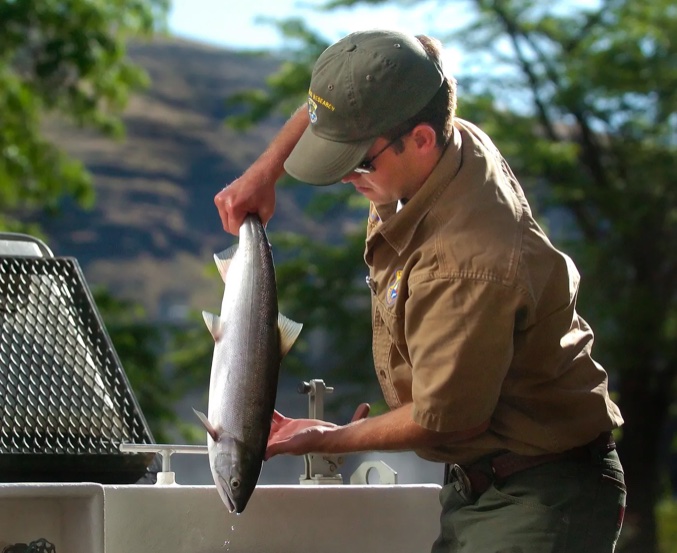 Mike Mauk always expects June to be busy.
Mauk, who owns Brewster Bait and Tackle, is usually ordering bait and helping customers prepare for the biggest event of the summer -- the arrival of sockeye salmon season on upper Columbia River and the beginning of the fishing frenzy on the Brewster Pool.
But things took a turn when sockeye salmon counts at Bonneville Dam started coming in lower than expected. Mauk began hearing talk of the salmon season being cut short, or worse.
Last week, official word came from the Washington Department of Fish and Wildlife: The upper Columbia River sockeye season, which was scheduled to begin Wednesday, was canceled.
"It's definitely heartbreaking," Mauk said.
The decision came after fisheries managers drastically reduced their expectations for this year's sockeye returns. Preseason forecasts called for about 275,000 sockeye to pass Bonneville Dam, which would have been enough for a four-fish limit and a two-month season.
But counts at the dam in late May and throughout June have lagged far behind the 10-year average. As of Thursday, just over 41,000 sockeye had crossed Bonneville. The 10-year average for the same date is more than 128,000.
Chad Jackson, WDFW's Ephrata regional fisheries manager, said Thursday that he now expects the total return of sockeye to the Columbia to be just over 100,000 fish. That's about one-third of the 10-year average, and about half of last year's return.
"It's going to be one of the lowest in the more modern era of sockeye," Jackson said.
Sockeye harvest is regulated closely to ensure enough fish survive to meet conservation and tribal harvest needs. It's possible fish numbers could surge late in the run, but Jackson said even a sharp increase likely wouldn't be enough to change course.
It's the second consecutive year that upper Columbia salmon anglers have been stung by an underperforming sockeye run. Last July, WDFW reduced fishing to four days per week and eventually closed the season about a month early because of low sockeye returns.
In contrast, 2024 was a banner year for the species, with a record-setting run of more than 750,000 sockeye passing Bonneville Dam.
Jackson said there's no clear explanation for why the fish have struggled the past two years, especially since it seems populations from Puget Sound north to Alaska seem to be doing OK.
"I don't think we have a smoking gun," Jackson said. "My curiosity goes to what happened in the freshwater as these things were rearing and migrating out."
Counts at Bonneville Dam include all of the Columbia's sockeye populations, including those bound for Lake Wenatchee or the Snake River. The ones that go to Brewster are headed for the Okanogan River drainage.
They typically spawn in streams in Canada that drain into Osoyoos, Skaha, and Okanogan lakes. After they hatch, they move into the lakes and stay for two years and then swim downstream to the Pacific Ocean. They typically come back to the freshwater as 4-year-olds.
Jackson said it's possible that freshwater habitat conditions were poor for this year's fish, or that they struggled to get past the dams and predators they encountered on their way to the ocean.
"There's not any one or two or three variables that we can point to at this moment," he said.
Even with a pair of down years, sockeye in the upper Columbia are doing a lot better than they were a few decades ago. In the 1990s, counts of Okanogan-bound sockeye in some years came in well below 10,000, according to a WDFW database.
Collaborative efforts by tribes and state and federal government agencies have bolstered the run over the past two decades. Now, annual counts of the Canada-bound salmon regularly surpass 100,000.
Anglers flock to the town of Brewster each July to try to catch them. The small river town sits near the confluence of the Okanogan and Columbia rivers, where the salmon gather and wait. Water temperatures in the Okanogan River in the summer are usually too hot for sockeye, so the fish stack up in the Columbia and hang out until the river cools enough for them to venture farther north.
Jackson said that thermal barrier typically breaks in September. Before then, however, the fish are good targets for anglers. Sockeye season typically opens July 1 and lasts through Aug. 31.
A trip to Brewster has become an annual tradition for some anglers. Fishing guides have no trouble filling seats on their boats for the season. Jerrod Gibbons, owner of the Omak-based Okanogan Valley Guide Service, had clients booked for guided salmon trips every day from the opener to well into August.
Since news of the closure arrived last week, he's been spending a lot of time on the phone, trying to reschedule trips for next year or convincing people to book a different kind of trip -- like catch-and-release sturgeon or kokanee on Lake Chelan.
"All my clients are dropping like flies," Gibbons said. "We're losing deposits. It's hurting."
Now that he's had to deal with two years of underperforming sockeye runs, he's worried about next season.
"It's going to put a hamper on bookings for next year," Gibbons said.
Austin Moser, who runs Austin's Northwest Adventures, had 28 consecutive days booked for salmon season. One of them was a client who had his trip canceled by last year's closure and rescheduled for this season.
"This year, I have to roll him over again," Moser said.
Moser said his clients understand what's happening, and that he's getting them rebooked. But the businesses in Brewster are going to take a big hit without big crowds of anglers coming to town.
"Salmon seems to kind of be the lifeblood of some of these towns," he said. "When sockeye fishing is happening, everything is bumping. The gas stations are full, the grocery store is full . . . It's a big boost for the community."
Mauk, who has lived in Brewster since 2004, said the shortened season of 2025 had an impact on the local economy, and that no season at all is going to be a bigger hit.
He took over the Brewster Salmon Derby a few years back. It was set for the first weekend in August. Instead, it's the second consecutive year he's had to cancel it.
"I'm not happy, but that's fishing," Mauk said. "It's nobody's fault. The fish aren't coming."
Related Pages:
Heat and Drought Devastate Sockeye Salmon Fishing and Spawning on Washington Rivers by William Yardley, Los Angeles Times, 8/3/15
Not Enough Fish: Washington Cancels Sockeye Season on Upper Columbia by Andrew Nusca, Spokesman-Review, 8/1/10
learn more on topics covered in the film
see the video
read the script
learn the songs
discussion forum